
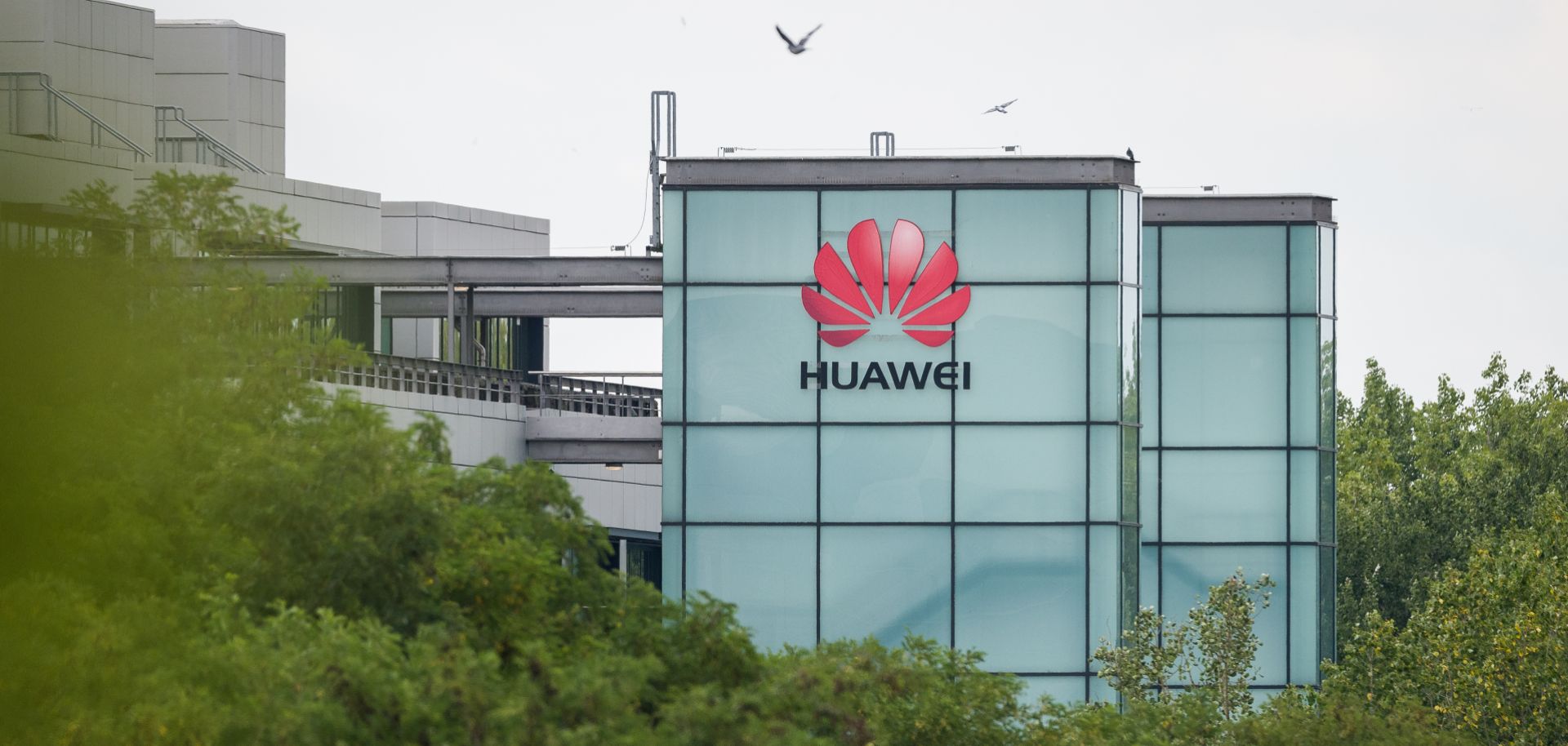
A view of Huawei’s U.K. headquarters in Reading, England.
The United Kingdom's move to oust Chinese tech giant Huawei from its telecommunications networks in the coming years will not only impede the country's 5G rollout, but will further dim hopes for a U.K.-China trade deal that could help London expand its economic relationships beyond Europe post-Brexit. But the decision nonetheless marks a significant victory for the United States, which has been pressuring its European allies to purge Huawei from their 5G infrastructure — especially if the British ban ends up being replicated elsewhere on the Continent.
- On July 14, Prime Minister Boris Johnson ordered Huawei's 5G equipment to be completely removed from British networks by the end of 2027, reversing a January decision to allow Huawei's limited participation in the building of Britain's 5G network. Starting next year, British telecom companies will also be banned from buying the Chinese companies' 5G equipment.
- The decision comes after the United Kingdom's National Cyber Security Centre concluded it could no longer manage the national security risk of using Huawei's 5G equipment after reviewing the impact of new U.S. sanctions that were introduced in May. By banning Huawei from accessing U.S. chip technology, the U.K. agency said the restrictions have forced the company to overhaul its supply chain, and that it was now unable to ensure the security of all its new suppliers.
- London has grown increasingly wary of the Chinese government's relationship with Huawei and the potential for state-backed espionage, as well as the challenges of upgrading and maintaining infrastructure, which could make its 5G network more vulnerable to other malicious actors and hackers.
London's decision to gradually implement the Huawei ban is a compromise between the governing Conservative Party, which demanded tougher measures against Huawei, and the U.K. telecommunications sector.
- Hawks in London's governing Conservative Party had pushed for a much quicker implementation of the full ban. They had also called on the U.K. government to force telecom operators to remove Huawei's equipment from the country's existing 3G and 4G networks, which London's new decision will not require.
- The United Kingdom's telecommunications sector, however, had also voiced concerns that a quicker ban would be even more costly and disruptive. Indeed, even with the new ban not going into full effect until 2027, British Digital Secretary Oliver Dowden said the decision could still delay the United Kingdom's 5G launch by 2-3 years and add as much as £2 billion ($2.5 billion) to the overall cost.
The Huawei ban will make China-U.K. cooperation over certain issues, including trade, less likely by further intensifying tensions between Beijing and London.
- The United Kingdom has expressed interest in reaching a trade deal with China as a part of its post-Brexit strategy. But such a deal is far less of a priority compared with the deals London also wants to reach with the United States and the European Union.
- China had previously threatened to retaliate against moves to oust Huawei from the U.K. market. While Beijing never specified what type of retaliation it could use, trade restrictions and pressuring and/or boycotting British companies operating in China are all possible options in response to the new ban.
The United Kingdom's decision will likely spur other countries in Europe, such as Germany and France, to reconsider the level of Huawei integration they'll allow in their next-generation mobile networks.
- Other countries were previously able to point to the United Kingdom, which is a member of the Five Eyes intelligence alliance with the United States, to still use the Chinese company's equipment.
- But with London now admitting that even it cannot mitigate the security and political risks associated with Huawei, smaller countries with fewer resources will be forced to acknowledge that they're even less likely to do so.
- In order to maintain trade ties and attract Chinese investment, several countries in eastern and central Europe, however, may try to reach a compromise where their networks still use some Huawei equipment and accept a higher level of espionage and cybersecurity risk.
Nokia and Ericsson are the Huawei competitors best suited to take advantage of Huawei's exit from the United Kingdom and the potential for other increased restrictions in Europe and other parts of the world. This will likely force some hawks in the United States and Europe to push for greater financial support for Nokia and Ericsson, as they are the only Western competitors to Huawei for 5G equipment. But their higher cost and lower manufacturing capacity will continue to cause bottlenecks in global 5G rollouts.
