
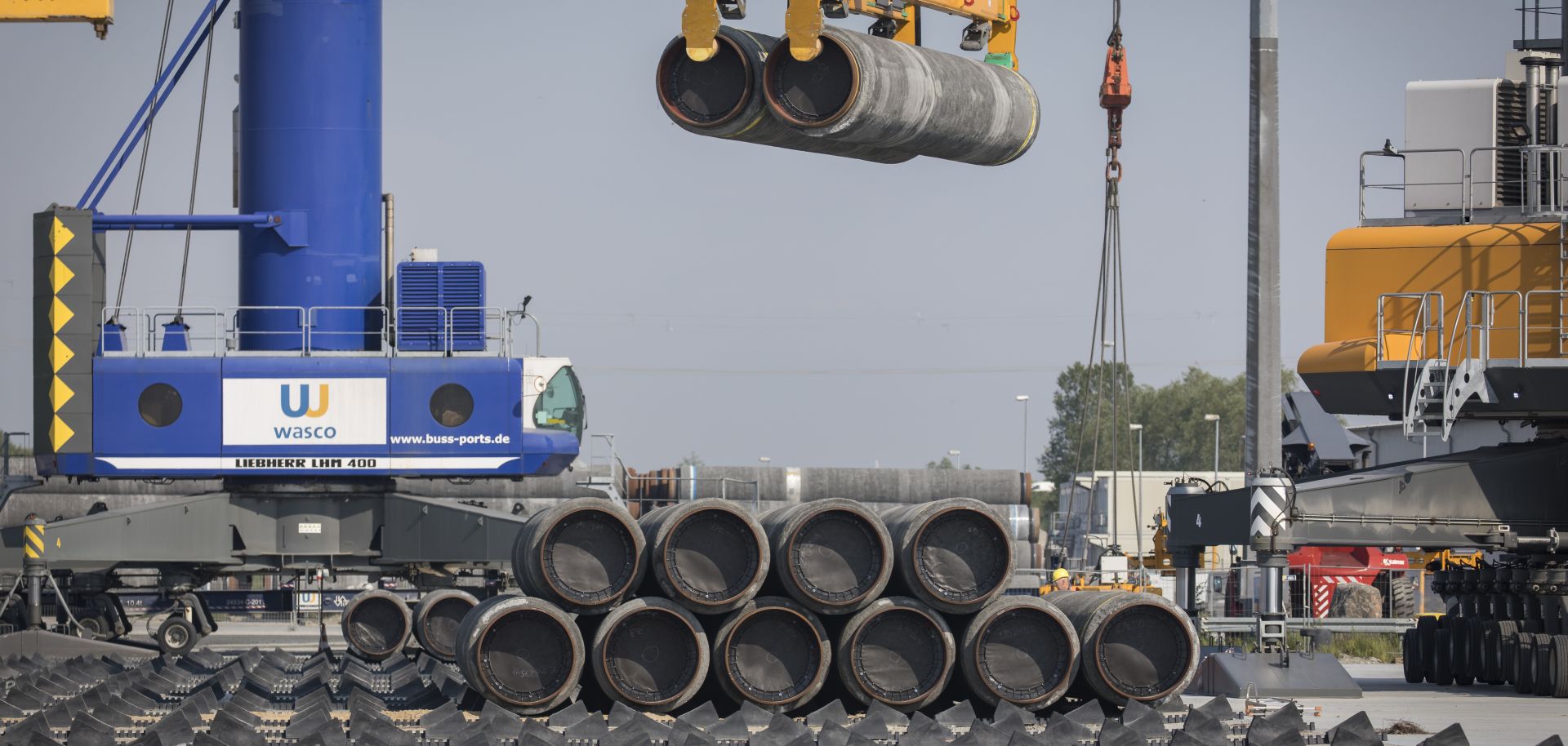
A crane moves Nord Stream 2 pipes at a port near Sassnitz, Germany, on June 5, 2019.
Denmark’s decision to drop certain technical requirements for operating in its waters will allow Russia to use both of its available pipe-laying vessels to finish constructing the Nord Stream 2 pipeline. On July 6, the Danish Energy Agency gave the project permission to use vessels in its waters without a Dynamic Positioning System, which allows ships to operate accurately without disrupting the seafloor. Having lost the services of two privately-owned pipe-laying vessels due to U.S. sanctions, Russia’s natural gas giant Gazprom has only had access to one pipe-laying ship with such a system: the Akademik Cherskiy. Another Russian vessel, the MV Fortuna (which is not equipped with a Dynamic Positioning System), will now also be allowed to operate on the natural gas pipeline between Germany and Russia in Danish waters beginning Aug. 3, when the deadline for appeals against this decision expires.
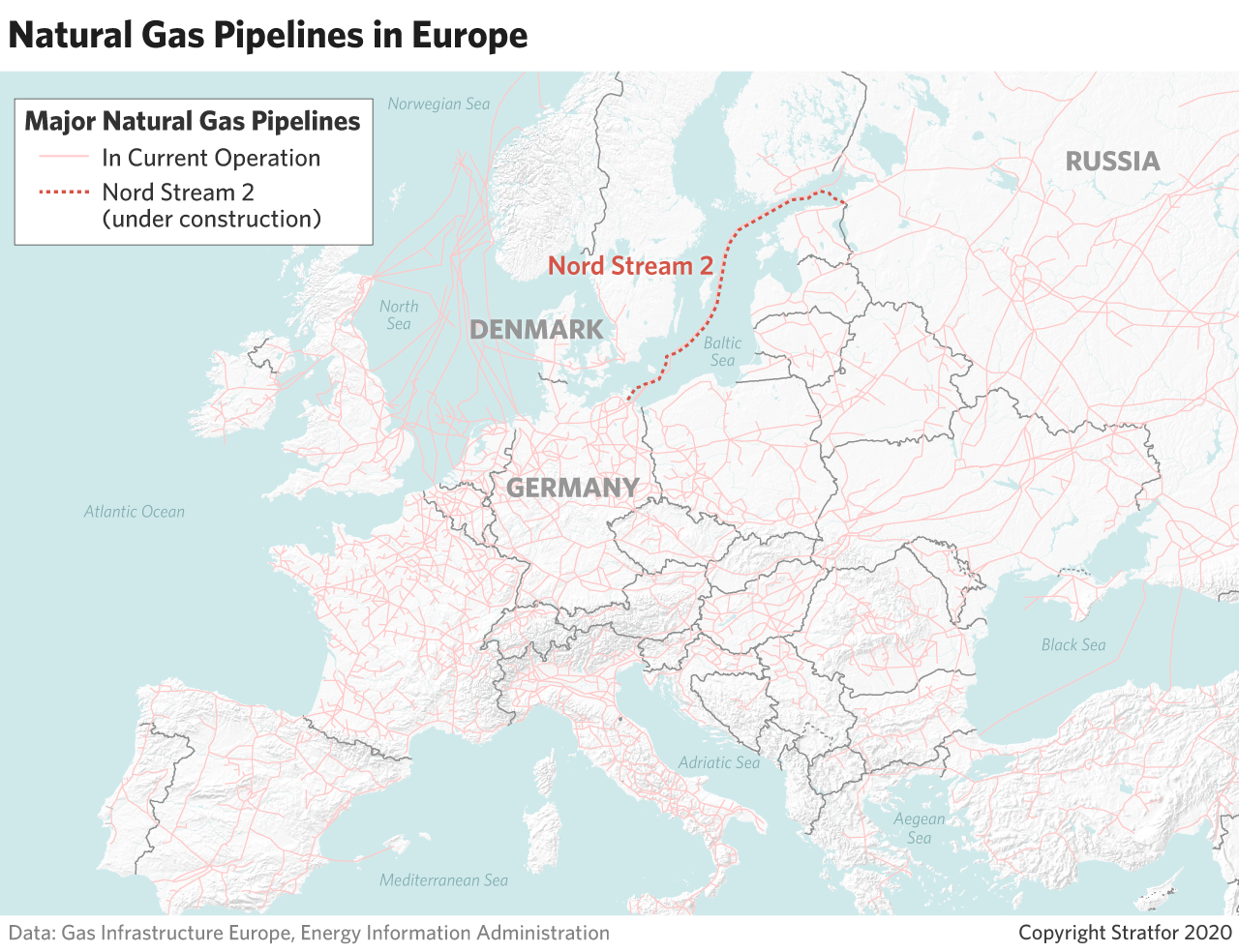
A restart of construction in early August could lead to a completion of the Nord Stream 2 pipeline as early as late September, but this timeline is vulnerable to new U.S. sanctions. Currently, only 160 kilometers (or roughly 99 miles) of pipeline remain unfinished in Danish waters. Given the slower speed of the Russian pipe-laying vessels, this effort is estimated to take just under two months. The United States, however, is now seeking to expand its sanctions to target all services related to constructing the pipeline, including supply vessels and backfilling vessels, in addition to pipe-laying ships. While the window to do so is narrow, there’s a chance the U.S. lawmakers could quickly approve and enact these sanctions before construction is complete, which would cause additional delays and cost overruns by prompting more contractors to abandon their activities on Nord Stream 2.
Even if construction is completed before additional sanctions disrupt progress, the United States could still take action to prevent Russia and Germany from putting their pipeline into operation. Previous U.S. sanctions only targeted deepwater construction activities related to the pipeline. The proposed U.S. bill, however, also seeks to sanction any entities engaged in the certification of the pipeline. This would effectively mean that official institutions in Germany or the European Union could become the target of U.S. sanctions if they were to greenlight the operation of Nord Stream 2. Such expanded sanctions, while not yet a certainty, have the potential to significantly escalate diplomatic tensions between the United States and Germany.
For Nord Stream 2 stakeholders, the risk of additional delays and cost overruns isn’t quite large enough to outweigh the $13.6 billion they’ve already invested into the project, but absolving the pipeline from all sanctions risk will be a politically sensitive exercise. Stakeholders may be hoping a more amicable U.S. administration after the November presidential election could result in reduced sanctions pressure. Germany and Russia could also move to set up special European entities to certify and maintain the pipeline without exposure to additional U.S. sanctions, though even those entities would still run the risk of being targeted by Washington in other ways. The first hurdle to clear, however, remains completing the construction of the infrastructure itself.
