
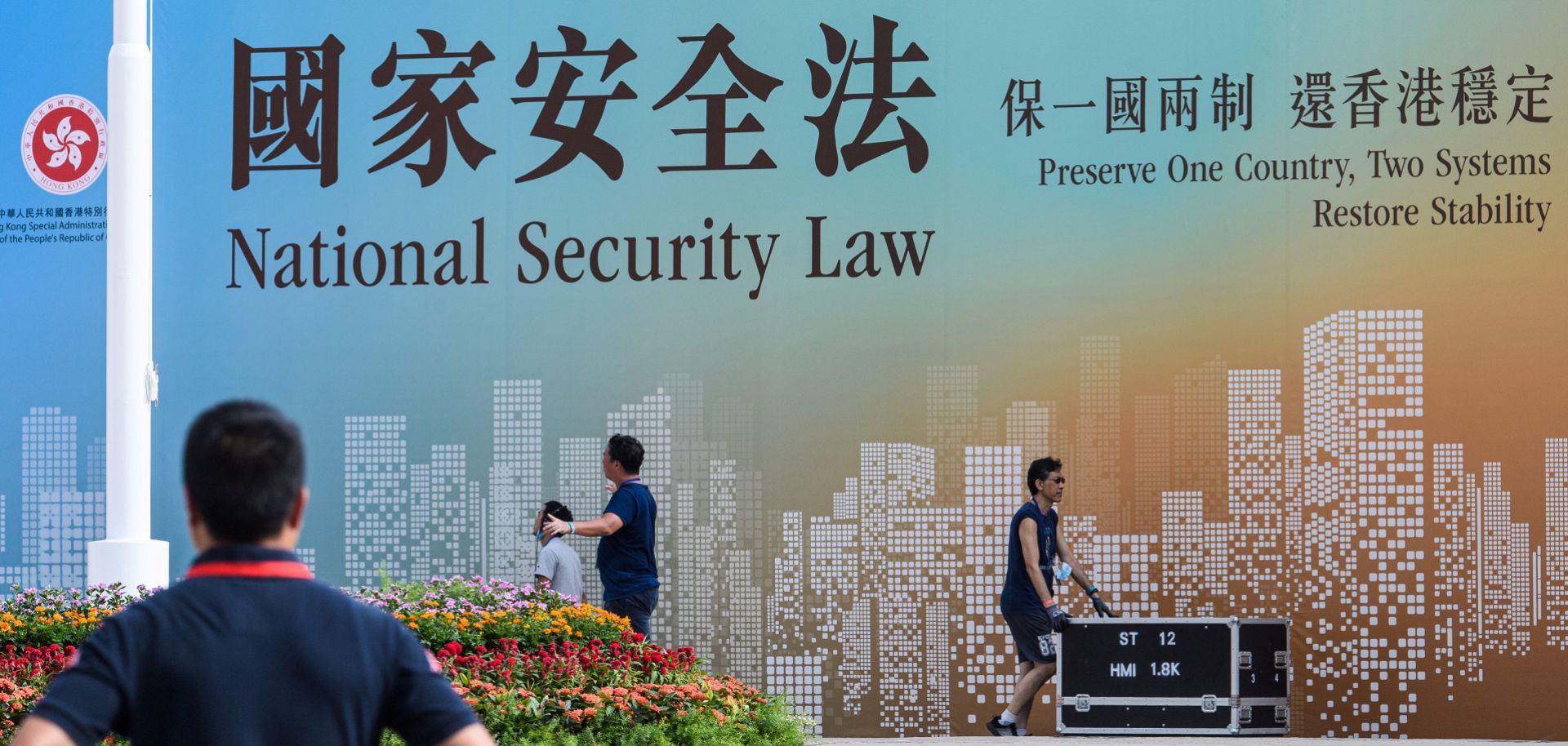
Technicians in Hong Kong walk next to a banner supporting China’s new national security law following a flag-raising ceremony marking the 23rd anniversary of the city’s British handover on July 1, 2020.
China's new national security law is forcing tech companies to pick a side in Hong Kong's political crisis and decide whether to comply or resist authorities in some way, or leave the city altogether — all of which carry the risk of retaliation from either Beijing or the United States and its allies. On July 6, Hong Kong's newly established Committee for Safeguarding National Security moved to implement seven, new enabling regulations for the national security law. The regulations — which include police powers to order internet companies to remove content or to seize their equipment with threats of fines or prison — have since prompted a spate of social media platforms and internet firms operating in the city to pause their cooperation with Hong Kong authorities.
- From July 6-7, U.S.-based Twitter, Google, Facebook and WhatsApp, as well as U.K.-based Telegram, all announced they would pause their compliance with user data requests from Hong Kong authorities in order to assess the implications of the new national security law. These companies do not rely on business in mainland China, and would thus be less vulnerable to retaliation from Beijing. However, they must still tread carefully given that several still use Hong Kong as a way to net ad revenue from Chinese companies.
- On July 7, Chinese appmaker ByteDance announced that it will remove TikTok from the Hong Kong market in the coming days, alluding to the risks of being caught up in the new national security law. The Chinese version of the app, Douyin, will remain operable in the city but must first be downloaded in the mainland. Although China-based, TikTok is in a particularly fraught business position. India recently banned the app from its massive market in response to the June 15 border clash between Indian and Chinese forces. TikTok's ties to mainland China also raises the risk of U.S. and Australian bans, especially if the company gets publicly wrapped up in the Hong Kong controversy.
- On July 7, U.S.-based company Zoom also suspended its compliance with Hong Kong requests to share user data. Like TikTok, Zoom has a global market as well as a large Chinese presence, which has already put it under suspicion by U.S. authorities.
- Microsoft, Apple and LinkedIn have also followed their U.S. peers in pausing compliance with Hong Kong authorities' requests for information. This is particularly challenging for these tech companies, given all three rely on sales into the Chinese market. Apple, in particular, is also reliant on Chinese supply chains for manufacturing.
Tech companies' decisions regarding Hong Kong operations, however, does not portend a mass exodus by other businesses. Companies with a physical footprint in Hong Kong, such as those in the financial sector, will take a more measured approach. Most businesses in the city are not as directly implicated in political or free speech issues, and Chinese authorities still want to preserve Hong Kong's status as an economic hub. U.S. actions and sanctions will be more important to decision-makers in these other sectors, though businesses with a physical presence have still shown a willingness to adjust their day-to-day operations.
- In June, the Hong Kong Internet Service Providers Association reported an increase in companies moving their servers out of the city. This may provide some insulation from scrutiny or potential cyberespionage in light of Beijing's larger security footprint in Hong Kong, which also increases the potential for the implementation of Chinese cybersecurity laws in the city.
- Under Article 29 of the new security law, Hong Kong might prosecute foreign companies for sharing vaguely defined "state secrets" or for "imposing sanctions." Given the ambiguity, it is unclear whether this could include releasing reports on Chinese state-owned enterprises or complying with U.S. sanctions.
- Foreign financial institutions might also face requests for information on their account holders in Hong Kong as part of national security investigations into pro-democracy activists for suspected foreign collusion or support for illegal activity. Complying with these investigations, however, might cause financial firms to run afoul with the United States.
The volatile political dynamic in Hong Kong and the steady erosion of the city's autonomy will ultimately pose the greatest long-term threat to internet-based companies by creating an increasingly restrictive business environment, accelerating the trend toward a far more fragmented global internet. The near future will see a cat-and-mouse dynamic between Hong Kong/Chinese authorities and pro-democracy forces that will play out in the city's streets, as well as online. As a result, communications platforms, media outlets and internet service providers will be increasingly pressured to hand over information or pull down content, which will open them up to retaliation by authorities in the form of fines and seizures, in addition to Western and public pressure to resist Chinese requests.
