
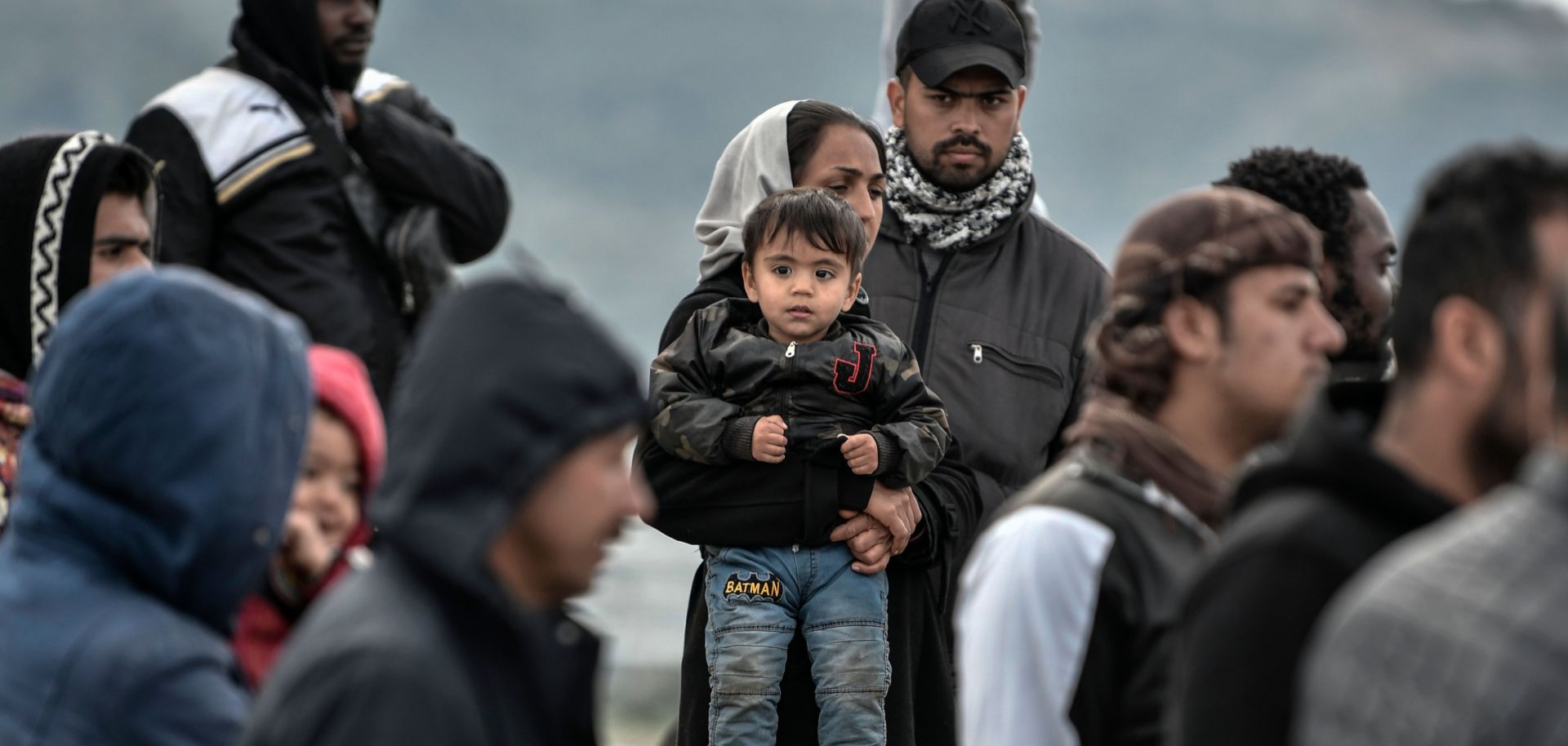
Refugees and migrants stand at a port upon arriving at the Greek island of Lesbos on March 7, 2020.
The arrival of migrants to the European Union by sea will increase in the coming months due to improving weather conditions. But factors including security agreements with the countries of origin and transit of migrants, as well as tougher EU migration policies, mean that the numbers will probably be lower than during the 2015 crisis. Migration to Europe by sea follows a cyclical pattern, with arrivals peaking between June and October when weather conditions are optimal in the Mediterranean. The number of asylum seekers and economic migrants arriving at the bloc, however, has fallen every year since 2015 — a trend that will probably continue in 2020.
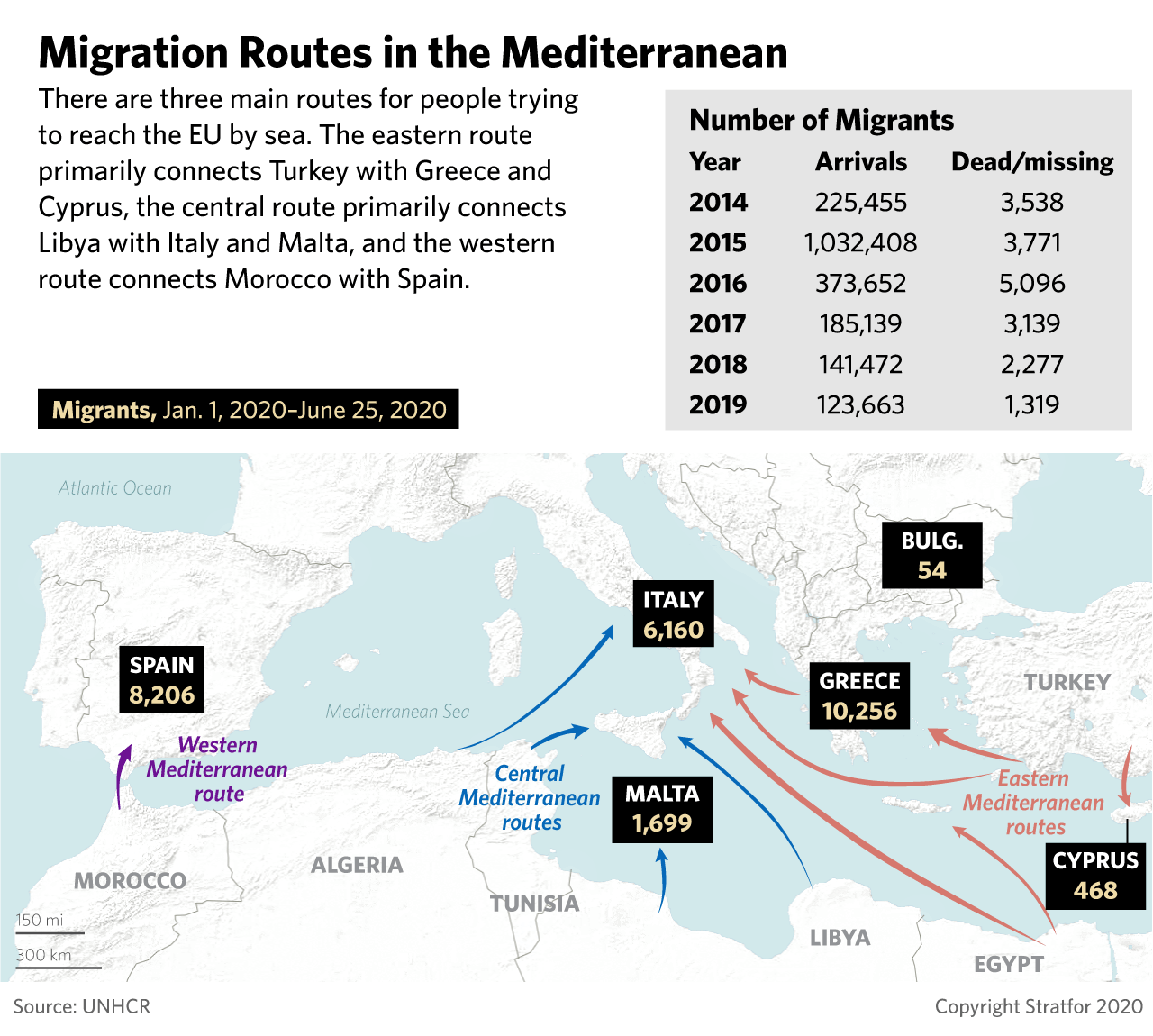
The eastern Mediterranean route will likely be this year’s most volatile migration route, as Turkey continues to leverage its gatekeeper role in political disputes with Brussels and Athens by alternatively opening and closing its eastern borders to Greece. The softening of COVID-19 lockdown measures in Turkey is likely to lead to an increase in people trying to cross the border with Greece as well.
- The Turkish government will continue accusing the European Union of not honoring the terms of their migration agreement, citing the slow disbursement of EU funds and pace of political negotiations over trade and Turkey’s accession to the bloc.
- Greek-Turkish relations will also remain tense because of growing competition for hydrocarbon extraction in the eastern Mediterranean and disputes over maritime boundaries.
While the use of western Mediterranean routes will increase during the summer, security cooperation between Spain and Morocco will probably keep migration flows within manageable levels. As migrants seek alternative routes, this cooperation could also lead to an intensification of arrivals to Spain from Algeria.
- In July 2019, the Spanish government approved a package of 32 million euros ($36 million) in financial assistance for Morocco to control irregular migration.
- Then in December, the European Union approved another aid package for Morocco that included 101.7 million ($437 million) for border management.
With no end in sight to the Libyan conflict, central Mediterranean routes will continue to be important for migrants trying to enter the European Union by sea. Human trafficking groups take advantage of the volatile situation in Libya to transport migrants across Africa to Italy and Malta, though in recent years greater cooperation between Italian and Libyan authorities has led to a reduction in arrivals. But the lifting of COVID-19 lockdown measures has prompted non-governmental organizations (NGOs) and charity groups to resume their rescue operations at sea, which will increase the appeal of these routes.
The European Union will increase the control of its external borders and provide additional resources to the countries of origin, though an EU mechanism to automatically distribute migrants upon arrival remains improbable. This means countries on the European Union’s external borders (namely Greece, Italy, Malta, Cyprus and Spain) and countries that cooperate in the distribution of migrants on a voluntary basis such as Germany, will continue to bear most of the immigration burden, while arrivals to Eastern European countries remain largely unchanged.
- The European Commission is expected to unveil a migration reform proposal in the coming weeks, which will probably include measures such as strengthening controls of the bloc’s external borders, improving the expulsion of irregular migrants, and increasing logistical and financial support for the countries of origin and transit of migrants — all of which EU member states broadly support.
- Countries in Central and Eastern Europe, however, will reject any plans to introduce quotas or automatic distribution mechanisms for migrants.
The political environment in Europe is less welcoming to migrants than it was in 2015, which will reduce the overall pull factor to the Continent. Fears of mass migration leading to new outbreaks of COVID-19 means EU members will be more willing to close their borders to sever the migration routes as well.
- In 2015, Germany’s decision to open its borders to more than a million migrants contributed to the significant increase in arrivals, but Berlin has since abandoned this policy due to domestic political pressure.
- Greece’s conservative government is also now more willing to reject migrants arriving at its sea and land borders compared with the country’s center-left administration in 2015.
But at a time when EU countries are facing deep recessions and rising unemployment due to COVID-19, even a moderate increase in immigration flows could further fuel social and political tensions within the bloc. Nationalist and far-right parties across Europe will likely again use immigration as a part of their political strategies to generate fears among voters at a time of economic malaise and uncertainty. Under pressure from these parties, moderate governments may also take a tougher stance on immigration and resist EU proposals to increase burden-sharing measures in the continent. In addition, fears connected to migrants spreading COVID-19 could lead to small episodes of violence and discrimination against refugees and migrants across the European Union.
