
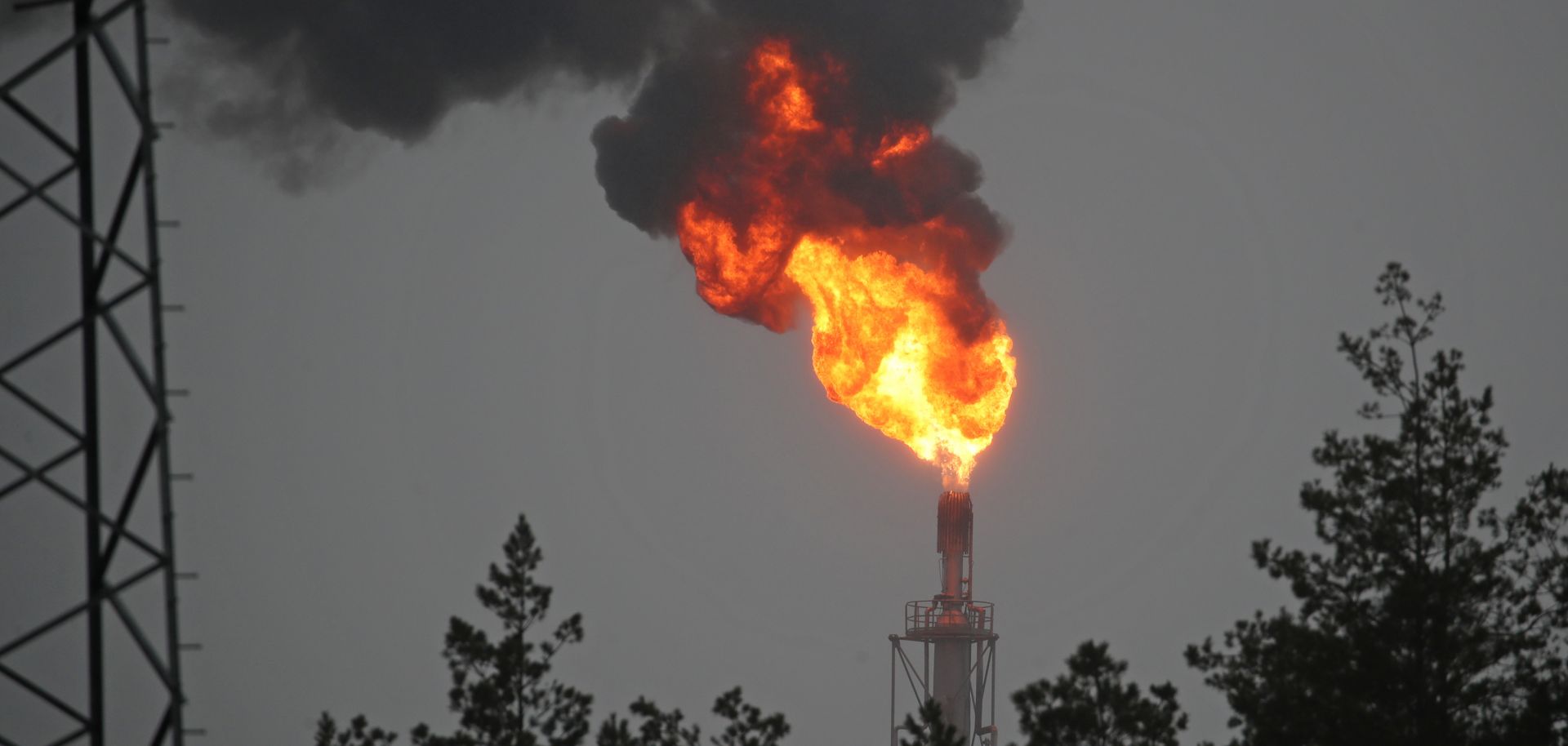
An image of a gas flare at the Mozyr Oil Refinery in Belarus on Jan. 4, 2020. Russia recently resumed its oil deliveries to Belarus after a pricing dispute prompted Moscow to halt its supplies at the beginning of the year.
Despite the recent resumption of Russian oil deliveries, Belarus has remained committed to diversifying its crude imports, which will enable it to negotiate more favorable terms in a potential integration agreement with Moscow. On Jan. 1, Russia moved to cut off Belarus’s access to its crucial oil deliveries after the two failed to reach an oil pricing agreement. As deliveries through the Druzhba pipeline from Russia dried up, Belarus turned to alternative sources of crude imports in Norway and Azerbaijan to partially replace those suspended by Moscow. These imports helped Belarus keep its refineries operational, albeit at only half their capacity, during the first quarter of 2020.
- Tankers delivered over 2 million barrels of oil from Norway to Lithuania’s Klaipeda port, from where oil was transported by rail to Belarusian refineries.
- After arriving at the Ukrainian city of Odessa, 4 million barrels of Azerbaijani oil, as well as other oil traded by Azerbaijan’s state-owned energy giant SOCAR, was also transported via pipeline to Belarus.
- A small number of Russian producers with close ties to Belarus also continued to provide limited supplies waving Russia’s export premiums.
- In May, Belarus received its first shipment of Saudi Arabian oil through the Lithuanian port of Klaipeda as well.
Determined to Diversify
In April, Russia restarted its oil deliveries to Belarus after the two reached a new pricing agreement, though Minsk has nonetheless continued to diversify its oil ties. Under the pricing deal, Russia agreed to wave premiums on its crude supplies and also provided Minsk its largest-ever discount at only $4 per barrel. Moscow also recently offered to compensate for the revenue Belarus lost due to a past adjustment in Russian oil duties.
But despite these sweeteners, Belarus remains focused on President Aleksandr Lukashenko’s plan to eventually import at least 60 percent of its oil from countries other than Russia. To that end, Minsk aims to import only about 8 million barrels of Russian crude in May, compared with the over 11 million barrels in April. Lukashenko also recently ordered the Belarusian government to construct the required storage infrastructure for a strategic oil reserve that would help the country overcome future disruptions of Russian supply.
Further reducing Belarusian dependence on Russian oil supplies, however, will require large infrastructure developments. As part of its greater diversification strategy, Minsk, for example, has repeatedly discussed its plans to import oil by pipeline from Poland. But pipeline infrastructure between Belarus and Poland currently carries Russian oil in the opposite direction toward Europe, and temporarily reversing the flow for such deliveries would force Poland to make technical adjustments. Belarus has already prepared for this by defining tariffs for that transport route, and Poland has reportedly started collecting bids for the required infrastructure upgrade, though the two countries have yet to reach an official agreement on the project.
The United States has declared its support of Belarus’s oil diversification strategy, eyeing the reduction of Russian influence in Europe through oil. But Washington pledges to financially support regional pipeline development from both Lithuania and Poland, as well as provide direct deliveries of U.S. oil, have not yet materialized.
Loosening Russia’s Hold
The diversification of oil supplies has enabled Minsk to hold off on accepting the terms of Russia’s broader integration plan. Russia aimed to leverage oil price negotiations by making its crucial discounts conditional on its integration agreement, which includes the establishment of several supranational bodies to oversee monetary policy, energy markets and customs. But for Belarus, Moscow’s proposed level of integration constituted too significant a surrender of sovereignty. By clearly demonstrating its ability to obtain crude oil from other sources, Minsk has effectively disarmed this leverage and has bought itself additional maneuverability in future negotiations on integration.
But despite countering Russia’s effort to leverage oil supplies, Belarus continues to be economically exposed to Russia through trade in natural gas and other goods. Russia still accounts for nearly half of Belarus’ total trade volumes, including 40 percent of its exports and 55 percent of its imports. Belarus, by contrast, represents only about six percent of Russian trade. This disparity makes Minsk vulnerable to the ups and downs of the Russian economy and makes it difficult for Belarus to achieve its own growth. Its over-reliance on Russia is a large reason why Belarus not only remains open to, but in fact wants, to deepen its economic ties with Russia — just not to the degree where it could hinder its other trade relations.
Minsk’s resolve and its ability to turn to alternative economic partners thus demonstrate that it will only agree on further integration with Russia on mutually acceptable terms. Expanding trade relations with the West in general, and the European Union in particular, remain a key priority for Minsk. In this, Belarus will be careful not to appear that it’s cozying up too close with Moscow, which could jeopardize those budding relationships and make Belarus subject to Western sanctions. Minsk will allow for pragmatic integration that can maximize useful trade with Russia, but not at the cost of the economic autonomy that it desires.
