
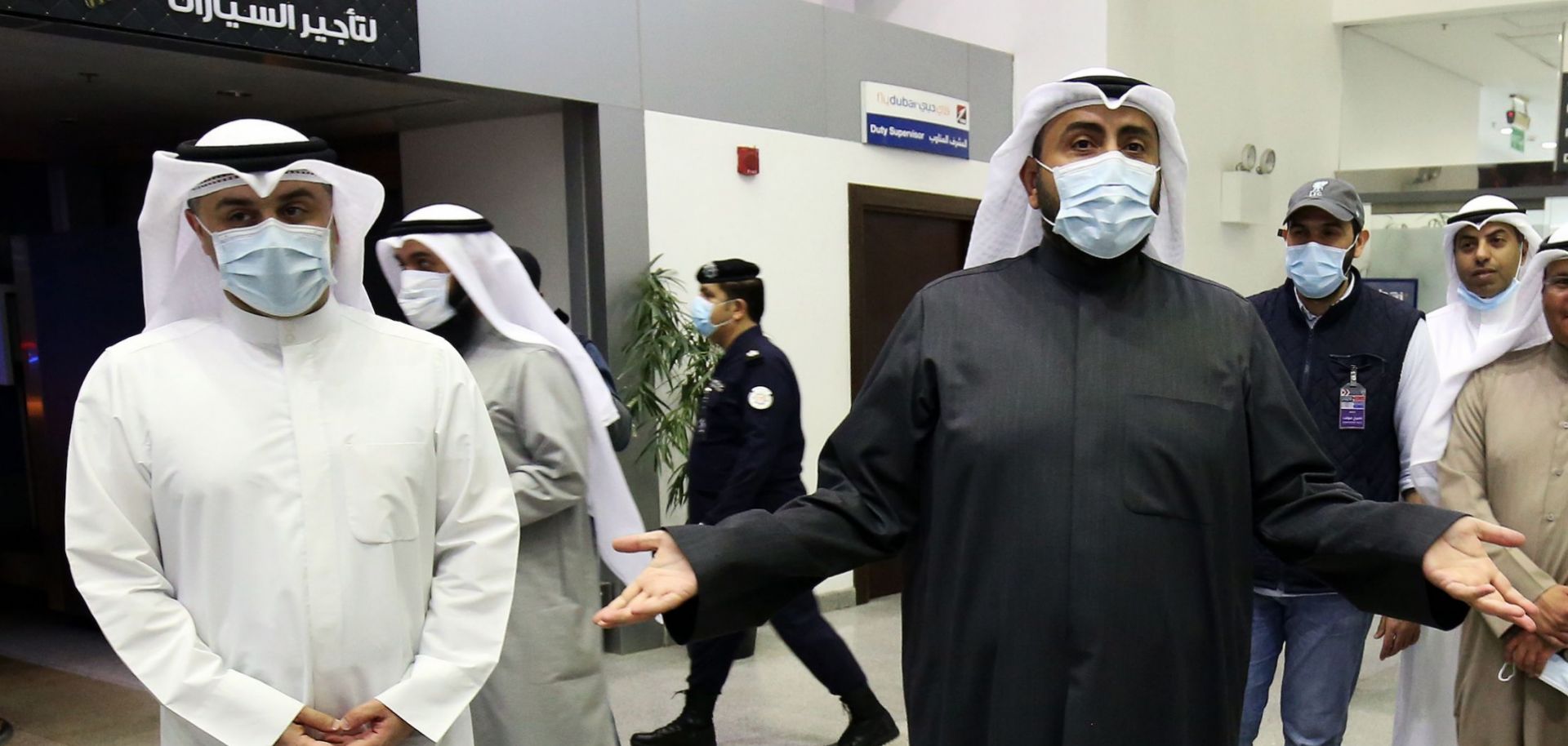
Kuwaiti Health Minister Sheikh Basel al-Sabah, right, speaks with the media on Feb. 22, 2020, as officials at the Kuwait City airport prepare to take Kuwaitis returning from Iran to a hospital to be tested for the COVID-19 virus. Iran has emerged as a regional epicenter of the coronavirus outbreak.
With cases in a half-dozen Middle Eastern countries that originated from travel within its borders, Iran has emerged as a regional epicenter of the coronavirus outbreak — which causes the respiratory illness the World Health Organization calls COVID-19 — just as global fears of a pandemic are amplifying. There are clear negative impacts for Iran both politically and economically, as well as potential negative economic and health impacts for the surrounding region. But depending on how Iran manages the internal and external information flow, the outbreak could also harm and/or help the country's already fragile foreign friendships, should it compel Tehran to reach out to the broader world for more help.
The Immediate Concern: Containment Within Iran
Containment of the COVID-19 virus within Iran will be a challenge because of Iran's poor health infrastructure and traditional unwillingness to communicate freely and openly across all branches of government and between health institutions. Heavy financial sanctions and global travel restrictions for its health professionals further impede Iran's existing infrastructure weakness. Iran has well-trained doctors but its hospitals and health facilities throughout the country are poorly equipped and supplied, and it especially struggles to provide rural communities with quality health care. A years-long health infrastructure improvement plan dubbed the Health Transformation Plan was found recently to have done little to improve rural access to health care facilities, which means if the coronavirus spreads to rural areas, effective treatment of and accurate reporting on the outbreak could become a more serious problem. Iran already shuttered schools in 10 provinces for two days and canceled numerous public events, designating 230 hospitals to focus on COVID-19 management. But only time will tell if these measures are enough to curb new cases.
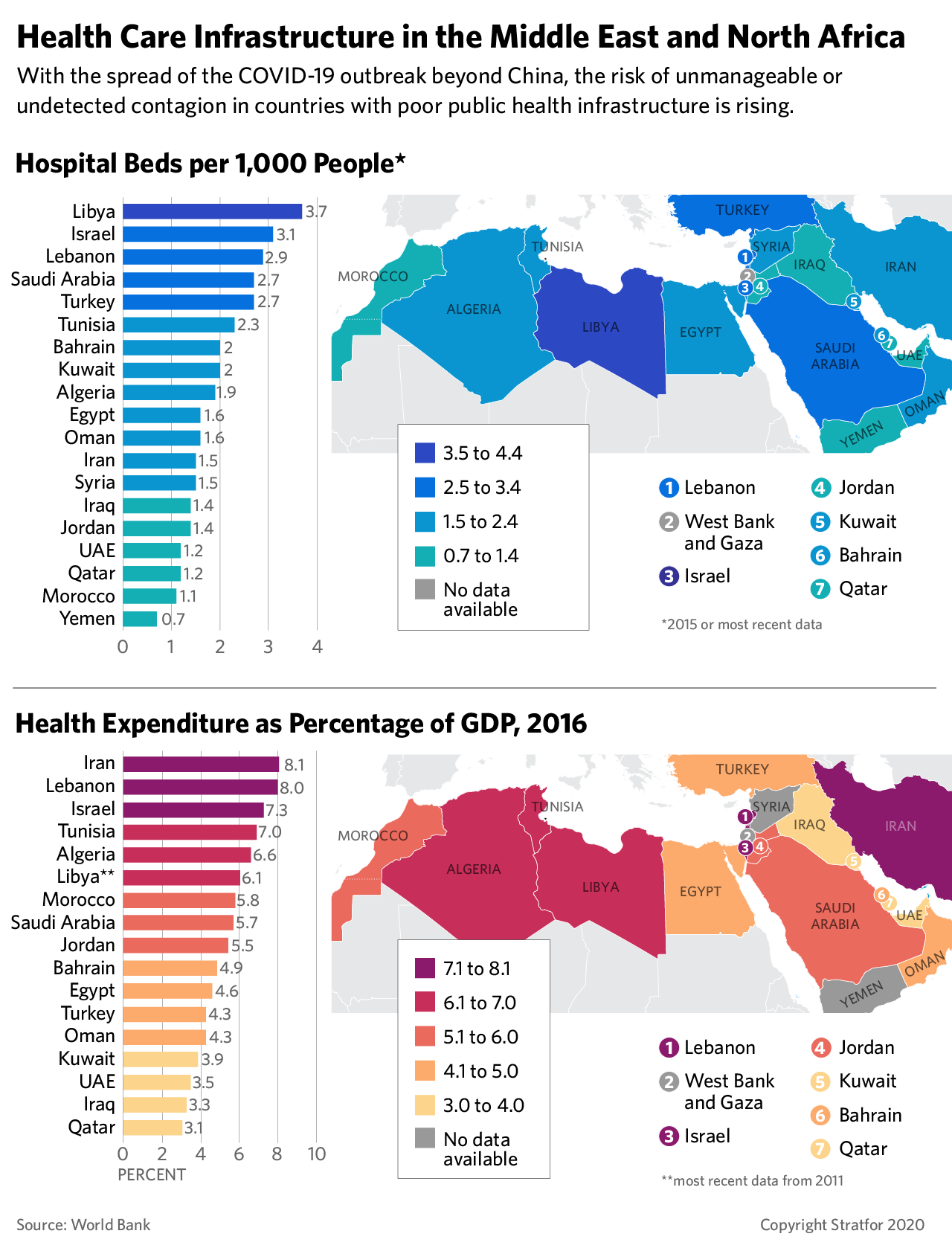
Another key challenge for Iran will be accessing and communicating correct information to both domestic and international audiences. Per available information from Iran's Health Ministry, as of Feb. 25, the number of cases in the country stands at 95, with most cases in the infection epicenter of Qom. With 15 deaths reported nationwide, Iran now has the highest number of COVID-19 fatalities outside China, underlining the serious nature of the outbreak. Of course, the reported figures raise the valid question about whether the death toll and infection count are actually higher. Iran's ability to access accurate health reporting from across the country is limited because of poor infrastructure. And its ability to accurately test and screen for infection is also in question because of the lack of access to the right equipment. Upcoming spring celebrations for the Nowruz new year holidays in Iran will be a risk for further spread of the coronavirus if the infections continue.
Domestic Political Impact in Iran
The COVID-19 outbreak has significant implications for Iran domestically: a further shaking of trust in the government. Iranians already struggle to trust their government — consider what happened with the Ukrainian airliner shootdown in January — and fears of a possible pandemic will undercut the government's ability to regulate information flow and ultimately control the virus itself. On Feb. 24, one Iranian member of parliament from the disease epicenter in Qom panicked Iranian media with a report that there have already been 50 deaths from the virus. Although the Health Ministry quickly refuted this report, accurate numbers remain unclear and are likely to change as more information becomes available. At least two government officials, including the deputy health minister spearheading infection-fighting efforts as well as a member of parliament from Tehran, have contracted the virus, raising the risk of further spread to government officials. Though these two officials have been open with the public about their own cases, there is likely a lot of information yet to be uncovered.
A small political silver lining from the timing of the outbreak is that it provides a convenient justification for low turnout in last week's parliamentary elections. But while fear of the spread of the COVID-19 virus was likely a factor preventing widespread turnout in the election, the reality is that the government was already struggling with its legitimacy with an economically anxious population. No matter how broadly pro-government media reports that fears of COVID-19 explain last week's low voter turnout, there are many reasons why Iranians lacked enthusiasm to cast their ballots for yet another government many of them struggle to trust.
Regional and Global Impact
With global fears of a pandemic rising, it is likely that Iran's neighbors will continue to shut border crossings and reduce travel and trade links in the near term to mitigate the virus' spread. Armenia, Afghanistan, Turkey, Pakistan and Iraq (both southern and the semi-autonomous Kurdistan region in the north) have closed their borders with Iran, while Kuwait, Oman and the United Arab Emirates have limited travel to Iran following confirmation of COVID-19 cases linked to Iran travel. Bahrain and Lebanon have also confirmed cases of COVID-19 linked to Iran travel but have yet to close their borders or restrict travel, though domestic pressure is rising to do so.
Because of sanctions and the unique nature of Iran's "resistance economy," Iran is not as globally integrated in terms of trade as it would like to be, though it is connected to the global community and especially the surrounding region in terms of travel connections. It has depended on the trade and travel links that it does maintain to help it weather the economic pressure from U.S. sanctions. Iran's economic growth is already sluggish, and if trade and transport links are cut with trade partners like China, Iraq, Turkey and Kuwait — all of which have temporarily reduced or cut travel with Iran or closed their borders — this will have a direct impact on Iran's non-oil sector revenue. Indeed, any curtailed trade, especially with China, will have a greater impact on Iran than on its trade partners because of Iran's dependence on a more limited number of trade links due to sanctions.
Religious travel to and from Iran could be a source of spread from Iran to a handful of neighboring and nearby countries that have a sizable population of Shiites, and raises the risk of all pilgrimages to Sunni, Shiite and Christian sites around the region being potential sources of infection. Shiite pilgrimages to and from Iran and Iraq, in particular, are a source of concern. As of Feb. 25, Iranian religious authorities have issued fatwas or religious edicts prohibiting travel to Qom, but it is unclear whether Iranian security forces will be attempting to limit physical travel. Saudi Arabia has yet to record any COVID-19 cases but when it hosts the Hajj pilgrimage in August, it will be on high alert for the spread of COVID-19 from Muslim pilgrims from around the world, including Iran. For some Muslim populations, the tradition of domestic travel to visit family and friends during the month of Ramadan will be a time of concern about infection spread. Business-related travel, of course, is a likely source of spread from Iran to neighboring countries, including with Iran's suspected patient zero, a merchant who had traveled to China.
Impact on Sanctions and Iran's Pariah Status
As countries rush to shut off travel and trade links to Iran to mitigate the spread of the coronavirus, the irony for Iran is that it is happening at a time when Iran is striving to combat U.S. efforts to isolate its economy from the rest of the world via sanctions. We will likely see an effort by the European Union to help Iran access the material help it needs. The COVID-19 outbreak comes at a time when a number of EU countries were already trying to find a way to help Iran access the goods it needs without triggering U.S. sanctions. Depending on how bad the infection spread becomes in Iran, the European Union will be motivated to extend a helping hand via the state-to-state supply of critical goods or financing, despite U.S. sanctions.
Based on precedent, there is deep uncertainty about Iran's willingness and ability to accept help from the global community and cooperate with it to contain the spread of COVID-19. If Iran shares information about its COVID-19 outbreak and cooperates with the outside world, there is a small chance it could lead to some leniency from the United States in terms of some financial restrictions, even as Iran's regional trade partners and neighbors temporarily shut down their links to mitigate the spread of infections. Iran's openness to a delegation from the World Health Organization (WTO) that is set to arrive this week is one sign of its willingness to work with the outside world. The WTO said sanctions negatively affect Iran's ability to treat the virus by impeding its access to medical equipment. Some of the U.S. sanctions on Iran allow for humanitarian goods, but depending on how bad the infection becomes, the United States might be swayed to further relax some trade restrictions.
