
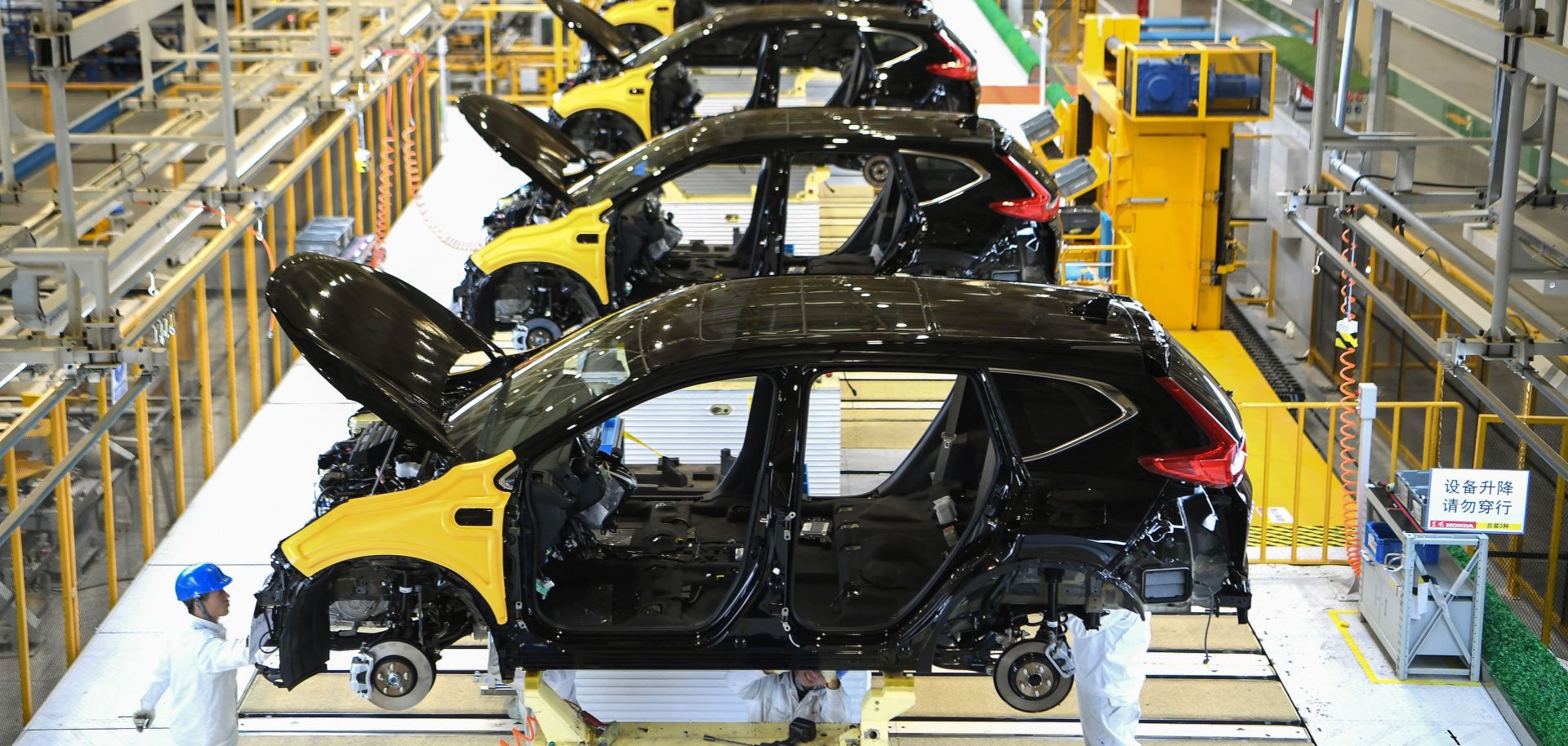
Honda's joint venture with Dongfeng Motor Corp. in Wuhan, China, shown in this 2019 photo, is one of several auto manufacturing and parts plants in the city and Hubei province idled by the coronavirus outbreak.
China's deadly coronavirus outbreak has left few of its economic sectors unscathed, but the effects of shutdowns on its auto manufacturing operations have been — and will continue to remain — especially acute. Hubei province, the epicenter of the outbreak, has asked companies not to restart shuttered operations until at least Feb. 21. Production for a number of auto companies outside of Hubei had already been delayed past the Lunar New Year holiday until Feb. 10, and in some cases, production still remains offline. Nevertheless, even once the outbreak subsides, Chinese consumer demand for automobiles will take a substantial hit this year, with estimates showing that demand could fall by at least 5 percent because of the economic slowdown associated with the coronavirus outbreak.
The effects beyond China have also been significant. China is not a major exporter of automobiles, but it's indispensable to the Asian supply chain as a supplier of parts that the region's assembly plants use. South Korean automakers such as Hyundai are highly exposed to supply chain risks emanating from the city of Wuhan, Hubei province and China, writ large. The outbreak, for example, forced Hyundai to temporarily suspend production at all seven of its plants in South Korea this month. Japanese automakers depend less on Chinese parts as their Korean counterparts — but no part of the Asian industry has been unaffected.
Adding Stress to a Struggling Domestic Sector
Even before the COVID-19 outbreak, China's auto sector had been struggling. The country's slowing economy and the tariffs that were part of the trade war with the United States drove an 8.2 percent drop in 2019 auto sales — the second consecutive annual decline after 27 consecutive years of growth. In December, a month before the coronavirus outbreak became public, the China Association of Automobile Manufacturers said it expected a further 2 percent decrease in sales in 2020. Now, with the effects of the outbreak expected to further batter the Chinese economy, growth could decline by as much as 1 percentage point — the trade association revised the sales drop to 5 percent.
Despite expectations that demand growth would continue to struggle, foreign automakers view China as an untapped market, especially in the burgeoning electric vehicle (EV) market. China has historically prevented foreign automakers from accessing its market but has allowed joint ventures with domestic companies to build plants in mainland China. Even with demand taking a hit, China remains the world's largest auto market. China recorded about 23.7 million new personal car registrations in 2018 — more than both Europe (17.9 million) and the Americas (10.6 million). The coronavirus outbreak will certainly not deter foreign investment in the Chinese auto sector. Because of the Chinese market's unique regulatory framework for things like emissions and safety standards, and given the incentives that Beijing offers which favor domestic investment, many of those automakers will prefer partnering with local companies to manufacture vehicles in China rather than exporting vehicles to the country, despite the risk of future disruptions.
Impact to Supply Chains
Hubei province, one of China's largest industrial centers, is a key link in the Chinese auto sector's manufacturing and supply chain. In 2018, 2.4 million vehicles were manufactured in Hubei, accounting for 8.7 percent of Chinese total output — the fourth-highest among Chinese provinces. Wuhan hosts the headquarters of state-owned Dongfeng Motor Corp., China’s second-largest domestic auto producer. Dongfeng focuses almost exclusively on the domestic market. The company has joint ventures with several foreign automakers, including Groupe PSA, Nissan and Honda. Each of those joint ventures has been directly affected by the coronavirus outbreak, as all three have a significant presence for manufacturing in Wuhan and/or Hubei province.
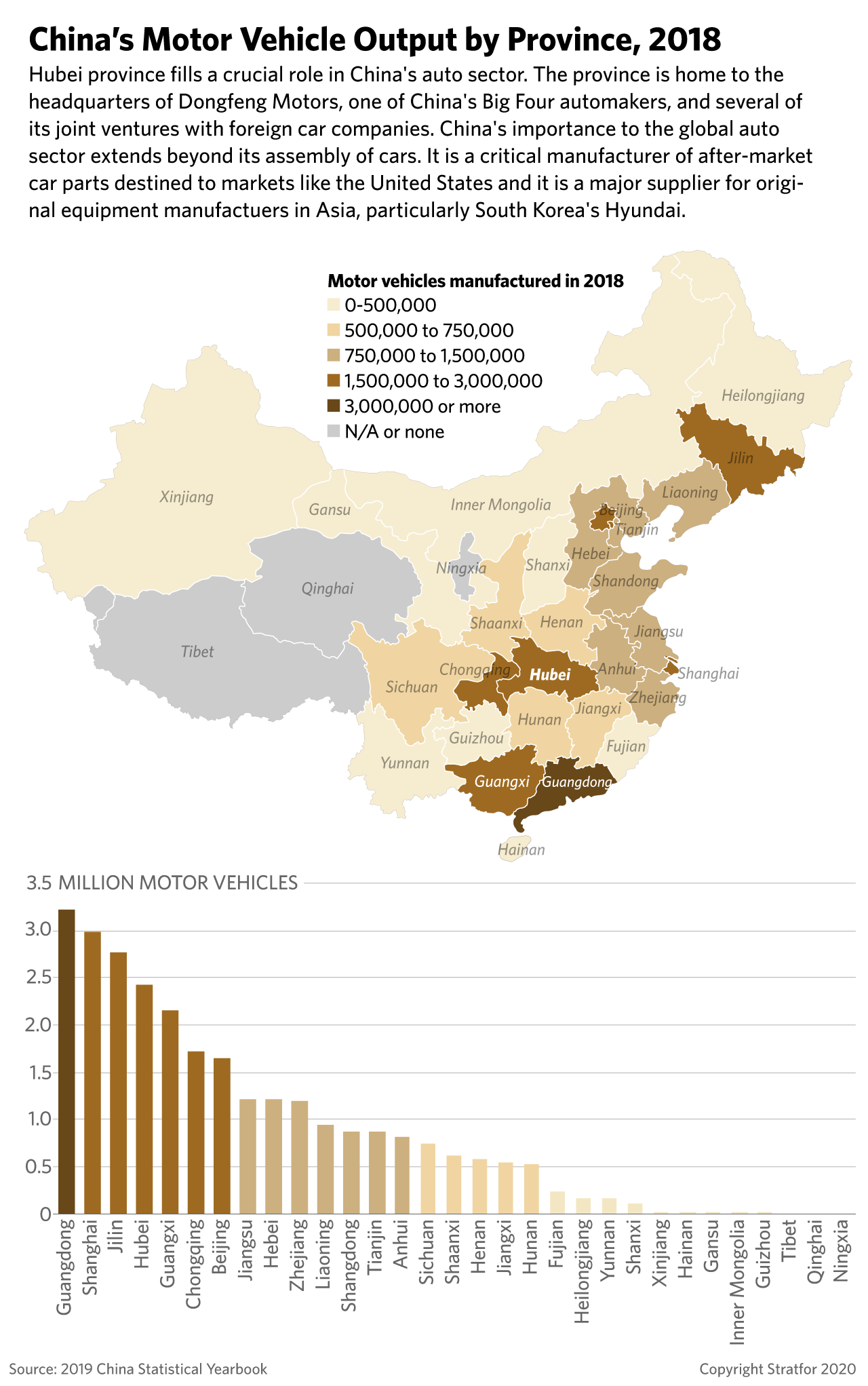
The remainder of China's Big Four automakers, SAIC Motor, FAW Group and Chang'an, as well as others such as Geely, do not have the same dependence on Wuhan and Hubei for assembly, though some rely on parts manufactured there. Many of those companies and their joint ventures with the likes of Ford Motor Co. and Daimler AG already have restarted operations, though a drop in domestic consumption will still hurt their bottom line.
China's auto sector exports vehicle parts globally, to the tune of $34.8 billion in 2018. Auto assembly plants in South Korea and Japan remain top destinations. But Japanese automakers have spent the better part of the past decade diversifying their imports away from China. As recently as 2012, more than 40 percent of wiring harnesses and ignition wiring sets imported by Japanese automakers came from China. In 2019, Japan imported $5 billion worth of those components, but just $675 million, or 13.5 percent came from China. On the other hand, of the $2 billion in wiring parts imported by South Korea in 2019, 87 percent came from China.
It should be no surprise that South Korean automakers saw the most significant and widespread hit to operations outside of China. Among others, Hyundai was forced to briefly idle all seven of its South Korean plants and Renault also suspended operations at its plant in Busan. Although China produces an array of auto parts, the importance and concentration of wiring harness manufacturing have proved to be a key limiter. Already, 37 out of 40 of China’s wiring harness suppliers began restarting operations the week of Feb. 11. But if a geographic spread of the COVID-19 outbreak forces another shutdown on the part of Chinese parts manufacturers, South Korean automakers could again feel the brunt.
Outlook
With the restart of Chinese parts plants, it appears as if the most damaging effects to the supply chains for most global automakers are over. The flow of parts to global automakers both in South Korea and elsewhere has resumed once again. Of course, the supply chain impact on companies like Dongfeng's joint venture partners in Wuhan remains significant.
Any future impact of Chinese supply chain links on foreign manufacturers will depend on Beijing's ability to contain the coronavirus outbreak in Hubei province. After all, even just the weeklong countrywide extension of the Chinese New Year holiday instituted to help contain the virus had a significant impact on automakers in South Korea and elsewhere, highlighting their lack of supply chain alternatives and limited stockpiles of parts. This means that if the epidemic spreads to other regions of China, forcing another manufacturing shutdown, the effects will be drastic. But even if the virus remains contained, the outbreak's effects on China's economy, and the subsequent effects on domestic vehicle demand, appear certain to extend the slump in demand growth for Chinese automakers.
