
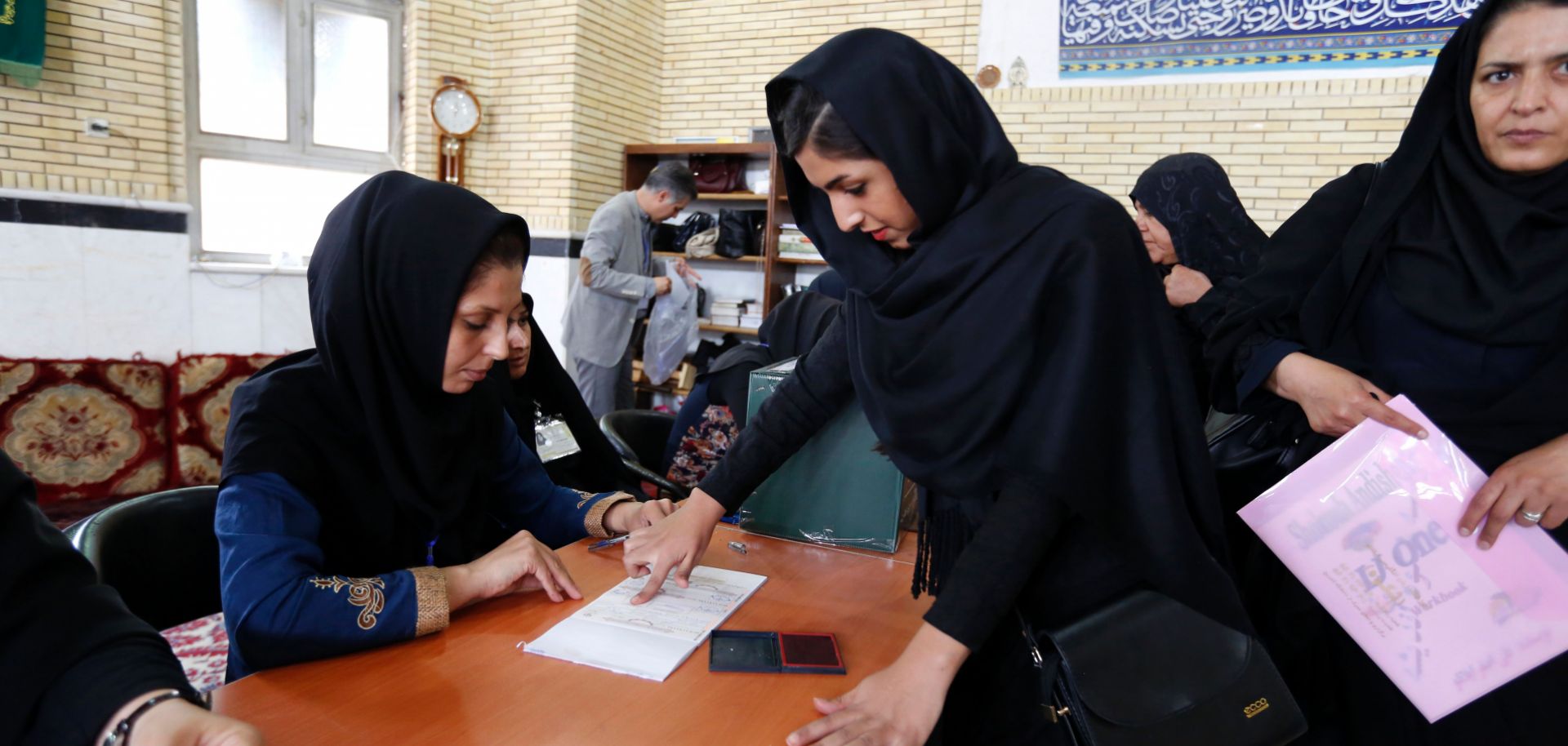
A woman votes in Iran's 2016 parliamentary elections. Iran holds new elections in February 2020 but no matter the outcome, the political establishment will remain united on key economic and foreign policies.
Editor's Note: This assessment is part of a series of analyses supporting Stratfor's 2020 Annual Forecast. These assessments are designed to provide more context and in-depth analysis of key developments over the next quarter and throughout the year.
Iran will hold parliamentary elections in February 2020 amid Washington's so-called maximum pressure campaign and associated sanctions. The initiative is wreaking havoc on all levels of Iran's economy and society, and the flagging health of the economy has become a major campaign issue for moderate and hard-line factions.
But whatever new Iranian government emerges from the elections, the Supreme Council of Economic Coordination will continue to make the most important economic decisions just as the Supreme National Security Council will continue to make the most important national security decisions. In Iran's complicated political system, it is unelected institutions like these two — not the executive branch or parliament — that control the most important levers of power, helping guarantee regime continuity.
Economic Woes and the Iranian Voter
Since most Iranian government revenues come from crude oil exports, strong U.S. sanctions on Iran's oil sector have weakened government finances and forced Tehran to undertake some fiscal reforms. U.S. sanctions have also pinched the average Iranian, making medicine and specialty goods harder to come by, and increasing the prices of daily necessities. Still, inflation — though high at 42 percent in November, according to the Statistical Center of Iran, with the highest uptick for food prices — has not swollen to the triple digits that many Iranians feared. And while the economy is seriously struggling, the government and the population are scraping by, thanks in part to economic diversification and tough and prudent macroeconomic policies aimed at mitigating the sanctions' impact.
The government's economic management effort is spearheaded by the Supreme Council of Economic Coordination, founded by Supreme Leader Ayatollah Ali Khamenei in June 2018 to help Iran weather the impact of progressively deepening sanctions that emerged with the May 2018 U.S. withdrawal from the Joint Comprehensive Plan of Action (JCPOA), better known as the Iran nuclear deal. This body ensures the involvement of Iran's main political factions and bodies and is jointly chaired by parliament speaker Ali Larijani (a traditional conservative) and judiciary head Ebrahim Raisi (a more hard-line conservative).
One of the council's priorities is shielding Iran's most vulnerable from the impact of sanctions, but the council and the government have made clear that shoring up the economy and weathering sanctions will require either more oil exports, higher taxes or changes to the country's costly subsidies for basic necessities. To this end, Iran hiked fuel prices by 50 percent in October to fund a direct payment system for the most vulnerable and to reduce gasoline consumption. The decision sparked Iran's most violent protests in years, but the government held its ground, mounting an intense crackdown to quell the unrest — something it would doubtless do again in the face of future unrest.
Even though the council includes representatives from many factions, Iranian President Hassan Rouhani is largely the face of Iran's economic policy, so he and his allies are likely to receive much of the criticism from unpopular policies like last month's fuel price hike. Rouhani won the presidency in 2013 and again in 2017 on promises of liberalizing the country's economy and generating economic growth from increased oil exports through negotiations with the West. Rouhani now finds himself unable to deliver on those promises and instead is forced to back the same unpopular policies he campaigned against, such as price controls, to keep the economy afloat.
Rouhani's rivals, whether they be hard-line conservatives or populists, will try to discredit the Rouhani government and its economic policies, such as last month's price hike. Still, voters are more likely to blame hard-liners for the violent crackdown and associated internet cutoffs, and with corruption linked to Iran's military apparatus. This will make it tougher for the hard-liners to tap into popular resentments over the economy.
How the Elections Could Play Out
Iran's parliament is carefully managed by the conservative-dominated Guardian Council, which must approve legislation before it can become law. The Guardian Council must also approve candidates before they can run for office. In the last parliamentary elections in 2016 — when the JCPOA was first going into effect — the council approved most reformist candidates for the first time in several election cycles. The election marginalized Iran's hard-liners in parliament, not only to the benefit of the moderates and reformists but also to the benefit of Iran's more traditional conservatives.
But Iran's reformist camp now is split over whether even to contest the 2020 elections. Boycotts and low turnout have long undermined the legitimacy of Iranian elections. Earlier in 2019, former President Mohammad Khatami called on reformists to participate in the upcoming vote unlike they did in 2008 and 2012 when most of Iran's reformists chose not to run or were disqualified, leading to considerable hard-line influence over those parliaments. A victory for the moderates in 2020 would matter despite the oversight of the Guardian Council because Iran's parliament serves as an important venue for the airing of the popular will, which can affect policy.
The hard-liners, however, are almost certain to gain more seats and influence in the 2020 elections. But unless there is a return to widespread disqualifications, they may struggle to gain enough seats to control the parliamentary agenda the way they did after the 2008 and 2012 elections.
Even a strong performance by Iran's hard-line conservatives in February would not necessarily translate into an immediate popular mandate. Still, a parliament dominated by hard-liners could embolden actors outside parliament, such as in the powerful Supreme National Security Council — a body responsible for the most important national security decisions comprised of Larijani, members of the Rouhani government and appointees made by Khamenei — and the Islamic Revolutionary Guard Corps to pursue more aggressive policies knowing that they have parliament's backing. It could also foment hard-line elements into launching impeachment inquiries into members of Rouhani's government. In the meantime, all factions are united in waiting to see whether the 2020 U.S. presidential election produces a new U.S. administration more open to negotiations, and will continue to back Iran's ongoing aggressive security strategy against the United States and its regional allies.
Regardless of who wins in 2020, Iran's factions will remain united behind the decisions of the Supreme Council of Economic Coordination and the Supreme National Security Council. Rouhani himself vocally supported harsh tactics against protesters rioting and blocking major highways with abandoned vehicles. So while the balance of power among the factions is certainly being recalibrated under the duress of economic sanctions, and we may see a slowdown in Iran's attempts to push out the Islamic Revolutionary Guard Corps from business ventures if Iran's hard-liners gain more influence, the furious popular reaction to the recent fuel price hike has convinced all factions within Iran's political leadership that they must work together if the regime is to survive the current intense U.S. sanctions pressure.
