
Labour Party leader Jeremy Corbyn campaigns outside Finsbury Park station in London on Dec. 2. Britons will vote to fill all 650 seats in the House of Commons on Dec. 12 in an election that might finally bring an end to the United Kingdom's Brexit saga.
The United Kingdom is just days away from a snap general election on Dec. 12, with the country's future outside — or even, perhaps, inside — the European Union hanging in the balance. Depending on who wins, Brexit could take very different directions, as the country's main political parties have radically different proposals for both the terms of the United Kingdom's exit from the European Union and the future trade ties between the country and the bloc. A victory by Prime Minister Boris Johnson's Conservative Party would increase the chances of an orderly Brexit in late January 2020. On the contrary, a government led by the main opposition, the center-left Labour Party, would increase the likelihood of a new referendum in which voters could choose to cancel Brexit altogether.
But even if there is an orderly Brexit in 2020, negotiations over a free trade agreement between the bloc and London will be complex as issues like the United Kingdom's alignment with EU norms and the future of the country's financial sector will hinder any quick deal — meaning that after long-winded talks on Brexit itself, Brussels and London might find themselves ensconced in trade talks that drag on even into 2021.
Three Possibilities for the U.K.
In terms of voting intentions, the Tories are currently far ahead of Labour at 43 percent to 33 percent, according to a "poll of polls" by Politico. However, the United Kingdom's first-past-the-post electoral system (according to which only the candidate who wins the most votes in a constituency is elected) means that a party's popularity does not necessarily translate into seats in the House of Commons. As a result, while most surveys suggest that Johnson's Conservatives will win a majority of seats in the new House of Commons, the predictions range from a comfortable majority of more than 60 seats to a small majority of less than a dozen. Other outcomes, such as a coalition between Labour and smaller parties such as the Liberal Democrats, are also possible.
A Tory Government. Based on the current polling numbers, at least three election outcomes are possible. The first is a Tory-led government — either because Johnson controls enough seats in Parliament to govern alone or because he reaches a deal with a smaller party like the Brexit Party. In this scenario, the Commons would probably approve the withdrawal agreement that London reached with Brussels in October relatively quickly, paving the way for the United Kingdom to leave the European Union on Jan. 31, 2020. That, in turn, would lead to an 11-month implementation period and free trade talks with the European Union. During this time, the United Kingdom would remain in the EU single market, which means that there would likely not be any meaningful economic disruptions for companies or households. At the same time, the Conservatives would seek to start free trade negotiations with countries like the United States during this 11-month period.
When it comes to the domestic economy, the Tories have vowed not to raise income tax rates, the value-added tax or national insurance payments, but they have also said the corporate tax will remain at 19 percent (according to current legislation, it will fall to 17 percent in 2020). The party has said it will spend an extra 100 billion pounds ($131 billion) on infrastructure by 2025 and reduce carbon emissions to zero by 2050. The Conservatives have also proposed the introduction of a points-based immigration system and the hiring of 20,000 more police officers by 2022.
A Labour Government. The second outcome involves a government led by Labour, either because it grabs a majority of seats in the House of Commons or because it reaches an alliance with smaller parties like the Liberal Democrats and the Scottish National Party (SNP). In this scenario, the United Kingdom would almost certainly ask the European Union to delay the current Brexit date so as to negotiate a new exit agreement and organize a new referendum with two choices: exit the bloc with the new agreement or remain in the European Union. As in the past, any requests for an extension would generate internal debates in the European Union, but if the delay stems from a general election or a referendum, Brussels is likely to accede to a British request.
In terms of potential Labour coalition partners, the Liberal Democrats want London to withdraw its request to exit the European Union, but — aware that it is unlikely to win a majority — it is open to establishing an alliance with others and organizing a new referendum. The Greens and the SNP also support a new Brexit referendum and have promised to campaign in favor of remaining in the European Union. At the same time, however, the SNP also wants a new referendum on Scotland's independence, which could create an obstacle to the negotiation of a government alliance with other parties.
At present, opinion polls suggest that, even if a small majority of British voters would vote "remain" in another referendum, the result would be close. Unsurprisingly, another period of Brexit-related uncertainty would probably hurt the British economy, as companies and individuals would face lingering uncertainty about whether Brexit would happen at all and would have to make contingency plans for either possibility.
A Labour-led government could also institute far-reaching reforms in the British economy. Labour wants to raise the income tax for people earning 80,000 pounds or more and to progressively increase the corporate tax rate from 19 to 26 percent by 2022. Labour leader Jeremy Corbyn has also promised to nationalize companies in the railway, water, energy and other key sectors, as well as the Royal Mail, to introduce significant increases in spending for housing and health care. Labour's electoral manifesto also calls for a "Green Industrial Revolution" to reduce the United Kingdom's carbon emissions by half by 2030 and to introduce a windfall tax on oil companies. Labour will probably have to dilute some of its promises, especially the nationalization of companies, if it ends up in a government coalition with the more pro-business Liberal Democrats. Labour's pledge to keep the United Kingdom in a customs agreement with the European Union after Brexit would also make it much harder for London to negotiate free trade agreements with non-EU countries.
A Hung Parliament. Finally, there is the third possible outcome: a hung Parliament in which no party or coalition manages to form a government. If this happens, Johnson would remain as prime minister but would not control a majority of seats, severely limiting his room to move. This would increase the chances of a no-deal Brexit, especially if Johnson refuses to ask the European Union to grant the United Kingdom yet another extension. A hung Parliament would create extreme uncertainty for businesses and households, both of which would have to make decisions on consumption, investment and spending without a clear picture of what would happen with the country. Such prolonged uncertainty would almost certainly have a negative impact on economic activity in the United Kingdom. This situation would eventually force Parliament to call for another general election to break the stalemate.
Impeding a Trade Deal
While a Tory victory would increase the chances of an orderly Brexit next month, it would not end the Brexit saga. Johnson, after all, has promised to sign a comprehensive free trade agreement with the Continental bloc by Dec. 31, 2020, but significant obstacles will complicate his chances of meeting that timeline.
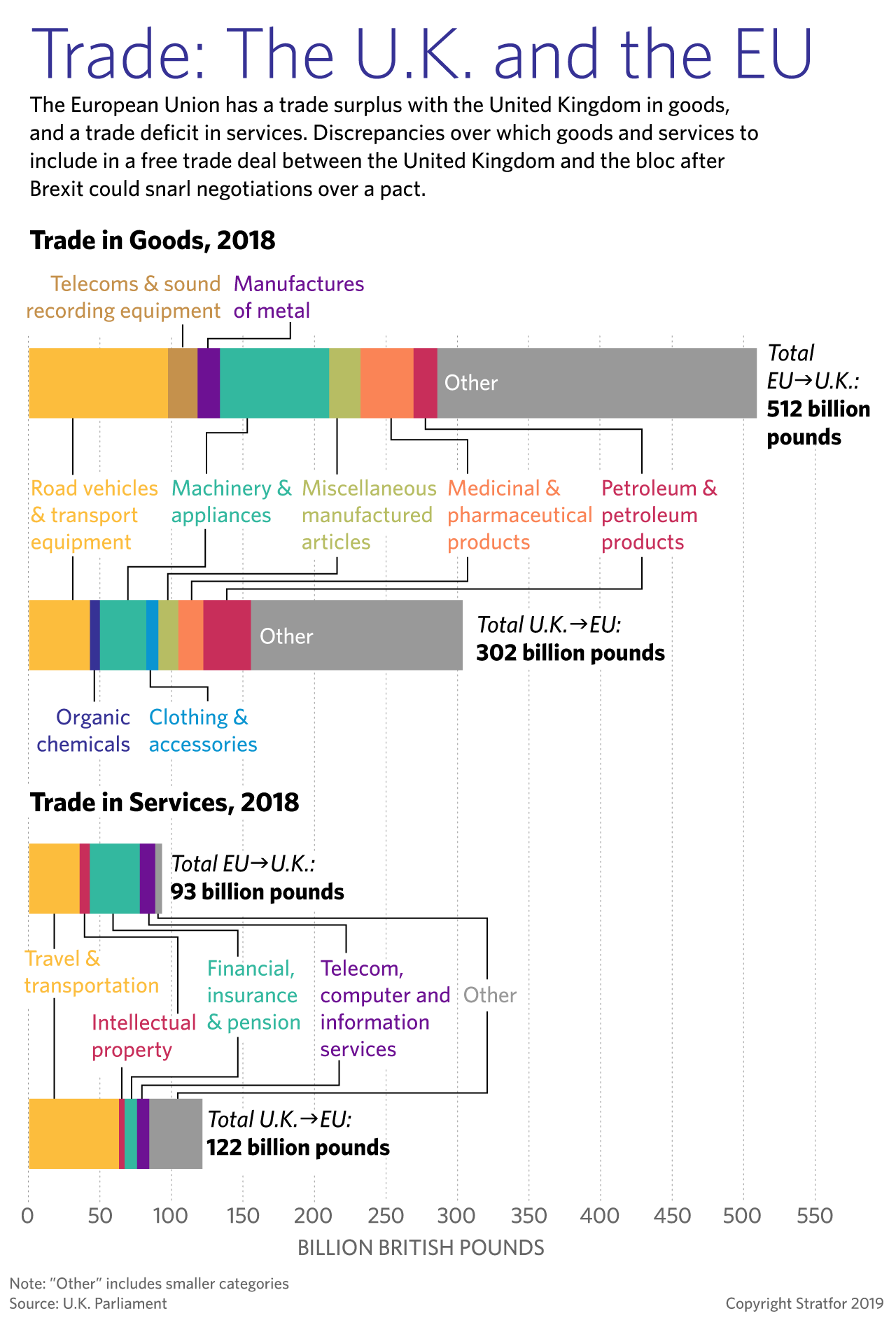
The first concerns the content of the agreement. Given that it enjoys a bilateral trade surplus on goods that it wishes to preserve, the European Union will accept a comprehensive deal covering a vast list of goods. Brussels, however, will demand that the United Kingdom remain aligned with the single market's rules and norms for goods — something that will run up against London's pledge to diverge from European standards to become more competitive. The bloc is also likely to demand access to British fishing areas for its members, but London will be reluctant to concede on such a point.
The pair, meanwhile, will find if more difficult to negotiate a free trade deal on services, as the United Kingdom is far more competitive in that area than the rest of the European Union. EU officials have said Brussels will consider granting "equivalence rights" to some areas of the United Kingdom's financial services sector, allowing British companies to sell their products in the European Union. But, as with goods, Brussels will demand that London continues to uphold Europe's financial rules. What's more, there is another problem with equivalence rights: The European Commission has to renew them every year, but London will probably demand a longer-term deal to reduce uncertainty in its financial sector. While the pair could compromise on a longer duration for the equivalence agreement, Brussels would likely reject a permanent deal, as it will want to retain the power to withdraw London's rights if the British government abandons EU regulations.
Because of these issues, the second obstacle for a free trade agreement would be time, as such deals take years to negotiate. Even in the case of the United Kingdom, which already complies with the bloc's regulations and norms as an existing EU member (which should make negotiations easier with Brussels than with others), the 11-month time frame envisioned in the transitional period seems overly ambitious. If the two fail to reach a free trade agreement by the end of 2020 and do not extend the period, they will have to trade using World Trade Organization tariffs starting in 2021. Johnson has said he will not ask for an extension of the transitional period, but he may have to abandon that promise at some point next year to ensure that London and Brussels have enough time to reach a deal. Ultimately, that means the United Kingdom may remain in the EU single market beyond 2020.
The United Kingdom's imminent general election will be crucial for the future of Brexit, as the government that emerges from it could take radically different directions, from approving the existing deal to trying to negotiate a new one that would then go to a referendum. A no-deal Brexit next month doesn't seem to be on the cards, given that the Conservatives want to approve the existing deal while Labour wants to reach a new one. Nevertheless, Brexit-related uncertainty will continue in 2020, as a Conservative-led government would struggle to reach a free trade agreement with the European Union before a year-end deadline, while a Labour-led government would likely send the country back to the beginning of the saga that started in 2016 — that is, by organizing a referendum, once more, on Brexit.
