
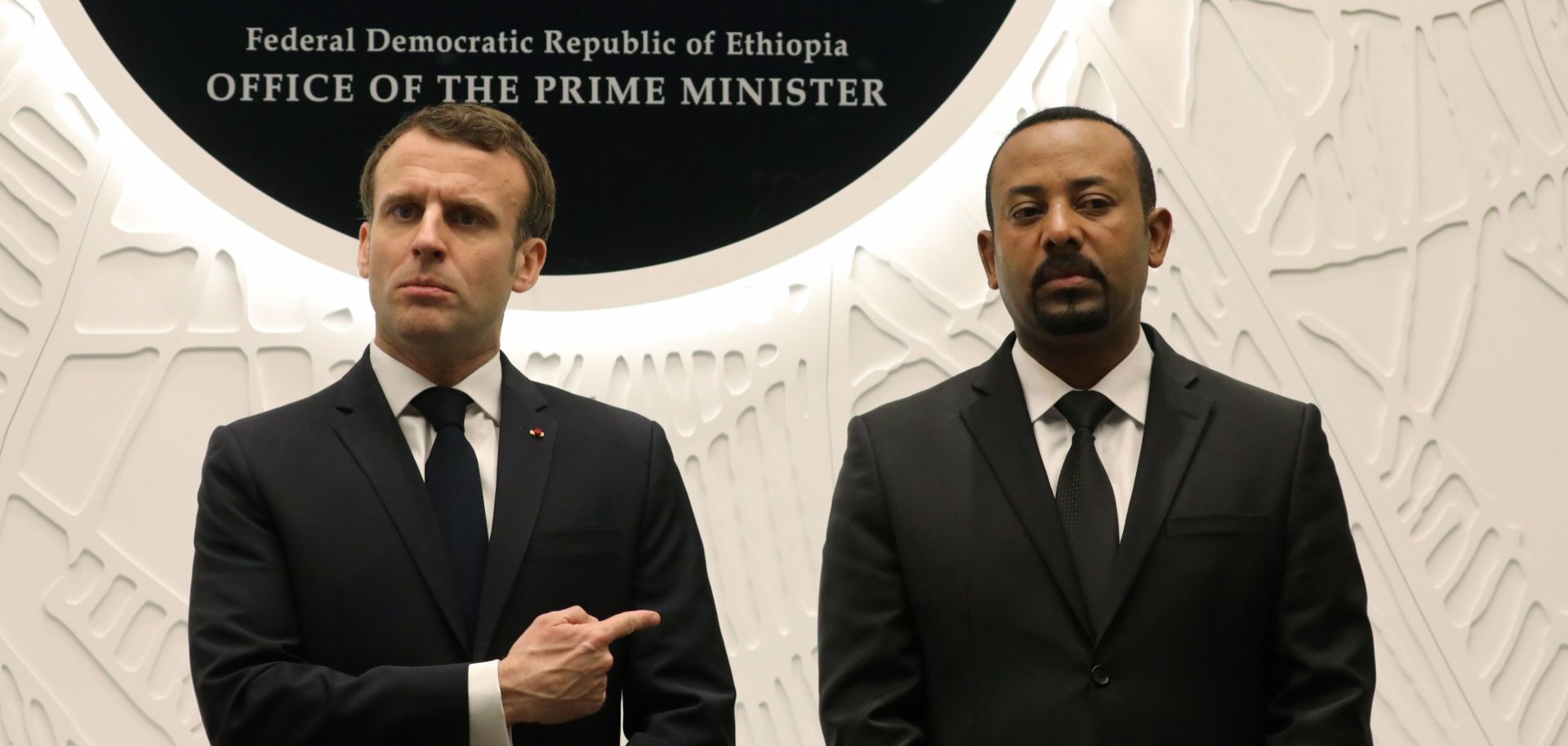
Ethiopian Prime Minister Abiy Ahmed (R) speaks with French President Emmanuel Macron after signing agreements during a meeting on March 12, 2019, in Addis Ababa. As Ethiopia opens up its economy, French companies stand to make big gains.
Editor's Note: This assessment is part of a series of analyses supporting Stratfor's 2020 Annual Forecast. These assessments are designed to provide more context and in-depth analysis on key developments over the next quarter and throughout the year.
The Horn of Africa, with its booming economies and critical location that abuts key international shipping lanes, has long attracted outside interest — as well as interminable conflicts. Yet as regional heavyweight Ethiopia opens its economy after decades of closed, state-centric development, new outside players are even more eager to do business there. Among that group is France, which is actively positioning its flagship companies to win big in the country in the years ahead. And luckily for Paris, Addis Ababa's long aversion to overdependence on any single outside power will boost French businesses as they seek to make inroads in a massive market of 110 million people.
The (New) French Connection
France, of course, is not the only outside power that harbors ambitions in Ethiopia and the rest of East Africa. Spurred by the war in Yemen, competition with Iran (and among themselves) and the pursuit of supply-chain connectivity, states in the Gulf Cooperation Council, especially the United Arab Emirates and Saudi Arabia, have showered the region with cash in recent years. But because many of these Gulf economies are so overly reliant on natural resources, they boast few companies that can lead the way in other commercial sectors of interest to target countries.
France, on the other hand, is not only well aware of Ethiopia's emerging commercial opportunities, but it is also poised to exploit them thanks to its many competitive companies. Since Ethiopian Prime Minister Abiy Ahmed's rise to power in April 2018, the ties between Paris and Addis Ababa have grown to an all-time high. For Ethiopia, this budding relationship goes deeper than commerce, as it dovetails with its desire to diversify its political and economic relationships beyond a reliance on China for infrastructure, the Gulf and Turkey for investment, and the United States for security. Indeed, for centuries, Ethiopia's leaders have fought to avoid falling into another power's sphere of influence — even during Europe's near-total colonial dominance of Africa in the 19th and 20th centuries. This geopolitical imperative has compelled Addis Ababa to seek multiple foreign actors to keep its options open, helping secure its survival and provide it with more resources amid the competition.
These circumstances are where a middle power like France can take advantage. President Emmanuel Macron has aggressively promoted French business abroad, particularly in new markets. In the past, for instance, France had little presence in Africa's non-Francophone countries, even powerhouses like Nigeria and Ethiopia. But with the erosion of French dominance in its former colonies and the rise of opportunities elsewhere, Paris is looking to drum up business in countries like Ethiopia that fall outside its traditional sphere of influence.
This year alone, France has volunteered to fund and oversee restoration work on Lalibela's Church of Saint George, one of Ethiopia's oldest and most sacred sites. In addition to this display of soft power, Paris struck an ambitious defense cooperation agreement with Addis Ababa in March to develop a future Ethiopian navy. The deal with a country that hasn't had a seacoast since Eritrea won its independence three decades ago certainly raised some eyebrows. But it does illustrate Ethiopia's confidence in its future economic strength (and the need to protect its maritime trade routes) and shows that France's defense industry sees lucrative contracts in the making — even if an Ethiopian navy is many years, if not decades, away. In a sign of the project's progress, Ethiopian media reported Dec. 2 that government sources had said the future navy would be based in Djibouti. That would make sense given their tight economic ties (Ethiopia is almost entirely reliant upon the port of Djibouti for imports and exports). In addition, Djibouti already hosts numerous foreign military bases, including a large one belonging to France, which would make it easier for Ethiopia and France to coordinate on developing the navy.
Also, early last month, French media revealed that Abiy asked in July for billions of dollars in heavy arms and other military equipment from France. Fulfilling his request could provide a huge boon for France's defense industry, which has made few sales to Ethiopia, a traditional arms customer of the Soviet Union or Russia, and has struggled in competitions for big-ticket sales in the past few years. Indeed, by jumping in early, France could hit a windfall as it seeks to bolster its national arms industry.
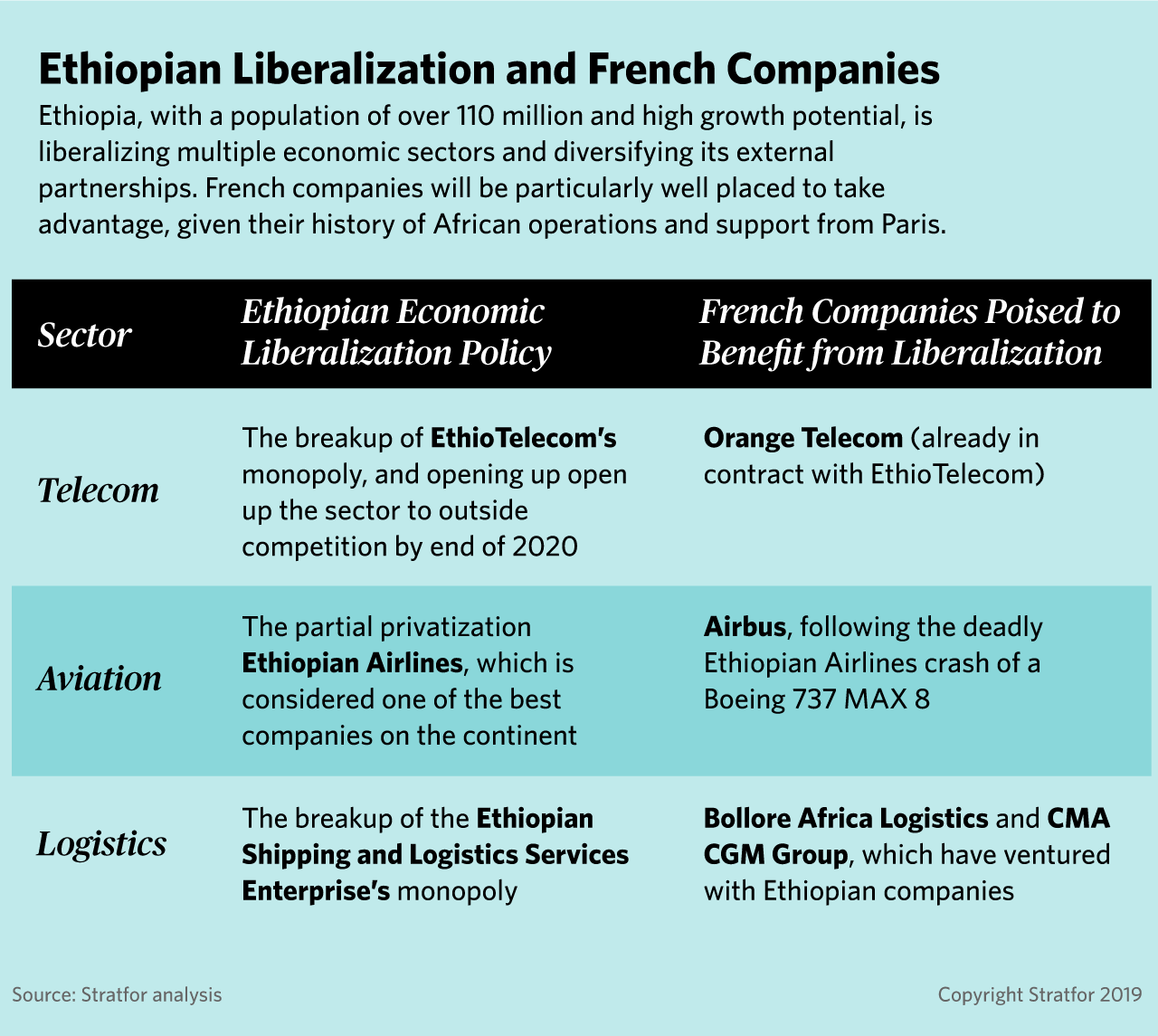
Beyond the security dimension, France wishes to capitalize on numerous commercial opportunities as Ethiopia's economic liberalization campaign moves forward. As the European market grapples with economic stagnation, East Africa — and especially Ethiopia — are growing at a rapid pace amid openings in previously closed sectors. Ethiopia, for example, will soon end EthioTelecom's telecommunications sector monopoly, prompting French firm Orange — which is already present in numerous countries in Africa — and others to angle for one of two international telecom licenses that Addis Ababa has promised to tender in 2020. For the likes of Orange, to put it bluntly, such an opportunity might come only once a generation.
Other promising areas include the automotive sector, which French firms Peugeot and Opel (a German subsidiary of a French conglomerate) will no doubt seek to exploit. Reports indicate that French automakers are actively working to set up assembly plants in Ethiopia. Besides the favorable terms that Ethiopia's government — which is desperate for private sector growth and jobs — will no doubt give, the country and broader region's economic futures are promising, growth that will allow members of the growing middle class to purchase more vehicles in the coming years. Relatedly, Ethiopia's aviation sector, too, is set to soar in the years ahead as its flagship carrier, Ethiopian Airlines, adds routes across Africa and the world. Following the deadly crash of Ethiopian Airlines Flight 302 in March and the controversy that subsequently engulfed Boeing's 737 MAX 8 aircraft, France has championed Airbus as an alternative for Ethiopian Airlines (and, by extension, the government which owns it), which currently splits its purchases between the two major airplane manufacturers.
An Electoral Hurdle
French companies may be right to feel confident about their prospects in Ethiopia. However, the African giant will have to first get through its general elections, slated for May 2020 in one piece. If deadly inter-ethnic violence continues or even escalates ahead of the polls, the country's ability to stay united will be put to the test. Indeed, just as Ethiopia has sought diverse relationships to protect its independence for centuries, its regular struggles to maintain internal cohesion have periodically forced it to redirect its focus inward at key moments in its history.
Should Ethiopia emerge unscathed from its election and strengthen its internal cohesion, its next leaders — regardless of who wins — will have no choice but to move forward with economic liberalization and reforms. This is because the country can only solve its serious economic problems, including unemployment and a foreign exchange crunch, by strengthening the private sector as the new engine of the economy. And if the government falters in this push, it would likely encounter pressure from broad swaths of the population, which already proved between 2016 and 2018 that they were willing to fight for change in the form of greater political and economic freedoms.
This trajectory of liberalization will greatly boost Ethiopia's economic might in the next decade and beyond. Indeed, as the country increasingly flexes its economic and political muscles in line with its growing economy, it will have more resources and confidence to mold itself into an attractive regional commercial hub. And with foreign players waking up to these growing opportunities, few are as well poised as France to tap Ethiopia's profound potential.
