
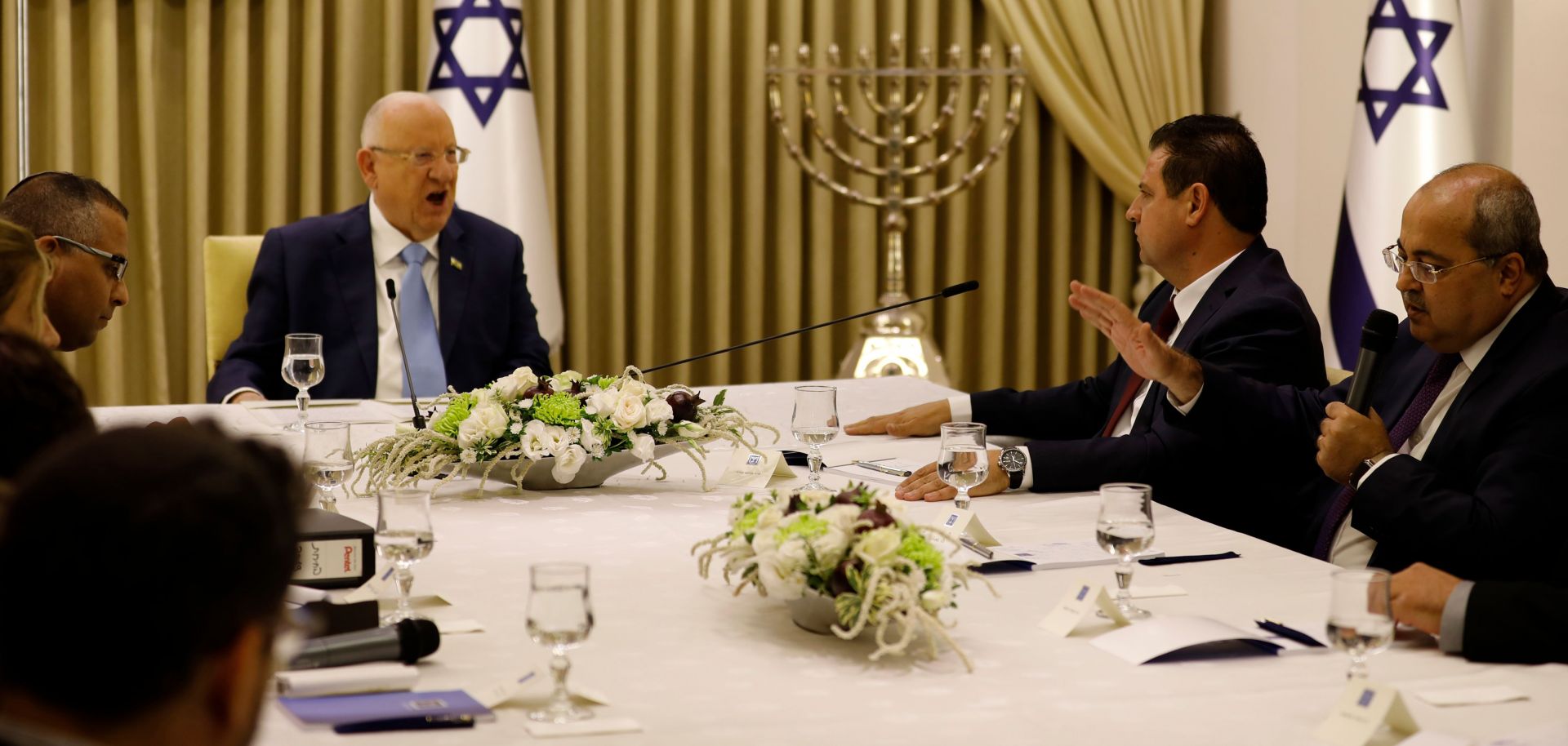
Israeli President Reuven Rivlin, shown here meeting with members of the Arab-dominated Joint List party in Jerusalem on Sept. 22, has handed current Prime Minister Benjamin Netanyahu the task of forming a coalition government after elections this month left a divided parliament.
Israeli President Reuven Rivlin has decided that sitting Prime Minister Benjamin Netanyahu should have the first crack at forming a new government after the Sept. 17 election left another split field. Israel's Basic Law, its form of a constitution, allows flexibility in how governments are formed, though a few rules keep the process predictable. However, the politics of that process are volatile, and for Israel to avoid a third election, Israel's politicians must make deep compromises.
If a unity government can be formed, it could create an odd alliance of parties in the opposition. Even though the Arab-dominated Joint List performed unexpectedly well on Sept. 17, its members could find themselves outside a unity government alongside right-wing nationalists and religious rivals like the New Right and United Torah Judaism — relegating those political fringes to the margins and anchoring the political establishment on a new center, which will define Israel’s strategic trajectory.
The old left that favored trading conquered land for peace treaties abroad and secular values at home has been deeply weakened over the past decade. The right wing now favors territorial expansion, especially into the West Bank, and the increased influence of the ultra-Orthodox in Israel’s national culture. But it has not yet proved that it can hold a government together long enough to push those priorities. The current political process, whether it results in a unity government or a third election, will help define just how much of Israel's strategy the right can control over the immediate future.
The Process
Now that Rivlin has made his choice, Netanyahu must find coalition partners who can fill at least 61 seats in the Knesset to establish a majority. Traditionally, this is done en bloc — that is, a party leader negotiates with other party leaders to bring into a coalition all the seats their party had won. That is not a formal rule, but a political tradition. Individual members of the Knesset can break ranks but rarely do so.
A presumed prime minister who cannot fill 61 seats faces two options: Go back to the president so another party can be given the chance to form a government, or dissolve the Knesset and hold another election. This leaves Netanyahu with 42 days to cobble together a majority.
The Necessary Compromises
To avoid a third election, Israel's political parties must make deep compromises. That's because Netanyahu's Likud party and its allies control about 55 seats; Benny Gantz's Blue and White party and its allies have 54. Between them sits Avigdor Lieberman and his Yisrael Beiteinu party's eight seats — enough to deny power to both Netanyahu and Gantz unless they join with Lieberman in his preferred unity government of Blue and White, Likud and Yisrael Beiteinu.
That makes a unity government of some kind the only viable option for a new Israeli government. But what can unify the parties?
Corruption. The parties must find a compromise on the looming issue of Netanyahu's trials on corruption charges. For now, Likud is demanding that the Knesset pass legislation shielding him from prosecution in some form. Many Israelis, especially in the Blue and White and Yisrael Beiteinu parties, find this proposition deeply unpalatable.
The Ultra-Orthodox. The parties must also decide what to do about the rising influence of the ultra-Orthodox and their religious parties. Secularists demand that the growing ultra-Orthodox population give up some of their special privileges, including their exemption from the military draft and their carve-outs for education. But to the ultra-Orthodox, these are matters of religious principle, and compromise is tantamount to apostasy. The parties can exclude the religious parties from a unity government, that would entail Likud abandoning some of its most loyal allies.
Personality politics. Netanyahu and Lieberman have a checkered personal history — and many in Gantz's alliance dislike Netanyahu but feel as if they can work with Likud. These issues require personal deals in back rooms to overcome. Sidelining Netanyahu is just one option.
These are major obstacles. If the parties cannot unify on these issues, the odds of a third election go up. The next few weeks will be telling as to how far the parties can go and how much they are willing to compromise.
