
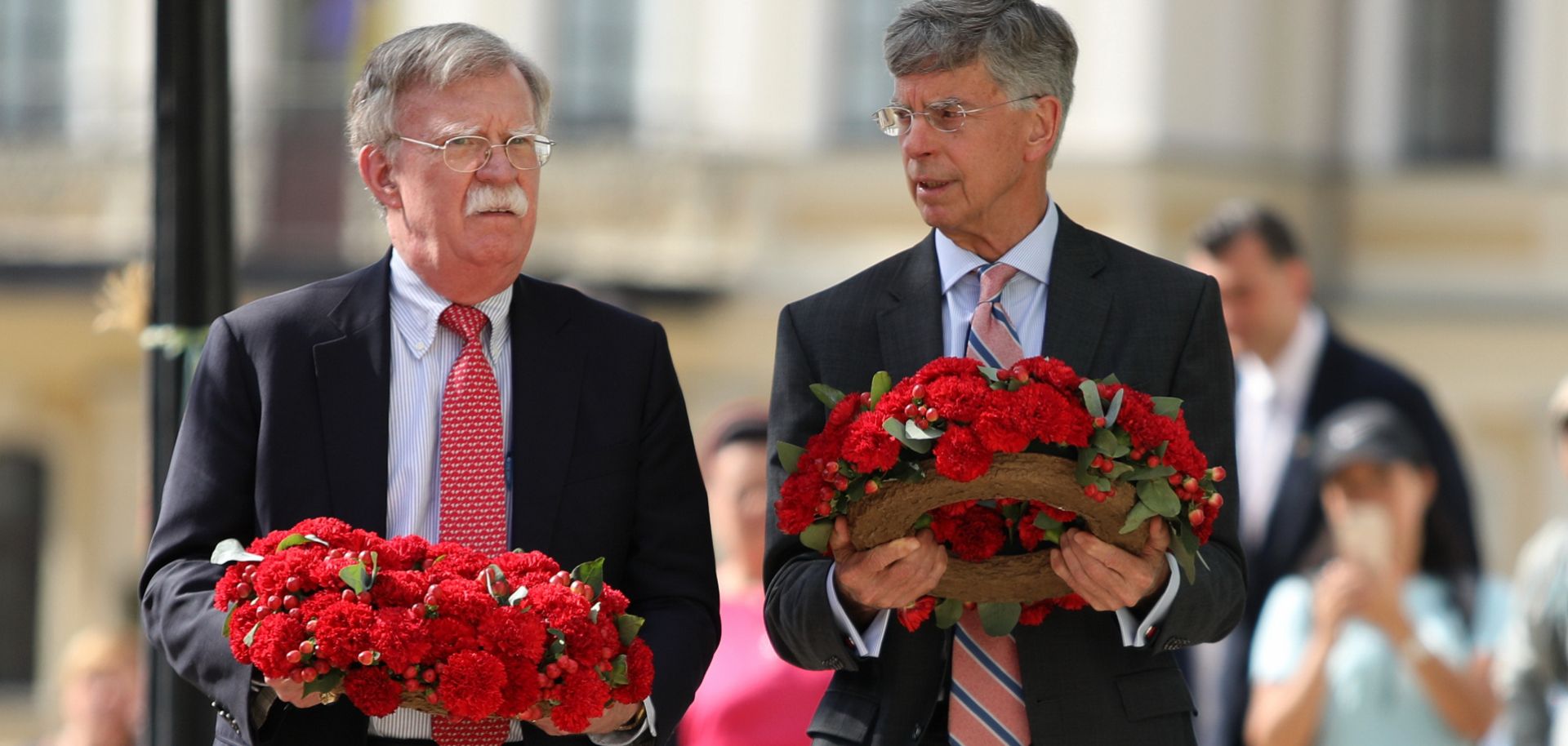
U.S. national security adviser John Bolton (L) and U.S. Ambassador to Ukraine William Taylor prepare to lay flowers commemorating Ukrainian soldiers who died in eastern Ukraine during a visit to Kyiv on Aug. 27, 2019. Bolton is hoping to woo Kyiv, Minsk and Chisinau during a trip to Eastern Europe.
In its great power battle with Russia, the United States is continuing to poke around the Eurasian giant's periphery. U.S. national security adviser John Bolton is visiting Ukraine on Aug. 27 as part of an effort to "underscore U.S. support for Ukraine's sovereignty, territorial integrity and Euro-Atlantic path," according to the U.S. Embassy in Kyiv. But that's not the only place Bolton — a key member of the U.S. security establishment and the presidential administration in challenging Russia — will head in an effort to increase American influence, with stops scheduled in Belarus and Moldova later in the week.
Why It Matters
Much lies beneath the timing of Bolton's visit to Ukraine, Belarus and Moldova. For instance, Bolton's stop in Ukraine, where the United States has provided significant security and financial support to Kyiv in its ongoing conflict with Russia-backed separatists in Donbas, comes ahead of next month's Normandy Four summit, which brings together Ukraine, Russia, Germany and France in an attempt to revive stalled negotiations over the conflict. Ending the fight in eastern Ukraine is one of Ukrainian President Volodymyr Zelenskiy's top priorities, but he has faced challenges early in his term, including the announcement by Russia that it will grant passports to residents of the disputed area. Bolton's meetings in Kyiv, accordingly, could set the ball rolling on efforts to oppose Russia's strategy to undermine the Ukrainian state.
Meanwhile, if Bolton's planned trip to Minsk indeed comes to fruition, it would mark the highest-ranking U.S. visit to Belarus in the past two decades. While Belarus remains firmly within Russia's orbit, the countries' recent spats over oil supplies may have created an opening for the United States to attempt to expand economic and energy ties there. In terms of security, the United States is likely to formalize plans to expand its military presence in Poland during U.S. President Donald Trump's visit to Warsaw on Sept. 1 — a development that could spark a Russian military buildup in next-door Belarus. Given this, all eyes will be on Bolton to see if he makes any security overtures to Poland while in the region or offers any direct measures to placate Belarus' own security concerns. Such overtures on Russia's periphery have irked Moscow in the past; during a tour of the Caucasus last year, Bolton broached the idea of weapons sales to Armenia. Washington and Yerevan have yet to conduct any arms deals, but that doesn't mean the Kremlin did not view the offer as provocative.
Finally, Bolton will visit Moldova shortly after pro-European and pro-Russian parties reached a power-sharing deal in the country, a battleground for influence between the West and the Kremlin. The governing coalition, however, is unstable, as the parties only agreed to share power to sideline a common enemy, the Democratic Party, led by oligarch Vlad Plahotniuc. Accordingly, the coalition partners differ profoundly over foreign policy, with the Socialists favoring integration with Russia and the ACUM bloc preferring Western integration. Thus, any support from Bolton to bolster or preserve the Western orientation of the government will be key to watch.
Background
Bolton's visit comes just weeks after the United States formally withdrew from the Intermediate-Range Nuclear Forces (INF) Treaty. He has been a staunch advocate of withdrawing from or revising arms control treaties with Russia, while also favoring stronger sanctions against Moscow — two drives that Washington has pursued with gusto under Bolton's tenure as national security adviser.
