
A woman crosses a street in Moscow, Russia.
Demographics will play an outsized role in shaping Russia's economic and military future, with the number of people it has determining everything from the size of its labor force to its tax base to its armed forces. Moscow's long struggle with low birth rates and high mortality rates is well known. Less well known is the impact of immigration and emigration on Russian demographics.
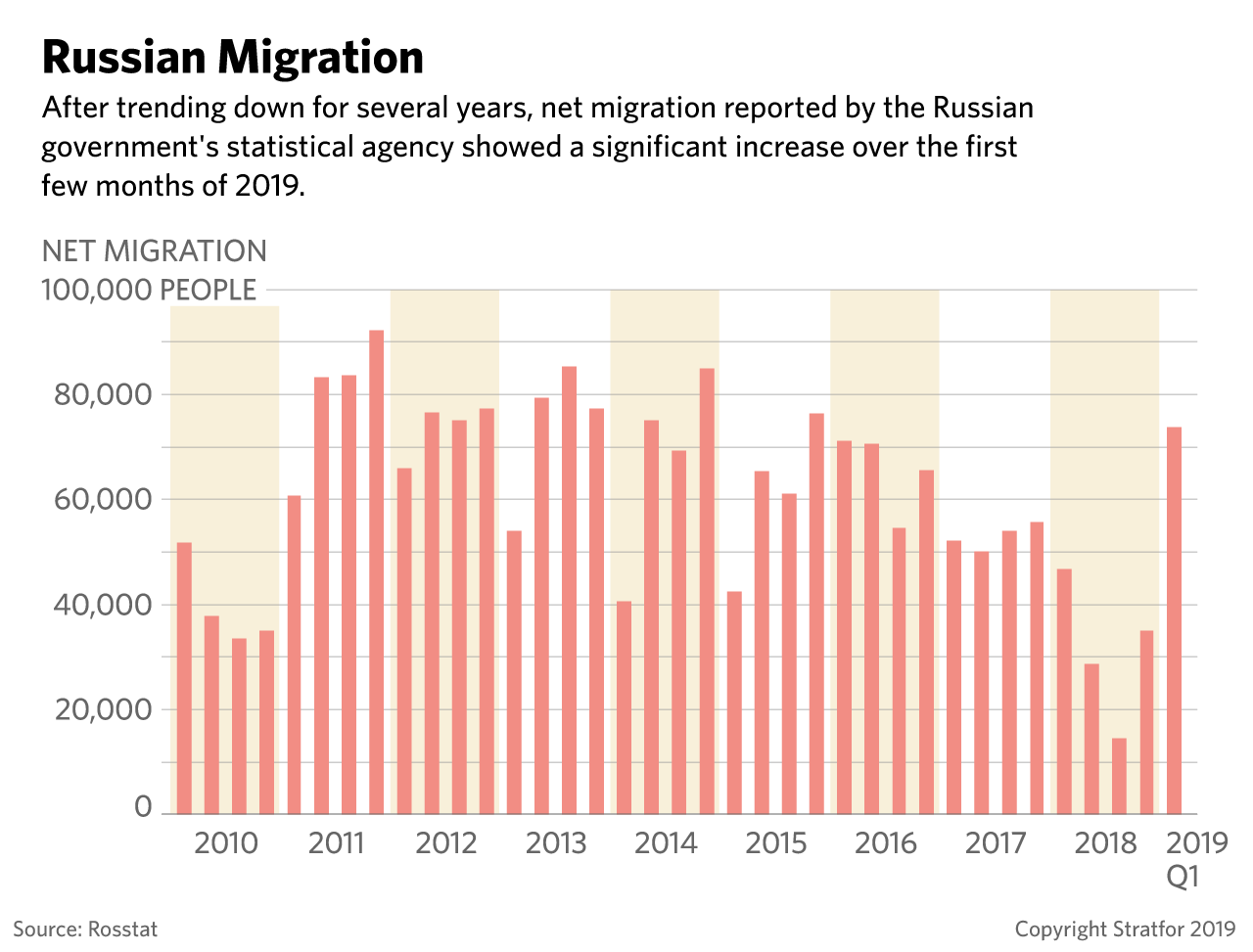
Over the five years leading up to and including 2018, migration numbers, too, trended in an ominous direction for Russia's demographic future. But now, early data for the first four months of 2019 has brought better news for Moscow. According to a study produced by experts at the Russian Presidential Academy of National Economy and Public Administration, migration from January through April in 2019 showed anomalously high immigration to Russia. For the same period, the Russian Federal State Statistics Service (Rosstat) reported 218,600 immigrants entering Russia, up from 177,300 over the same period in 2018. Given that emigration from Russia was largely the same for both periods, that means 98,000 more people entered Russia than left in the first four months of 2019. And since total immigration for all of 2018 was 124,700, 2019 could see a significant increase from 2018 in immigration to Russia if the trend holds. This is bolstered by the fact that significantly lower levels of immigration are generally reported during the first quarter in Russia than over the rest of the year, so if seasonal trends hold, the rest of the year should see an even greater inflow of migrants than did the first four months.
Trend, Blip or Bad Numbers?
While it is too early to rule this the start of a more permanent trend, even a temporary shift from the trend of stagnant immigration coupled with growing emigration would be significant. Nothing, however, guarantees that immigration will continue — or even ever was — on this trajectory. The Russian Presidential Academy of National Economy and Public Administration has suggested that the increase in immigration relative to emigration in the first four months of 2019 might merely have resulted from underreporting of immigration, or a new methodology for counting migration. Forecasts about migration are, of course, only as good as the numbers they are based on, and the most complete numbers on Russian migration come from Rosstat itself, whose reliability has been questioned before.
But even if the numbers for the first four months of 2019 are accurate and reflect the start of a trend, it would do little to alter the downward trajectory for Russian demographics in the coming decades. Regardless of whether the current uptick in immigration is maintained over the year or even the next several years, Russia's population will still decline overall, and its economy will still suffer. While at least the decline would not be as serious as the 2018 data had suggested it would, the country would still face critical shortages of human capital.
Low vs. High Skills
Most immigrants to Russia during the first four months of the year reportedly came from Armenia and Ukraine, both former Soviet republics that are among Moscow's top sources of migrant labor due to shared cultural traditions. In a bid to attract 5 million to 10 million immigrants over the next six years, Moscow has tried to drum up interest in attracting immigrants from those countries and others that share similar characteristics. It has streamlined its immigration procedures to make the process more appealing. Immigration from Ukraine and Armenia had dropped somewhat since the 2015 economic downturn in Russia. Now, even though the Russian economy still struggles, the 2019 numbers suggest that increasingly positive perceptions of available opportunities in Russia are attracting more immigrants.
Of course, the number of immigrants versus emigrants alone does not determine what migration means for the Russian economy. While Russia may be attracting more immigrants, the people moving there generally have limited education and skills and are destined for sectors like the service industry or construction. Russian emigrants, by contrast, generally are more highly educated, and are drawn abroad by better career opportunities. So even if Russia attracted enough immigrants to offset emigration, losing its youngest and brightest citizens would still reduce its ability to achieve technological breakthroughs. But while Russia cannot escape its negative demographic trends, if the positive early figures for 2019 are sustained, it can at least reduce the damage.
