
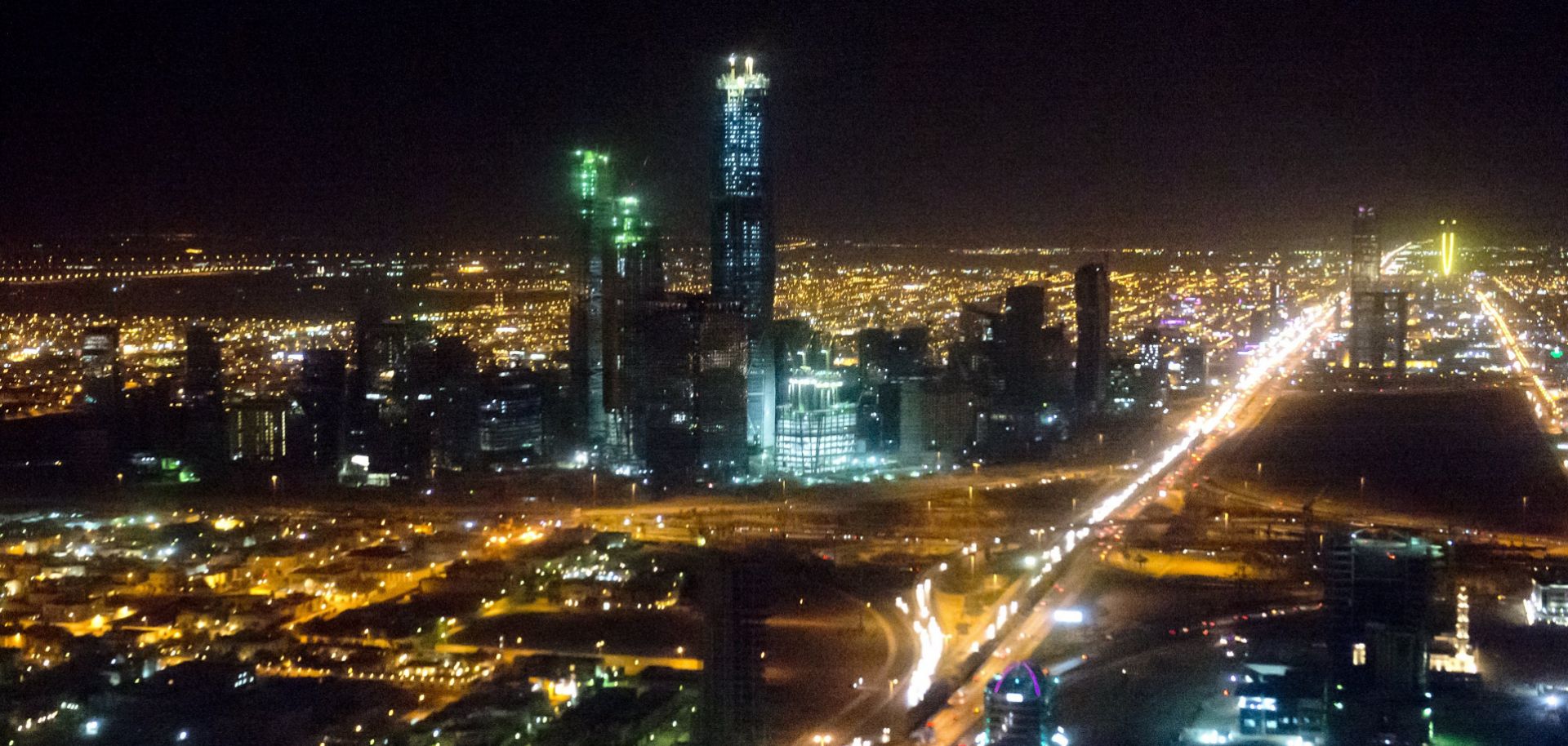
The skyline of Riyadh, Saudi Arabia, March 28, 2014, is seen at night in this aerial photograph from a helicopter.
Saudi Arabia's economic transformation has made big promises to its people. But for many Saudis, the dream of a middle-class lifestyle is becoming increasingly elusive. As their disappointments add up, the social contract between the Saudi rulers and citizens becomes more frayed. A growing popular dissatisfaction is driving Saudi policymakers to look for ways to increase opportunities for their people. But the process of doing so risks politicizing the kingdom's development strategies and fundamentally changing the way Saudi Arabia does business.
As their country moves away from its economic model based largely on hydrocarbon production, Saudis hungry for economic and social opportunity find themselves drawn to the kingdom's central cities. But even those Saudis who get the education necessary to compete for better jobs and take lifestyle risks in pursuit of a slice of the new Saudi dream by moving to the big cities don't always find success. That has only sharpened the division between the haves in Saudi Arabia's core regions and the have nots in its outlying provinces. But even within the economically more vibrant big cities, Saudis are discovering a financially frustrating life ahead of them.
The Central Cities: Power, Influence and Opportunity
The most prominent Saudi cities — the capital, Riyadh; the holy cities of Mecca and Medina; the cosmopolitan Jeddah; and the oil center, Dammam — have exerted an outsized influence on the kingdom's economic output, social life and politics since its foundation in 1932. That helps explain why Saudi society today is so highly urbanized: More than three in four Saudis live in cities, with almost half the population in cities of 1 million or more.
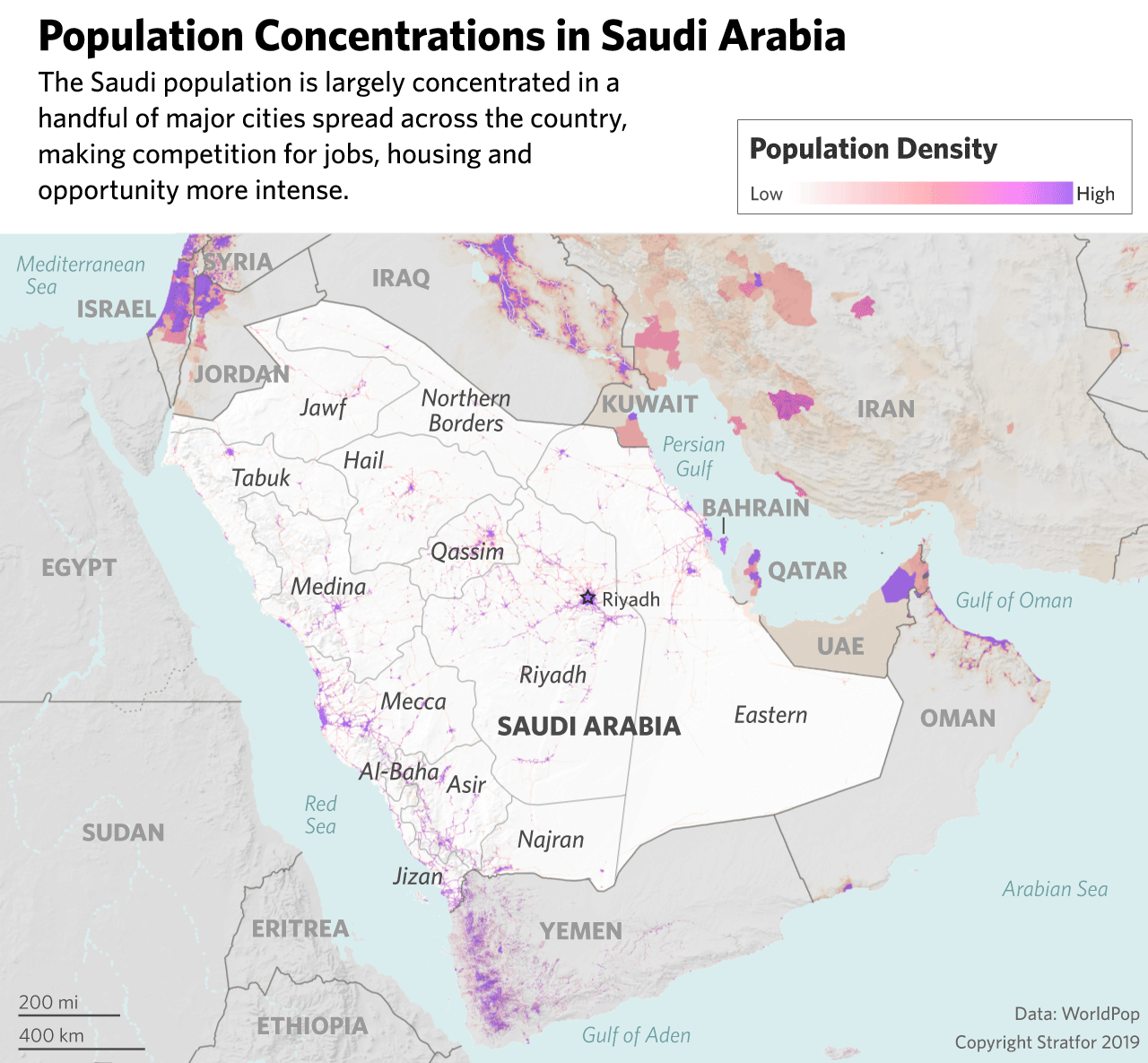
This was a product of the kingdom's political and economic system. Riyadh's growth relied on its close connection to the royal family and the ministries and various offices that carried out royal directives. Mecca and Medina's holy status attracted growth in the form of pilgrims and universities; Jeddah benefited by being near to those cities and to the sea. For Dammam, it was its status as the biggest city in the oil-rich Eastern Province.
Saudi Arabia's urban-heavy demographic has created a split in housing and employment opportunities between city dwellers and those in less-developed provinces. In those outlying regions, which long have lacked the attention from the royal family necessary to bring internal investment, it is a problem that compounds itself. As people from the farther-flung regions move to cities to find the jobs they can't find at home, the places they leave behind fade even more.
For example, Al-Baha province in Saudi Arabia's highlands lost more than 31,000 people, 5 percent of its population, to net internal migration in 2017. Hail and Qassim provinces in the central part of the country each lost around 23,000 people that year (a little more than 4 percent of Hail's population and almost 2 percent of Qassim's). Such losses make sense: Unemployment rates in all three regions topped the national average of 12.7 percent, as measured in the fourth quarter of 2018. And this trend is only likely to continue.
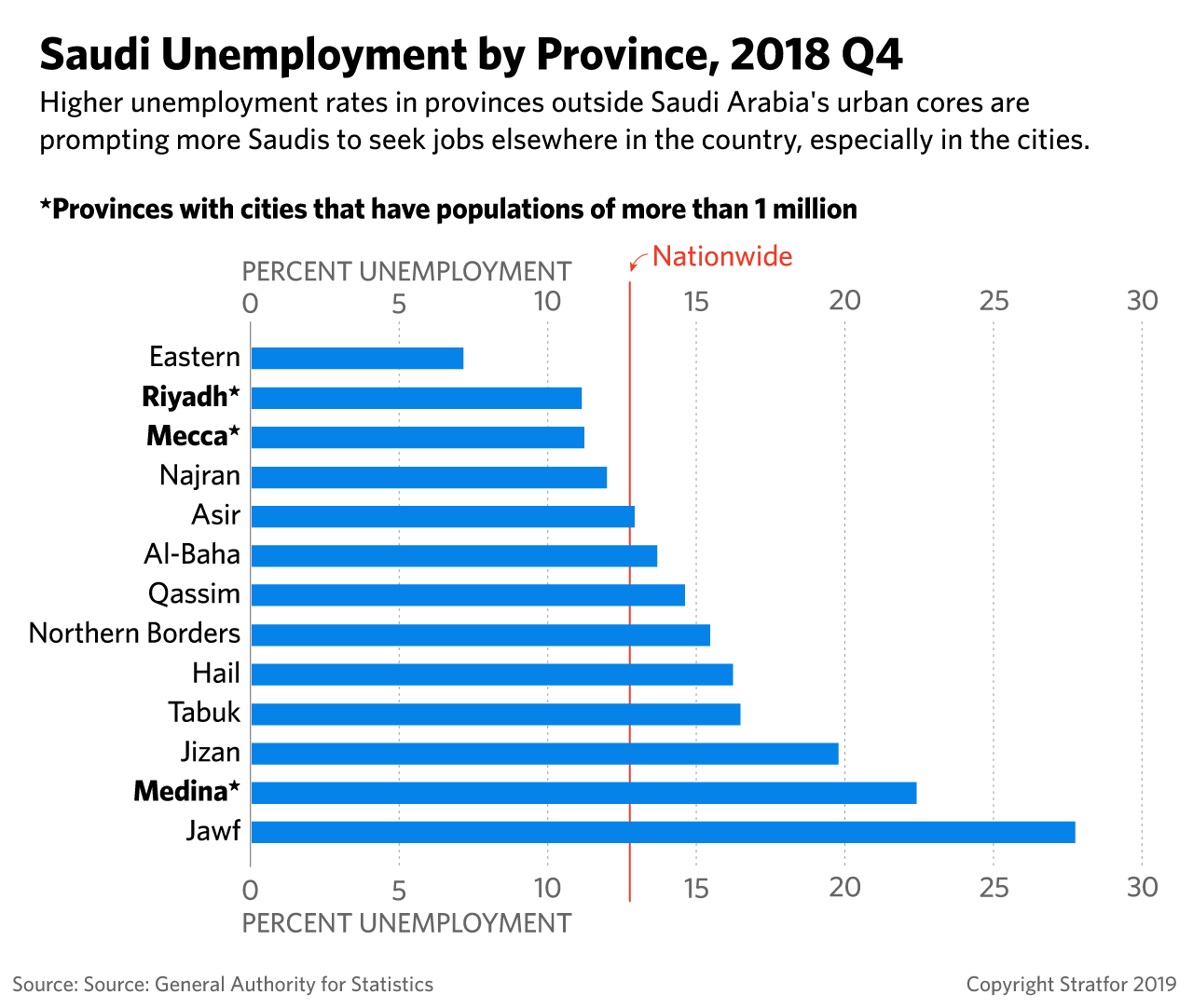
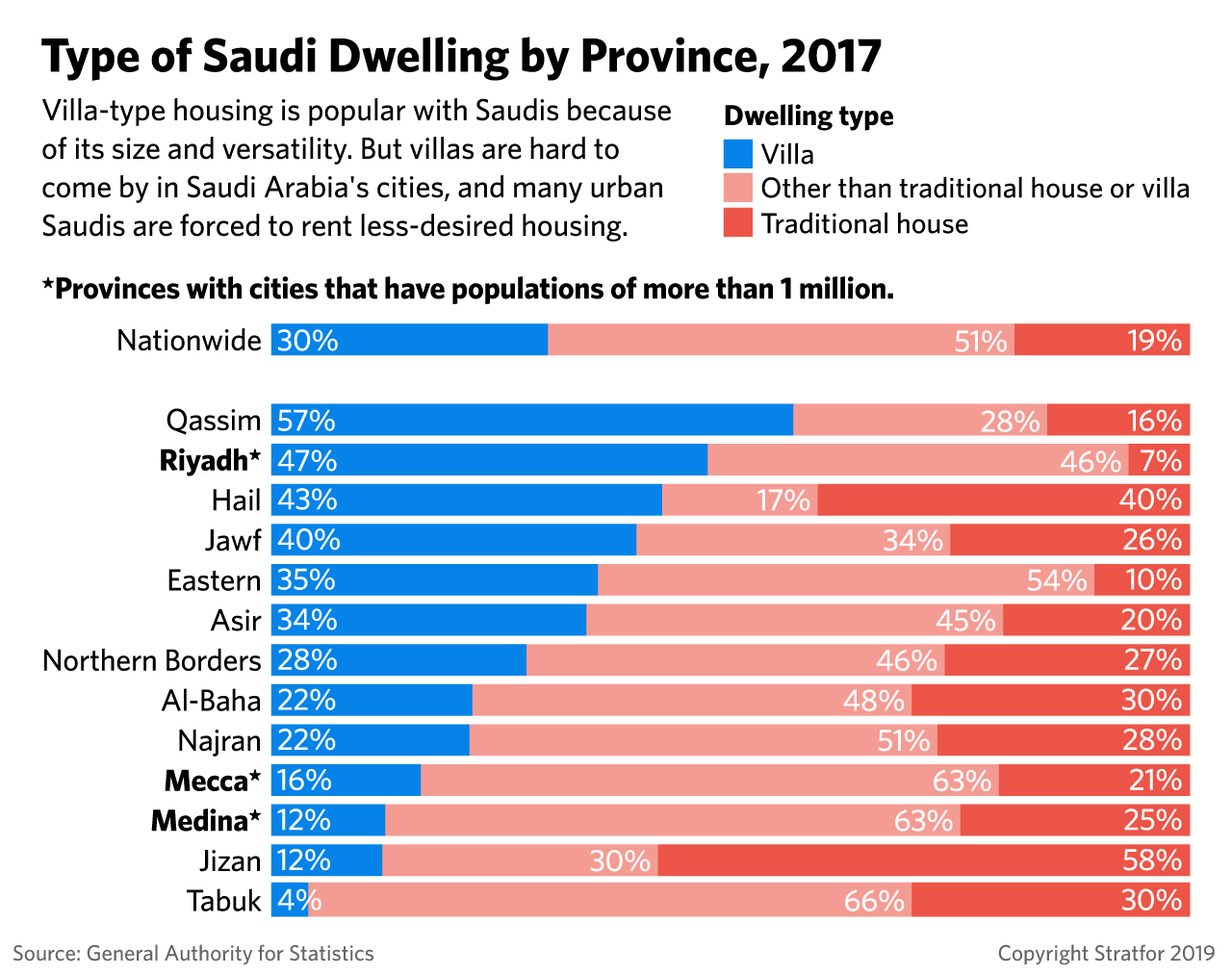
That migration pattern is emblematic of the lack of opportunity within these outlying provinces — many of which struggle to provide not only sufficient jobs but also high-quality housing. The more rural provinces generally feature older, traditional-style dwellings, leaving their residents stuck with crumbling homes and little opportunity for improving them.
But the big cities don't necessarily offer a panacea. While urban unemployment rates are lower, not everyone who wants a high-quality job can find it. Compounding the issue, there is not enough top-tier housing to fill demand, especially the much-desired modern villas that are the cornerstone of Saudis' expectations for a primary dwelling. These shortfalls have frustrated many urban residents, especially those who invested money in relocation and education expenses. These issues force many urban Saudis into renting — 64 percent of the urban population live in apartments — making them vulnerable to market price swings and undercutting a sense of long-term stability.
What Happens to a Dream Deferred?
These ongoing patterns of Saudi migration — the abandonment of outlying regions and increasingly crowded cities — will only make the inequality issue more acute. Attempts put forth thus far by the monarchy to alleviate the social convulsions created by these uneven opportunities appear unlikely to address the core problems.
One such effort to offset the social and economic stresses of development, the Citizen Accounts program, offers direct cash payments to Saudi citizens. In urban areas, the program can help buffer higher costs of living, but it does not address the key issues of rising rents and housing shortages, nor can it ensure that labor markets saturated with workers holding higher degrees can provide the types of jobs they want. And in the outlying provinces, the payouts do not provide enough support for meaningful investment in community development, instead offering an income that simply offsets rising prices as subsidies for electricity and water dwindle.
Another initiative, the "Sakani" housing program, aims to enable 70 percent of Saudis to own homes by 2030. But the top-down administration of the program through the Housing Ministry leaves it susceptible to waste and mismanagement. The structure also increases risks that implementation will not always align with local needs: Distant, often unaccountable bureaucrats often impose requirements that don't solve the issues at hand. The program provides neither guarantees about the quality of housing to be provided nor whether it will be located in places Saudis actually want to work. In addition, there's no mechanism to ensure that people buying homes would be able to make payments in the long term — and that the government doesn't end up on the hook in the event of a future real estate downturn.
While the kingdom has set goals for improving the quality of life for Saudi citizens, they are ill-defined and difficult to measure. Accountability for meeting the goals falls to centralized officials who may not have a full understanding of local quality-of-life issues. This also makes outcomes susceptible to data manipulation by those same bureaucrats. Furthermore, similar state-directed quality-of-life programs instituted by smaller countries, like the United Arab Emirates and Qatar, have failed to show success. The scale of the effort in Saudi Arabia would be much larger, making requirements even more complex and success even more difficult to achieve.
How the Monarchy Could Adjust
As it tries to minimize unrest and control the narrative of change, the kingdom will get more creative in addressing quality-of-life issues — and restructure away from the top-down development process it has traditionally followed. Instead of simply imposing development goals and conditions, the monarchy will likely explore methods to secure buy-in from those affected by its policies. The kingdom already holds municipal elections, albeit for bodies with very limited power: It could allow these institutions to be built up to create more robust debate and discussion. This would provide forums for people to more openly vent their frustrations and offer policy guidance. The kingdom's currently toothless legislature, the Shura Council, could also be part of this process. Although it would unlikely be able to substantially affect policy in the near term, over time, the Shura Council could become a more open forum for debate and discussion in the mold of the Federal National Council, which plays a similar role in the United Arab Emirates.
Such political changes, while a far cry from democracy, would nevertheless fundamentally transform the way business is conducted in Saudi Arabia. Right now, contracts and investments are routinely funneled purely through a handful of top-level officials. This model would not work in a future Saudi Arabia attempting to defuse frustration stemming from the kingdom's social and economic inequalities by considering the concerns of everyday citizens more carefully. Changing that model, in turn, would change the way the kingdom courts businesses and investors, at times slowing the process and making certain projects more susceptible to local pushback.
As it stands today, there is nothing holding the monarchy back from courting investment abroad without much consideration for local concerns. But in the future, carte blanche for business as usual will not be guaranteed. Those sorts of changes are likely to become an increasing part of the Saudi development landscape. Continuing societal rifts would eventually force the monarchy to increase the weight it gives to its subjects' reactions to developmental projects. Along the way, this will alter the way that Riyadh interacts with the international business community.
