
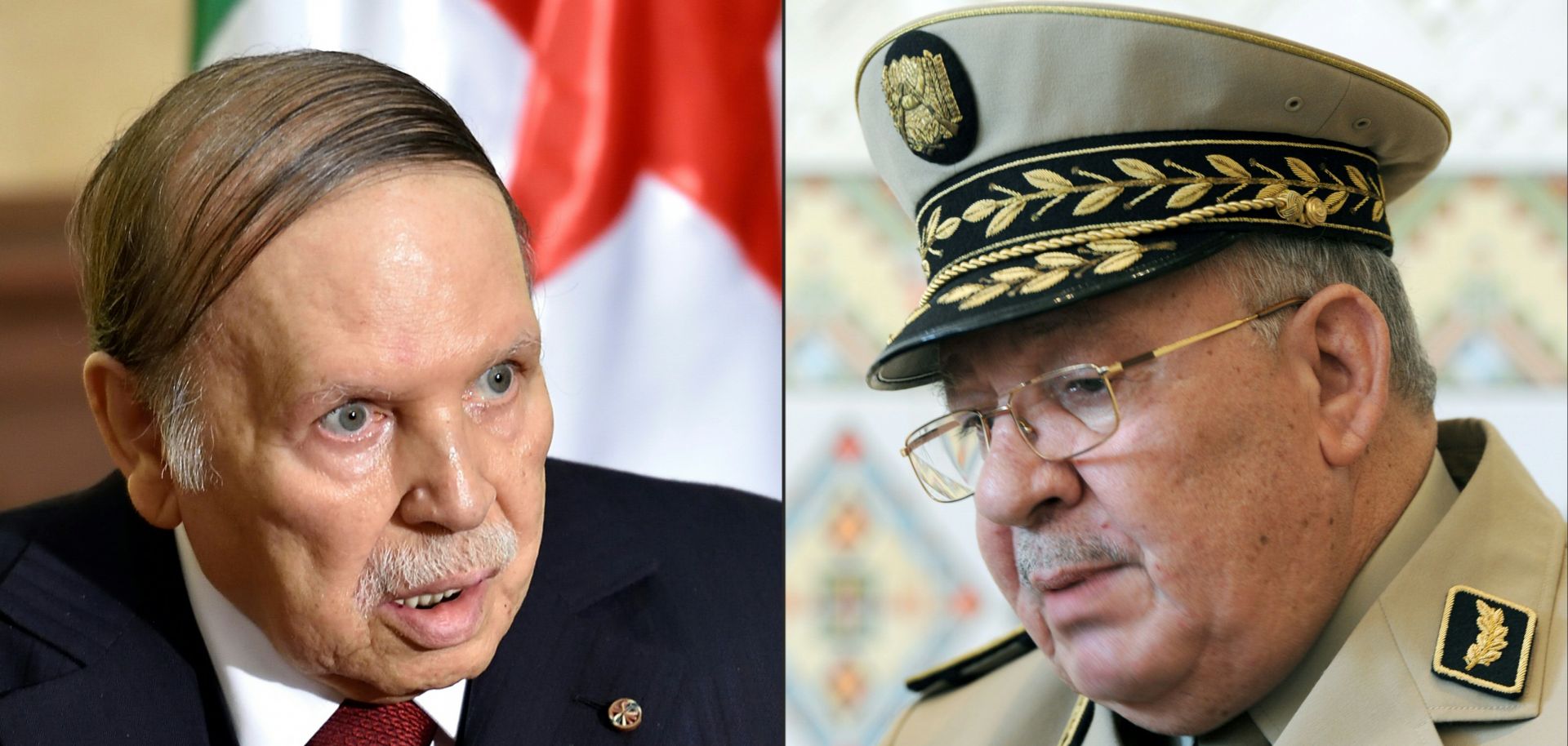
This combination image created on March 26 shows Algerian President Abdel Aziz Bouteflika (L) during an official visit to Zeralda, a suburb of the capital Algiers on April 10, 2016, and Algeria's Chief of Staff General Ahmed Gaid Salah at the Houari-Boumediene International Airport in Algiers, on May 20, 2014. Algeria's chief of staff called today for Bouteflika to be declared unfit to govern, following weeks of mass protests demanding the ailing leader step down.
What Happened
On March 26, Gen. Ahmed Gaid Salah, chief of staff of the Algerian People's National Army, called for the implementation of Article 102 of the constitution. This is the first step in the process to install an interim government should the president be deemed incapacitated.
What Happens Next
By invoking Article 102, the army chief is setting in motion a Constitutional Council review of ailing President Abdel Aziz Bouteflika's physical ability to govern. If the Constitutional Council meets, the reviewing body will have to make a recommendation to the Algerian parliament, and if the Constitutional Council determines that the president is incapacitated, both chambers of parliament must assemble to vote on subsequent steps. A two-thirds majority is required by law to remove the president.
If the Algerian parliament votes to remove Bouteflika, the president of the upper house or Senate, Abdelkader Bensalah, will become the interim president for 45 days. If the president is still incapacitated at the end of that period, the presidency will officially be rendered vacant. This interim period can continue for up to 90 days, but presidential elections must be organized, as Bensalah cannot legally inherit the presidency without a public vote.
Why It Matters
By throwing his weight behind Article 102, the army's chief of staff is directly appealing to key political stakeholders in Algeria, including powerful opposition parties, to abandon Bouteflika for their own political survival.
What We're Looking for Next
- Will the Constitutional Council agree to take up the issue? The Constitutional Council is chaired by Bouteflika loyalist Tayeb Belaiz, and four of its 12 members are appointed by the president. This is hardly the first time the council has been pressured to address the matter of Bouteflika's health, but popular demonstrations are straining the ruling government's ability to keep the peace. Because the call to implement Article 102 comes from a powerful political figure, what happens next will be a critical test of whether Algeria's political elite are on board with the removal of the president at this time.
- Is the army trying to move faster than the ruling party? The powerful Algerian army has a monopoly on force, but it is just one influential actor among many. Although Salah's call to action is a clear signal that the army wants to accelerate a political transition, it could also be a sign that the military wants to shake up the process in a way that can't easily be controlled by the president's loyal allies — specifically those with a vested interest in remaining in power.
- How will political opposition parties react? Major opposition parties are already upset about the army's call to implement Article 102 of the constitution, viewing the move as uncomfortably close to a military coup. This is a particularly controversial issue in Algeria, where the army is remembered for having forcibly challenged election results alongside the ruling government in 1992 — an action that tipped the country into a bloody civil war. For the sake of political survival, however, the parliament could respond favorably to a transition of power, especially given the current level of public discontent.
- Can the ruling party agree? The call to remove the president comes at a difficult time for the bureaucratic ruling National Liberation Front (FLN) party. The FLN is already split over how and when to move forward without Bouteflika, and the timing of the president's exit could exacerbate existing fault lines among the party's major factions.
- Will Bouteflika choose to step down? The president's legal term ends on April 26, which likely means demonstrations against the government will continue until then if no other action is taken. To circumvent protests, Bouteflika could choose to step down beforehand. Dissenting Algerians might well be satisfied by a constitutional ruling to remove Bouteflika — many protesters argue that the prolongation of his term is unconstitutional. Still, a voluntary step-down will only happen if Bouteflika's supporters agree on a replacement, and some protesters might view Article 102 as a means of accelerating the presidential elections and rendering a proposed national dialogue conference pointless. Potential choices for Algeria's next president include current Prime Minister Noureddine Bedoui and current Deputy Prime Minister Ramtane Lamamra.
