
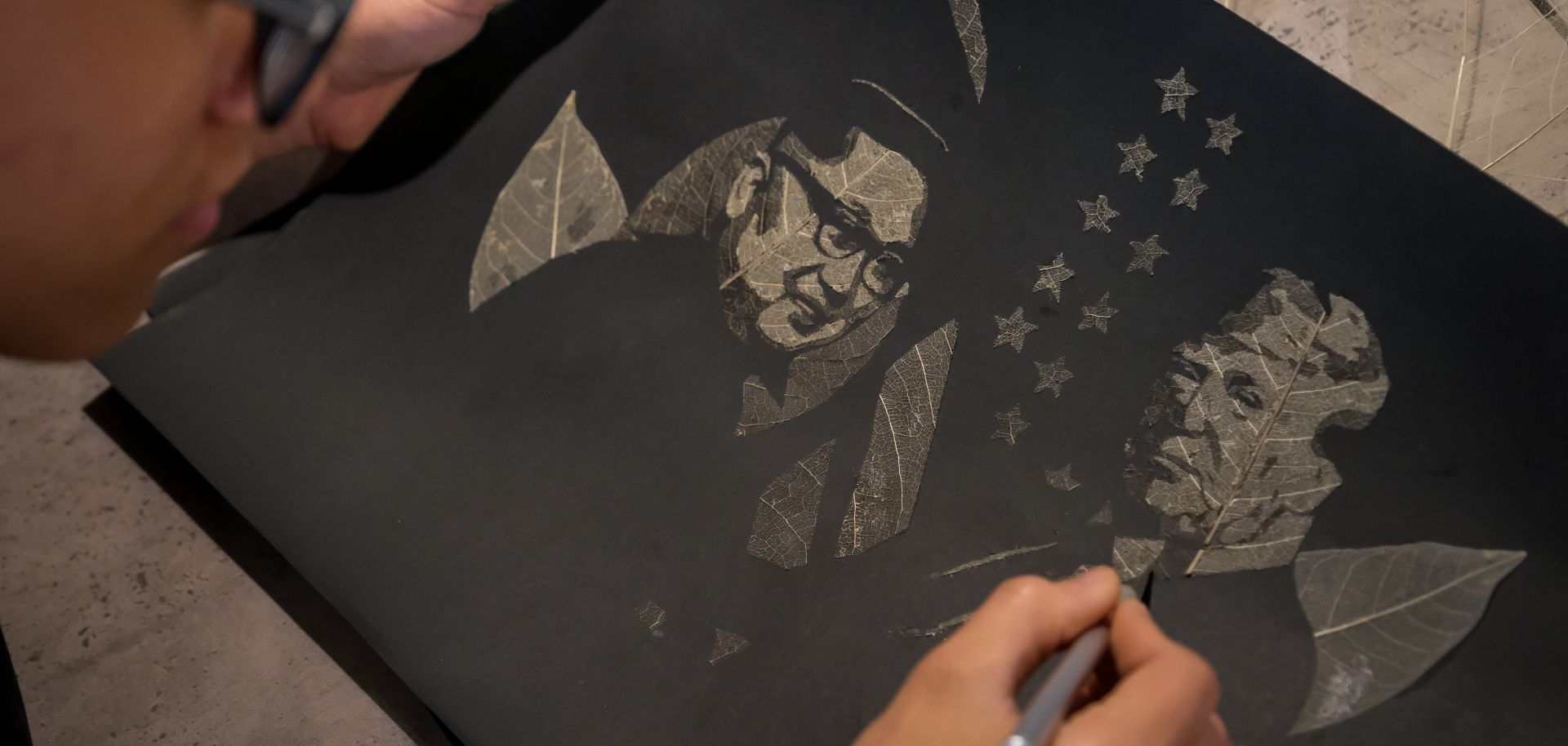
HANOI, VIETNAM - FEBRUARY 23: Nguyen Cong Toan, 22, cuts dried leafs to make portraits of U.S. President Donald Trump and North Korean leader Kim Jong-un in honor of the upcoming summit between Trump & Kim in Hanoi on February 23, 2019 in Hanoi, Vietnam. Toan & his friends just stated a new startup called hatolo focusing on local crafts. Nguyen Duc Loc, another member of the group, consider the summit as a very good marketing chance for Vietnam and he has been contacting U.S. Embassy to offer this dried leaf artwork to Donald Trump but he got no response yet. U.S. President Donald Trump and North Korean leader Kim Jong-un are scheduled to meet on 27-28 February in the Vietnamese capital, Hanoi, their second meeting since they first met in Singapore last June as experts reportedly suggests there could be discussions around the dismantling of DPRKÕs Yongbyon nuclear facility while working toward complete denuclearization at the Korean Peninsula. (Photo by Linh Pham/Getty Images)
With eight months of lackluster progress toward North Korean denuclearization since their first summit, U.S. President Donald Trump and North Korean leader Kim Jong Un will sit down in the Vietnamese capital of Hanoi this week. The summit begins with heightened pressure on the U.S. side to extract some sort of tangible progress from North Korea and to lay out a sustainable road map for their future relationship. This means adopting a more humble view of what concessions would be acceptable to it and a focus on managing the North Korean threat to the U.S. mainland — not an all-or-nothing push for denuclearization. And, above all, having spent years developing its nuclear and missile programs as well as substantial economic resources, North Korea will not give up its nuclear deterrent easily or cheaply — and will certainly not risk moving quickly on measures to do so. Instead, the United States and North Korea are focused on a compromise that keeps their outreach in motion while easing the threat this nuclear deterrent poses to the United States.
What to Watch for
Given the high-level nature of the summit and the broad discretion of both leaders in conducting foreign affairs, expect the unexpected — and expect heavy symbolism. But there are several options on the table, some of which could come to fruition later with more strings attached:
Korean War Peace Declaration
A highly symbolic U.S.-North Korea declaration of the end of the Korean War has long been on the table and seems a likely summit takeaway. Since the measure would not require U.S. congressional approval, it would not be legally binding but nonetheless would represent an acknowledgement of the war's end, fulfilling the pledge made at the leaders' previous summit in Singapore to build a lasting and stable peace regime. North Korea, however, has been clear that a declaration of the end of hostilities would not be a concession on Washington's part that would be worth nuclear concessions on its own.
Sanctions Relief
The lifting of the U.S.-led economic sanctions regime has been North Korea's main point of contention with Washington, and it is clearly pushing for the United States to budge on the sweeping maximum pressure front. In this, Trump has broad discretion over most sanctions and can carve out exemptions as needed. But this process is unlikely to move rapidly. Peeling back sanctions would be a risky move for the United States given the potency of the "stick" they give Washington to wield against North Korea. If the United States makes moves on sanctions, they are likely to be clearly demarcated to allow inter-Korean projects to proceed further, with provisions for them to swing back into place if certain concessions are not granted. The United States would ask for a significant step from the North Korean side here.
Dismantling of Sites
Out of the September inter-Korean Pyongyang summit, the North said it would permanently shut down the missile engine testing facility and missile launch pad at Tongchang-ri with experts present and would take further steps such as permanently closing the Yongbyon nuclear facility in exchange for U.S. "corresponding measures." Stephen Biegun, the U.S. special representative for North Korea, said more recently that North Korea has agreed to tear down all of its enrichment sites.
North Korean Weapons Declaration
This is a key demand from the U.S. side: A full accounting of the scope of North Korea's nuclear arsenal, nuclear enrichment sites and, at least, select missile stockpiles. This would lay the foundation for discussions on precisely what parts of Pyongyang's weapons program the United States wants to see rolled back and what concessions it will grant in exchange. This would be unlikely to come immediately from the summit but could come in phases, and the United States has reportedly focused on details of the Yongbyon nuclear research facility and possibly details on the scientists responsible for North Korea's ICBM program.
Opening Liaison Offices
Exchanging representatives would be an initial step toward reviving normal relations short of formal diplomatic ties that would allow for more routine communication to avoid sudden diplomatic breakdowns, particularly mistrust on the North Korean side.
Codifying Testing Freeze
Pyongyang's unilateral decision to suspend nuclear and missile testing has been the key shift in the U.S. stance toward North Korea since 2017. Although in part due to the North having declared completion of both its state nuclear force and attaining ICBMs, formally declaring this freeze would codify it and give the White House a political victory to tout. This could come with a corresponding codification by the U.S. on suspending major military drills.
More POW/MIA Cooperation
Further coordination on the return of Korean War-era U.S. military remains would be an easy and highly symbolic move for the United States.
The Bottom Line
It is important to keep in mind that the upcoming Trump-Kim summit is primarily about framing their next steps. Although the symbolic moment — and the chance for maverick decision-making — means the summit is important, any concessions from either side will all depend on lower-level meetings to firm up details and timelines. They would all be contingent on further good-faith measures between the two sides. This second Trump-Kim summit could pave the way for a third, with the potential for Kim to attend the U.N. General Assembly in September if all goes well. The lower level talks that would have fleshed out the broad agreements struck between the two leaders at their Singapore summit largely failed to materialize, but working-level discussions did get on track during the past two months in the run-up to their meeting in Hanoi.
