
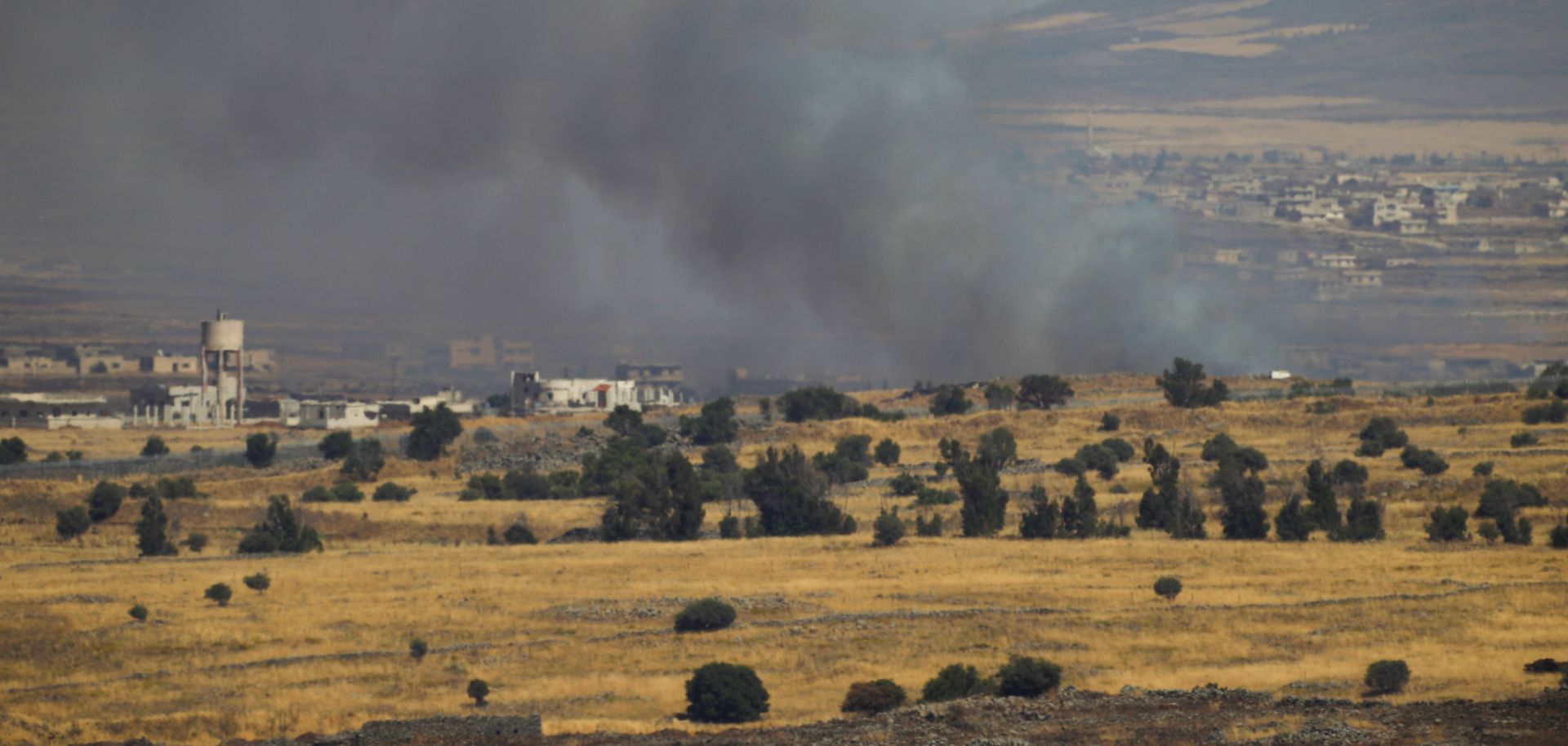
A column of smoke rises from Syria, near its border with the Israeli-occupied Golan Heights, on June 24, 2017, after an Israeli airstrike. Russia is taking steps to beef up Syria's air defense network since Syrian forces accidentally shot down a Russian plane while responding to an Israeli attack on Sept. 17, 2018.
Russia is trying to avoid disaster in Syria. After a Syrian surface-to-air missile battery accidentally shot down a Russian surveillance plane Sept. 17 while responding to an Israeli attack, Moscow is moving to secure Syria's airspace, as expected. Russian Defense Minister Sergei Shoigu announced Sept. 24 that his country would increase its support for Syria's air defense network in hopes of preventing future accidents and "ill-considered actions" by "hotheads" — namely, Israel. But Russia's actions won't stop Israel from carrying out airstrikes against Iranian assets in Syria. In fact, they may raise the risk of an escalation between Iran and Israel.
Shoigu outlined a three-part plan for beefing up Syria's air defense. First, Russia will deliver S-300 long-range surface-to-air missile systems to the Syrian forces, which currently rely on the obsolete S-200 system for long-range air defense. Next, it will work to improve the Syrian air defense network's command and control functions to better detect targets — and to properly identify Russian aircraft. Finally, Russia will step up its use of electronic countermeasures, such as jamming devices, to interfere with Israeli combat aircraft going after targets in Syria. These steps will doubtless make it harder for Israel to carry out future airstrikes in Syria, but they won't stop the attacks. Using tactics like standoff missile attacks and deploying its new F-35 stealth fighter jets, Israel can mitigate the increased risk to its pilots. The country, in fact, has already announced its plans to continue striking at Iranian and Hezbollah targets in Syria.
As Israel digs in, the danger now lies in the heightened threat of confrontation between its forces and Russian troops in Syria. Greater involvement in Syria's air defense network will afford Moscow more control over Syrian air defense operations to help minimize the risk of accidentally targeting friendly, neutral or civilian aircraft. But it will also put more Russian personnel on the firing line between Israel and Syria. Israel has made clear that it will not hesitate to fire on surface-to-air missile batteries that engage its aircraft. Depending on how involved Russian personnel become with the Syrian air defense network, that threat could extend to them.
Even if Russia manages to avoid casualties in future confrontations between the Syrian air defense network and Israeli aircraft, it could still suffer serious embarrassment. Israel could unleash a barrage of cruise missiles or anti-radiation missiles to knock out the S-300 air defense batteries that Russia is planning to give Syria. That would reflect poorly on Moscow, which has long touted the capabilities of its air defense systems, a prominent part of many of Russia's lucrative arms export deals. And short of overwhelming the S-300, Israel could undermine its reputation merely by continuing its airstrikes despite the system's presence in Syria. (By the same token, the new F-35s could lose their sheen if shot down; no weapon is invulnerable.) A less likely, though dangerous, possibility is that Russia will decide to ensure the success of its announced deterrence measures by operating its own air defense system against Israel.
Russia's attempts to prevent a larger conflict in Syria may well have the opposite effect. By threatening to thwart Israeli airstrikes, Moscow will only raise the risk that Syria's civil war will turn into a regional one.
