
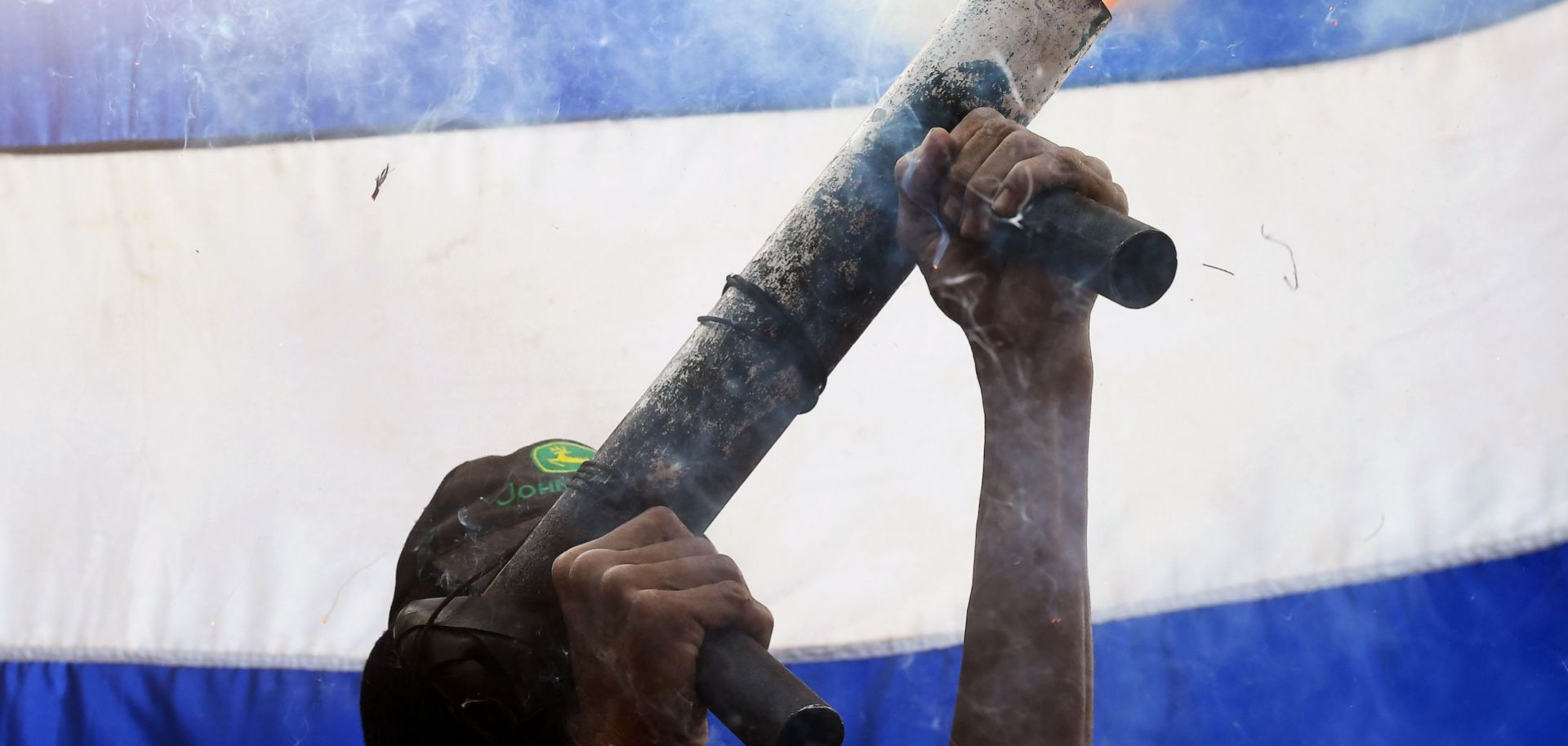
A protester in Masaya, Nicaragua, fires a homemade mortar into the air on June 18, 2018. Members of the uprising, which began in April, have seized territory across the country, including parts of the capital, Managua.
In Nicaragua, there's probably no going back to the way things were. A two-month uprising has severely damaged President Daniel Ortega's standing with the private sector and with the country's voters. Almost 200 people have died since protests first broke out across the country in mid-April in response to a social security tax hike designed to prop up Nicaragua's public finances. Now Ortega is struggling against daily violent demonstrations and a fragmenting political base to preserve his presidency. He may yet subdue the current wave of protests, but the consequences will probably come back to haunt him before the 2021 presidential election.
The President's Survival Strategy
Ortega is steadily losing support. Much of the business community left his side in May, and the armed forces started turning on him as well, leaving only the national police and paramilitary units to try to suppress the protests. Ortega will rely on these forces to disperse the protesters in the months ahead while also trying to isolate the most embattled parts of the country, which lie beyond the capital of Managua.
Depending on how he fares in these endeavors, Ortega may wind up facing a threat from his own party, the Sandinista National Liberation Front (FSLN). Many outside observers have overlooked the party's internal machinations in the chaos of the demonstrations. But if the rest of the FSLN leadership starts to doubt the incumbent president's viability in the next election, the search for a suitable successor will be on. The party may try to push the president to resign should he become too great a liability. Otherwise, it could force him to move up the election — a proposal a U.S. envoy to Nicaragua reportedly made this month — though holding an early vote would require significant negotiations between and within the ruling party and the opposition. When and whether the succession process unfolds will depend on the level of violence on the streets.
Raising pressure on the government and its allies in hopes of driving Ortega out of power is the main purpose of the protests. They will achieve that goal only if the violence in the streets keeps escalating or if Ortega fails to keep his party together. Although the state has lost the support of many of the private sector's most powerful representatives, it has begun using intimidation tactics, such as threats to seize property, to keep them in line. This strategy, of course, may well backfire on the government: The people Ortega is threatening will probably turn on him as soon as they have the chance.
What Happens Next
Even if Ortega's administration survives until the next presidential election, it will likely pay a political price at the polls in 2021. The race, moreover, may prove a flashpoint for another protest cycle if Ortega or his wife (his current vice president) is in the running. Between now and then, the administration will try to keep the FSLN together and work to stop the protests across Nicaragua. Nevertheless, the violence and upheaval in the country will get worse before they get any better.
The president's reluctance to leave power, meanwhile, will probably prolong the pain in Nicaragua's private sector. Protests regularly cut off the highway that runs north to south along the country's Pacific Coast, restricting transport to and from Costa Rica and Panama. Furthermore, workers across Nicaragua — and especially in smaller cities — are having trouble commuting to work because of roadblocks demonstrators have built from paving stones and other debris. These disruptions will persist, compounding the risk to multinational businesses operating in Nicaragua as Ortega keeps up his effort to recover the towns and cities protesters have seized, including Masaya, Chinandega, Leon and Granada.
Going forward, the key factors to watch will be the ruling party's unity and the level of violence on the streets. If Ortega manages to promptly retake the territory the protesters have overrun, including neighborhoods in Managua, then he will be better able to convince his political allies that he should stay in power. But the longer the struggle continues, and the more casualties it causes, the harder it will be for Ortega to make his case. Likewise, if he fails to seize key strongholds such as Masaya, doubts will quickly grow in the FSLN about his future. The deciding factor here will be the armed forces. If they join the police and paramilitary forces in trying to quell the unrest, then the protests will be as good as dead. If, on the other hand, they keep out of the fray, Ortega and his wife may be out of a job by the time the next election rolls around — if not sooner.
