
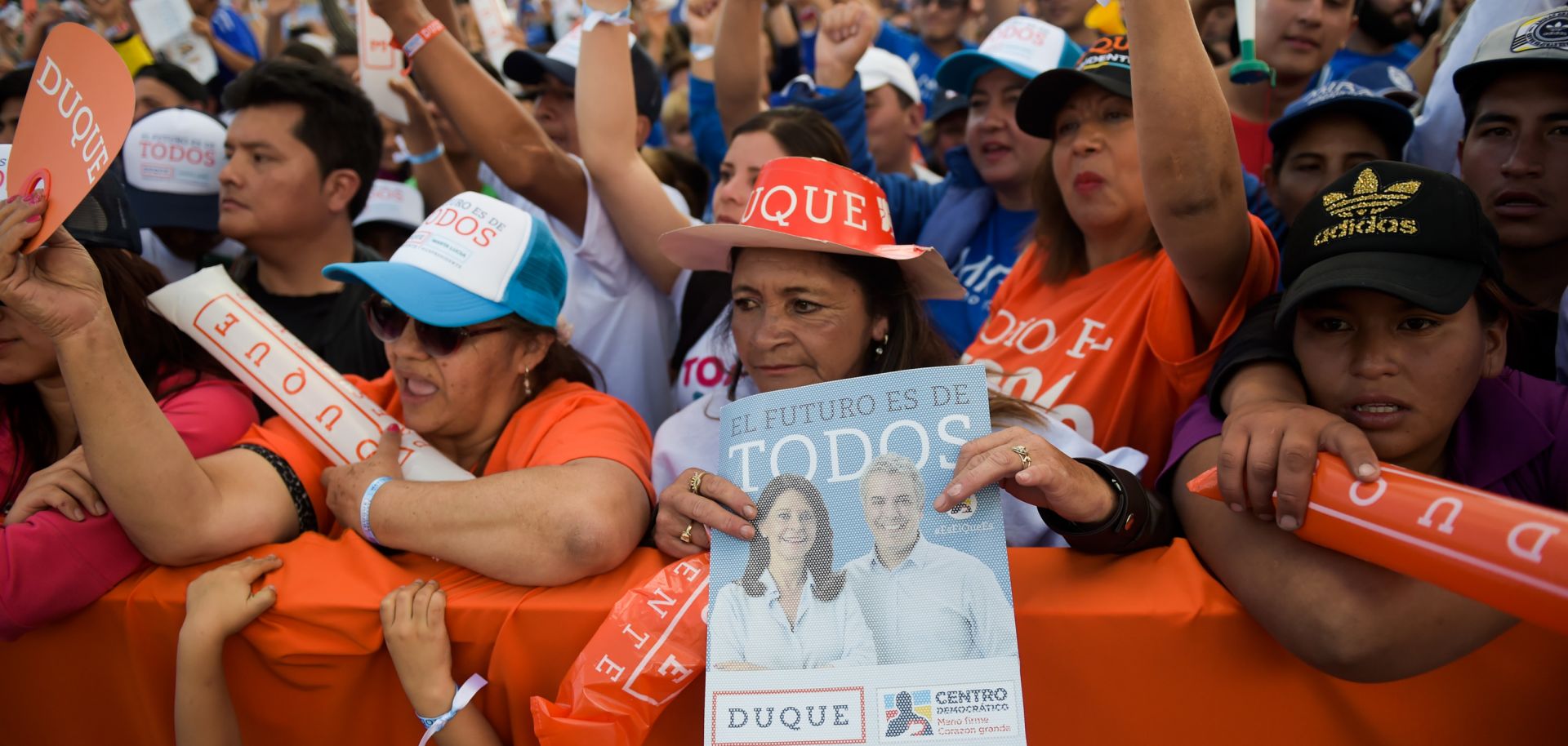
Supporters of Colombian presidential candidate Ivan Duque attend his final campaign rally in Bogota on May 20, ahead of the May 27 presidential election.
Colombians will head to the polls on May 27 for an election during a fateful time for their country. The candidates in the first round range from the far right to the far left, but two hopefuls from opposite sides of the divide — the socialist Gustavo Petro and the conservative Ivan Duque — stand the best chance of advancing to a June 17 runoff. From there, the winner would have the opportunity to leave a deep impact on Colombia's landmark peace deal or trade policy.
What Is Happening
Colombia's voters are heavily polarized heading into the May 27 elections, and polls have suggested that they are gravitating toward the far ends of the political spectrum. About a third of voters have declared that they intend to vote for Duque, while another third intends to vote for Petro, a former mayor of Bogota. The two candidates appear to have the best chances of qualifying for the June 17 runoff to determine the next president. High poverty, an economic downturn and the controversial peace agreement with the communist Revolutionary Armed Forces of Colombia (FARC) have all contributed to this polarization.
Why This Matters
The next president of Colombia will have significant influence over specific areas of policy, but he (all polling indicates that none of the female candidates has a chance of reaching the runoff) is unlikely to enjoy a congressional majority unless he forms alliances. Because of the difficulties in forming coalitions in Congress, the winner is unlikely to implement his agenda easily. The ideological differences between the potential winners are so stark that specific policies — such as the peace deal with the FARC — could vary greatly.
For example, if Duque wins, he could move to undermine the FARC peace deal without any congressional support. The conservative candidate could hinder the agreement by threatening to prosecute top rebel leaders who allegedly engaged in criminal activities after the signing of the peace deal. FARC leaders do not possess any immunity for crimes committed after Dec. 1, 2016, when the agreement went into effect. The success of such a tactic would depend on whether the government can dig up enough dirt on the rebel leaders. Colombian authorities, however, have already arrested FARC leader Seuxis Hernandez (also known as Jesus Santrich) for cocaine trafficking and have transferred an associate (the nephew of FARC leader Ivan Marquez) to the United States. If a Duque administration gathers evidence of wrongdoing by the FARC leadership from the two men, it could use it against the rebels.
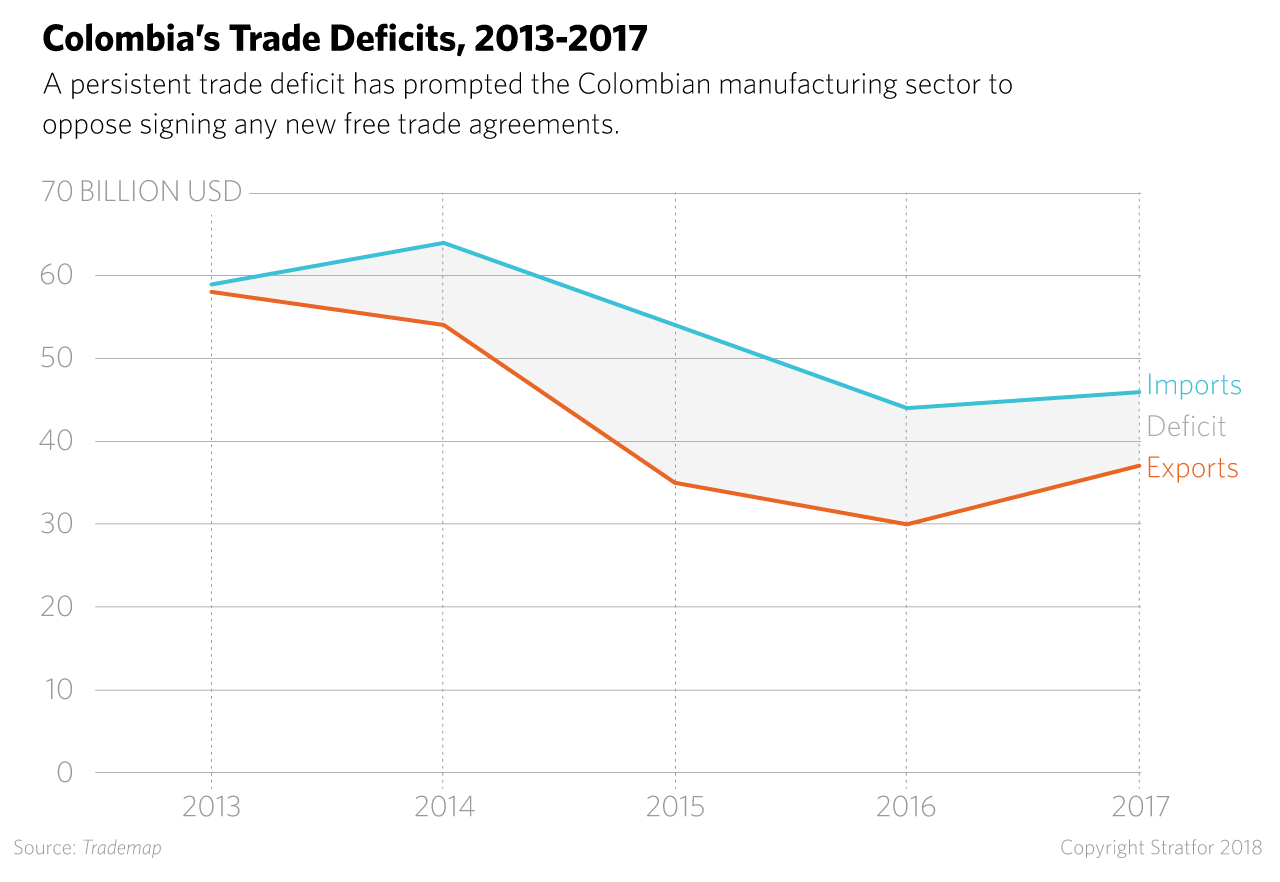
A Petro presidency, by contrast, would likely take less aggressive action against the FARC but pursue more disruptive actions on foreign trade. In general, all the major candidates in Colombia's election agree that the numerous free trade deals signed over the past 15 years have not always benefited the country. Producers in vulnerable sectors such as textiles and agriculture have suffered economic losses due to foreign competition, and they are now leading the charge against new trade agreements. Even Duque has called for a deceleration in trade negotiations, but Petro has suggested going one step further and reviewing — and if necessary, revising — existing free trade agreements.
What Will Happen
If Petro wins the first round, parties that are closer to the center, such as the Liberal Party or the Radical Change party, could lend their public support to the other candidate — likely Duque. Regardless of who ultimately wins, the next administration will be restricted to making incremental changes to the country's security and economic policies. After decades of war, Colombia faces no risk of a return to a major insurgency — even if the FARC deal fails. Likewise on trade, investors need not fear protectionism in the administration to come. No candidate — even Petro — has demanded a fundamental change to Colombia's stance on imports and exports; instead, all candidates have advocated a slowdown in the expansion of trade, albeit through different means.
Whether it's Petro or Duque — or perhaps an unexpected outsider — whoever takes over from President Juan Manuel Santos next month will likely need to construct strong congressional alliances to approve legislation. But in areas in which a president is unencumbered by the legislature, such as the peace deal and trade policy, the country's new leader could take Colombia in a new direction.
