
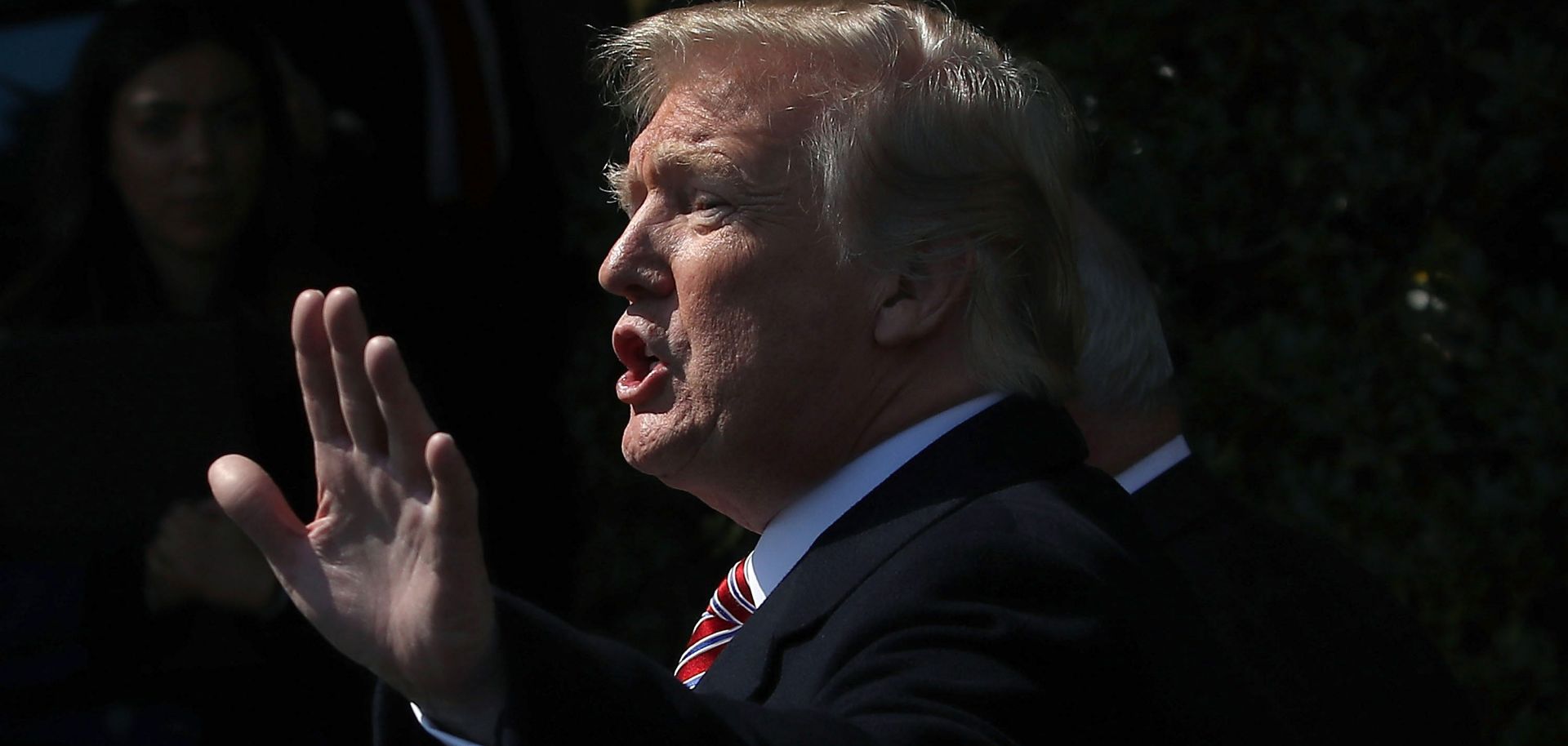
U.S. President Donald Trump waves to the crowd after an event to honor the 2017 NCAA Football National Champion Alabama Crimson Tide, at the White House, on April 10, 2018 in Washington, D.C. Alabama beat the Clemson Tigers 35-31 to capture the championship.
Has the White House shifted its trade policy? U.S. Sen. Ben Sasse, a Republican from Nebraska, announced April 12 that President Donald Trump had directed his two top officials — new National Economic Council Director Larry Kudlow and U.S. Trade Representative Robert Lighthizer — to explore rejoining the Trans-Pacific Partnership (TPP). One of Trump's first moves after taking office in January 2017 was to pull out of the trade deal, which his predecessor, Barack Obama, had agreed to. Trump responded to the reports that he would revisit his TPP decision by emphasizing that he had no timeline for a review and that the United States would re-enter the agreement only if its terms changed.
Trump first floated the possibility of rejoining and renegotiating the pact in January as the TPP's remaining 11 members — Australia, Brunei, Canada, Chile, Japan, Malaysia, Mexico, New Zealand, Peru, Singapore and Vietnam — which had continued negotiations without the United States — were putting the finishing touches on a new agreement, now known as the Comprehensive and Progressive Agreement for Trans-Pacific Partnership (CPTPP). (They signed it in March.) Trump's apparent order to re-examine U.S. participation in the deal raises questions about why the White House may be reconsidering its position and about many of the issues that will emerge as a result. Nevertheless, while longer-term geopolitical forces will nudge the United States to eventually return to this trade grouping, several political obstacles still stand in the way of its doing so immediately. Following is a rundown of the issues driving the re-examination and the complications that could arise from it.
U.S. Exporters' Concerns
Though Trump has argued that the TPP would have damaged U.S. employment because of the access to U.S. markets it would give other countries, being on the sidelines of a deal between the rest of the TPP members will hurt U.S. exporters. The 11 signatory countries will have tariff-free access to one another's markets when the CPTPP comes into force. U.S. businesses will not. When touting the original TPP deal, the Obama administration trumpeted the reduced tariffs that U.S. exporters would enjoy on 18,000 products, including machinery and automotive and agricultural products.
A key selling point for the TPP was that it would break down trade barriers with Japan. Under the deal, the United States would have gained much cheaper access to the country's heavily protected agricultural markets, such as its lucrative beef market. Now, Australia's beef exporters have gained that advantage instead. Disquiet with the turn of events has spurred backlash from the U.S. agricultural sector and other export-oriented groups that wield considerable influence in the normally pro-free trade Republican Party, perhaps influencing Trump's view of the TPP decision. When he ordered the U.S. withdrawal from the pact, the president vowed to seek bilateral trade deals with signatory countries such as Japan in place of the TPP. But in the intervening months, Tokyo's interest in such a deal has been virtually nonexistent. Japan didn't even bother trying to secure an exemption for its steel when the United States recently slapped tariffs on all such imports.
Countering China
Washington's initial interest in the TPP was its utility as a counterweight to China's rising economic influence in the region. The idea was that by sealing a cross-Pacific trade deal similar to the North American Free Trade Agreement — and one that would have functioned as de facto replacement for much of NAFTA — the United States could further tie the TPP economies to its own, giving its fellow signatory countries options to resist Chinese economic pressure. In addition, the United States hoped that the highly advanced TPP deal would serve as the model for all future global trade pacts. It included elevated labor and environmental standards, intellectual property protections, and coverage for digital and data trade. It also — in a not-so-subtle dig at China — included language stating the need for state-owned companies to compete in a market economy.
As the current White House puts China in the crosshairs of its economic and trade policies, many of the strategic underpinnings of TPP are becoming more attractive to Trump as a means to counter China. Washington now hopes to push Beijing to cut its support to state-owned companies, remove its trade barriers and dial back its intellectual property rules, among other things. The question, however, is whether the Trump administration can find a way to merge its strategic concerns over China with the president's protectionist agenda at large. And will the overlap be acceptable to the rest of the TPP's original members?
What Would the U.S. Want From the TPP?
It's not clear how the United States would approach rejoining the TPP or its successor deal, the CPTPP. It could take any number of paths, including trying to join the CPTPP without any major changes — though that option would present a challenge. Many of the original deal's more stringent demands, which the rest of the TPP's members had begrudgingly accepted at the United States' insistence, didn't make it into the CPTPP. The new CPTPP retained 22 of the TPP's original articles as suspended chapters, and most of them fit within core strategic U.S. interests. Many of these are related to protections for intellectual property, provisions that the United States would want to restore before signing on to the CPTPP. The deal's members would also have to revive the TPP's investor-state dispute settlement for the pact to win approval in the U.S. Congress. Some strategic provisions — such as the treatment of state-owned companies — are still in place, however.
The United States could simply demand the pertinent chapters' reinstatement before rejoining the TPP, but the Trump White House likely instead would push for its own changes, tantamount to renegotiating the deal. If the current NAFTA renegotiations are any indication, the demands could be aggressive. U.S. negotiators in the NAFTA talks have made a push to undermine Mexico's competitive advantage in wages, an advantage many CPTPP members share. The United States also has pursued modifications to set regional content levels in the automotive sector as high as 85 percent (since reduced to 75 percent) to qualify for reduced tariffs under NAFTA. Similar CPTPP requirements for the sector range from 35 to 45 percent — a far cry even from the 62.5 percent regional content requirement in the original NAFTA deal.
And should the United States decide to rejoin TPP (or to join CPTPP), it would raise questions about NAFTA. Mexico and Canada, as CPTPP signatories, might opt to use the newer pact's rules in lieu of NAFTA's provisions, choosing whichever is more desirable.
How Would CPTPP Members React?
CPTPP members' reaction to a re-entry by the United States will be critical. Before the TPP, some participating countries lacked a free trade agreement with the United States. Joining the TPP granted them the prospect of greater access to the world's largest market despite the costs on their political or economic systems. Some participants also shared the U.S. strategic objective of gaining trade options beyond China. These factors could give participants an incentive to accept a U.S. return, even if it means changing the agreement. Even so, negotiators for some current members would be leery about the extent of any protectionist measures the United States may try to introduce. The possibility of the United States' inclusion in the deal, moreover, may compel some potential members — such as Thailand, South Korea or the Philippines — to more carefully consider their plans to join the agreement lest they give the impression of taking Washington's side in its heightened competition with Beijing.
The Midterm Factor
Any substantial move to rejoin the TPP or to enter the CPTPP will be a topic of much debate in the United States. When Obama signed the TPP, it wasn't clear that the deal would muster enough votes for ratification by the U.S. Senate or House. Trump could use the fast-track authority in the Trade Promotion Act to make approving the deal a matter of securing a simple majority in the Senate. The law's timing requirements, however, are strict: Once a deal is agreed to and signed, a six-month review period starts in Congress. Even if the United States decides to rejoin TPP and quickly reaches an agreement on terms with the pact's members, the Trump administration would have to sign and present the new deal to Congress by midsummer for lawmakers to vote on it during the current session. A delay could push the pact's ratification beyond U.S. midterm elections and into the 116th Congress, in which Republicans could potentially lose control of the House. Many Democrats rejected the original draft of the TPP, and they may still harbor the same objections to the pact. As a result, it's unclear whether they would consider, much less approve, the trade plan under Trump.
