
U.S. President Donald Trump confirmed that he authorized precision airstrikes April 13 (the early hours of Saturday, April 14, local time), targeting facilities in Syria linked to the government's chemical weapons program. Trump said that the strikes had been authorized in a combined effort with the United Kingdom and France, and that the operation against the Syrian government's chemical weapons capabilities would be sustained, integrating "all instruments of national power." British Prime Minister Theresa May issued a statement aligned with the White House statement, clarifying that the strikes were intended to be "limited and targeted" and are not about intervening in Syria's civil conflict. Pentagon officials confirmed that normal deconfliction channels with Russia were used, but that the Russians were not notified of target sites in advance and they did not attempt to intervene in the strikes, as had been expected.
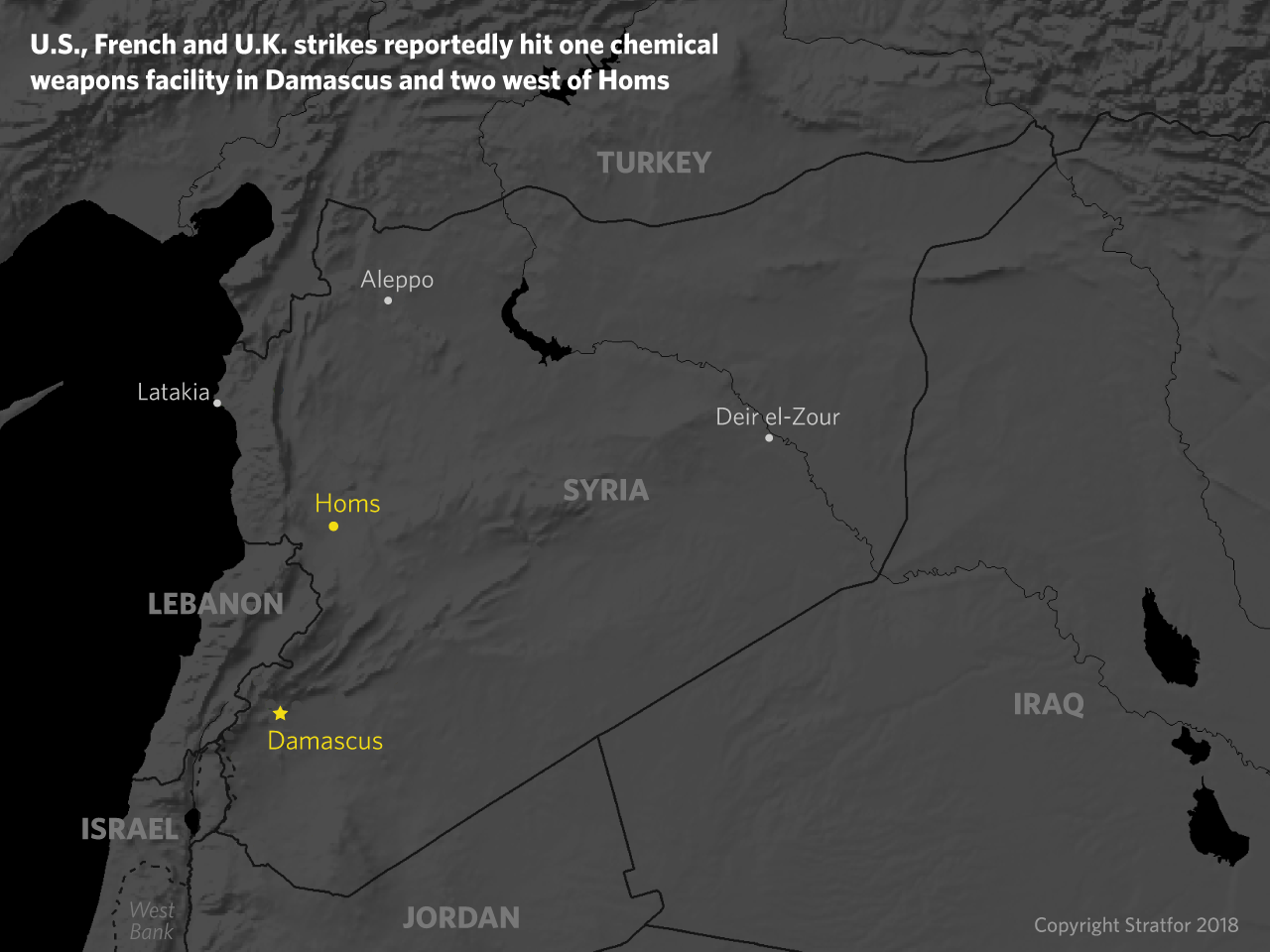
Concurrent with Trump's speech, reports emerged from Syria of airstrikes targeting scientific research facilities in Damascus and Homs provinces. In addition, attacks were reported against the Mezzeh airfield — a major Syrian Republican Guard helicopter and air base and one of the installations linked to the government's operations targeting rebels in Eastern Ghouta. There were also reported strikes on the Jabal Qassioun mountain range overlooking Damascus, an area replete with army headquarters and artillery positions that supported the Eastern Ghouta campaign. State television also reported that the Syrian government launched anti-aircraft missiles over Damascus. The reported targeting aligns with a priority on striking facilities linked to chemical weapons. The target set was significantly expanded from the 2017 strike on the Shayrat airbase, which hit more than half a dozen targets, including air bases and chemical weapons sites. This indicates that the scope of the current operation is beyond a punitive strike, extending into a concerted effort to severely degrade the Syrian government's ability to manufacture and use chemical weapons.
Beyond the immediate tactical objective of degrading the Syrian government's ability to deliver chemical weapons — and a promise to sustain the military campaign as needed — Trump's speech touched on a broader strategic intent to challenge Iran's presence in Syria. The United Arab Emirates, Saudi Arabia and Qatar were named as allies in the effort to not only degrade the Syrian government's chemical weapons capability, but also to work against Iranian interests in the region. Qatar reportedly provided a staging ground for U.S. B1 bombers involved in the airstrikes.
