
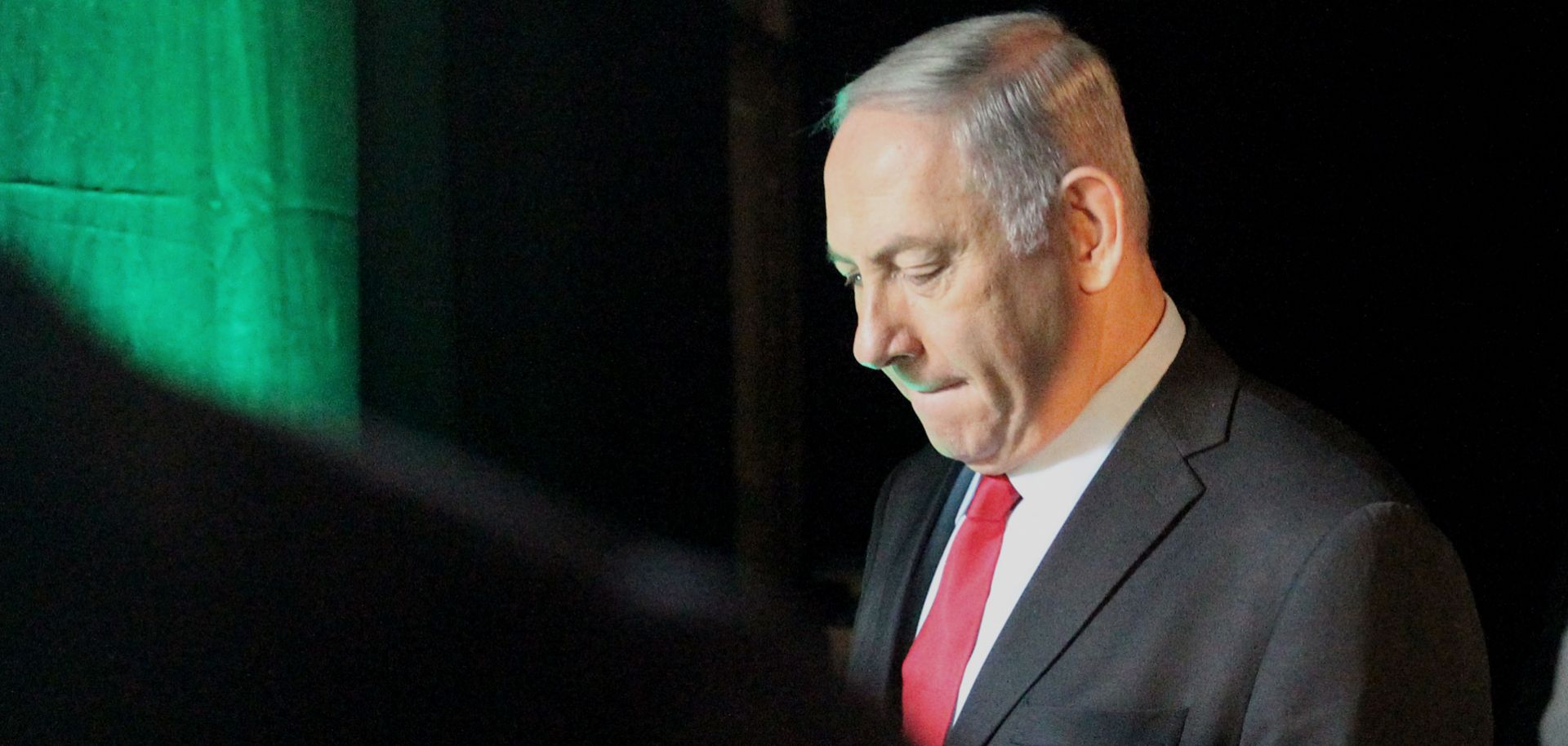
Israeli Prime Minister Benjamin Netanyahu in Tel Aviv, Israel, Feb. 14, 2018. Israeli police have recommended that Israel's attorney general bring corruption charges against Netanyahu.
The political drama simmering at the highest levels of government in Israel could reach a boiling point soon. Prime Minister Benjamin Netanyahu faces multiple allegations of corruption that could force him to resign, face early elections or stand trial. Last month, Israeli police recommended that Attorney General Avichai Mandelblit indict Netanyahu for fraud, bribery and breach of trust. Since then, key Netanyahu allies have come forward as potential witnesses while police have added evidence to their investigations. Although the government around Netanyahu so far remains intact, his ability to finish the remaining 20 months of his term as prime minister is becoming less and less likely, raising questions about who might succeed him and what effect a new prime minister might have on Israel's security policy.
What Happens Next?
The decision to charge Netanyahu is in Mandelblit's hands, making the next few months (the possible duration of the attorney general's consideration of the police evidence against Netanyahu, based on precedent) a waiting game. Netanyahu has been questioned by police in three cases, which led to the indictment recommendation to the attorney general. Questioning is likely in yet a fourth case.
Eventually, the prime minister and his lawyers will face a hearing, where Netanyahu will likely continue to proclaim his innocence. The prime minister is no stranger to corruption investigations. In 1997, his first premiership suffered under the weight of multiple corruption allegations and a police recommendation to indict him. The attorney general at that time, however, did not think the case against Netanyahu was strong enough to hold up in court, and Netanyahu's coalition continued to support him.
This time around is different. Key allies such as Shlomo Filber, who served as communications minister from 2015 to 2017, have offered to testify against Netanyahu. Filber was the first Netanyahu appointee to accuse him of a crime and his decision to testify against his former boss marks a shift in support for the prime minister. The government has managed to press forward with business as usual (the Knesset passed a budget mere hours after the first police recommendations to indict Netanyahu surfaced) but there are signs of cracks in Netanyahu's ruling coalition. Since the ruling coalition has a 67 to 53 majority in the Knesset, at least 15 lawmakers would have to defect to remove Netanyahu. Recent polling results suggest that public support for Netanyahu is waning, and that he could lose elections if they were called today. Meanwhile Netanyahu, with his typical confidence, has said he welcomes the call for early elections.
Who Are the Likely Replacements?
There are ambitious members within the ranks of Likud, Netanyahu's party, who would like to be prime minister someday. Yuli Edelstein, the speaker of the Knesset, has decried the damage done to Likud by the corruption allegations against Netanyahu. Yisrael Katz, the intelligence minister, has said he would take over Netanyahu's post if corruption charges became too burdensome. Gideon Saar, the former transport minister, also has been flagged as a potential successor from within Likud.
Naftali Bennett, the education minister and member of the Jewish Home party, is another possible contender, if a more extreme right one. Bennett could take the government in an even more conservative direction, though he's been a member of Netanyahu's coalition since 2013 and his influence in government is considered well known. The same could be said of Defense Minister Avigdor Lieberman, founder of the Israel Our Home party. He's an obvious candidate for prime minister whose rise would follow the established pattern of Israeli defense leaders landing top political positions upon retirement from the military.
It is unlikely that any of these potential contenders would pursue dramatically different policies from Netanyahu. Numerous electoral polls, and the prevailing political winds of the past decade, indicate that most voters likely would continue to support Likud and other right-leaning parties that embrace fiscal conservatism and strong defense and security policies, either in the event of early elections or if elections are held in November 2019 as currently scheduled.
There are, of course, contenders who are not in line with Netanyahu on many policy matters, but even they would be operating within the constraints of a system that has allowed only more conservative voices to rise to the top. For example, former journalist Yair Lapid built Yesh Atid as a centrist alternative to Likud in 2012, but he has backed some of the same policies for which Netanyahu and his coalition are known, like expanding West Bank settlements. And although the Labor Party's Avi Gabbay potentially could move Israel in a more left-leaning direction, he hails from the Bezeq telecommunications company and is viewed by many as not having the political experience to fill Netanyahu's shoes. Should he become prime minister, he would have a weak mandate.
What Do Netanyahu's Problems Mean for Israelis?
Netanyahu is hardly the first Israeli prime minister to face serious corruption allegations, a fate that also befell Yitzhak Rabin and Ehud Olmert. And fallout from unpopular war efforts forced Golda Meir and Menachem Begin to resign. Still, Netanyahu's indictment or resignation would prove disruptive. After all, Netanyahu is a fixture of Israeli politics, currently serving his ninth year as prime minister. If he does finish his second elected term, only Israel's founder and first prime minister, David Ben-Gurion, will have served longer.
Operating as a lame duck premier under the weight of an indictment would damage Netanyahu's ability to handle Israel's security and policy concerns: spillover from the Syrian civil war; Iran's network of influence in the Levant and broader Middle East; restive militancy in the Egyptian Sinai, Gaza Strip and West Bank; and the looming threat of another war with Hezbollah in Lebanon. There is also a chance that a prolonged investigation would damage Likud and turn public opinion against the party, damaging the electoral prospects of future center-right politicians.
Would Israeli Foreign Policy Change?
Whoever might replace Netanyahu would still be contending with longstanding Israeli foreign policy tenets driven by Israel's geopolitical position, which pits a small state against larger enemies like Iran and multiple non-state enemies like Hamas and Hezbollah. Israel's government, no matter who leads it, strives to defend Israel's security in an unfriendly neighborhood by relying on stronger partners like the United States. Israel's government will also act to pre-empt threats posed by immediate neighbors like Hezbollah and Hamas. Maintaining a military edge over its enemies has been a driving component of Israeli foreign policy since the country's founding.
Netanyahu views the Middle East as a dangerous region that requires an iron fist and a military poised to defend Israel. He is widely viewed as a strong voice for ensuring security for Israel, and to that end, he has proven adept at managing Israel's relationships with key allies. This aptitude includes maintaining a close relationship with Israel's most important security benefactor and backer, the United States, under the Donald Trump administration, and keeping it at arm's length under the Barack Obama administration. This flexibility, while not going so far as to damage Israel's security ties, has played very well at home. The Israeli public will still demand security, whether Netanyahu is at the helm or not.
The question of whether a replacement prime minister will continue the hawkish talk on Iran and Hezbollah and keep up the military campaign against both seems mostly answered. All the potential Likud successors to Netanyahu agree on these points and differ only by degrees. Katz, for example, was a key part of Netanyahu's lobbying effort to Trump against the Iran nuclear deal, and he recently told a Saudi media outlet that Israel will teach Iran "a lesson it will never forget." Katz, in particular, is close to Saudi Crown Prince Mohammed bin Salman, and may increase the pace of the warming ties between Saudi Arabia and Israel should he succeed Netanyahu. Saar, meanwhile, has made it clear he considers the potential of missiles in Lebanon to be a red line, and Edelstein has said the nuclear program in Iran is "like giving a gun to a murderer."
So, regardless of who takes over Likud, Israel's active anti-Iran, anti-Hezbollah campaign will continue. Israel's leadership will remain a key voice in Washington's ear on how to move forward with the precarious Iran nuclear deal. During his current visit to Washington, Netanyahu made it clear that Israel wants the United States to either "fix or nix" the deal before the May 12 sanctions waivers deadline. Netanyahu's close personal connection to President Trump during this critical decision-making period is likely shaping Trump's action.
Meretz and the Joint List, an Arab coalition in the Knesset, are the only likely parties that would notably change the direction of Israeli foreign policy. But they control a paltry number of seats in the Knesset. It would be all but impossible for them to accrue enough votes to make a policy difference, or to have a shred of a chance at winning the premiership. Israelis may declare themselves done with Netanyahu should the corruption allegations against him lead to criminal charges, but by and large they consider the foreign policy course he has charted their own.
