
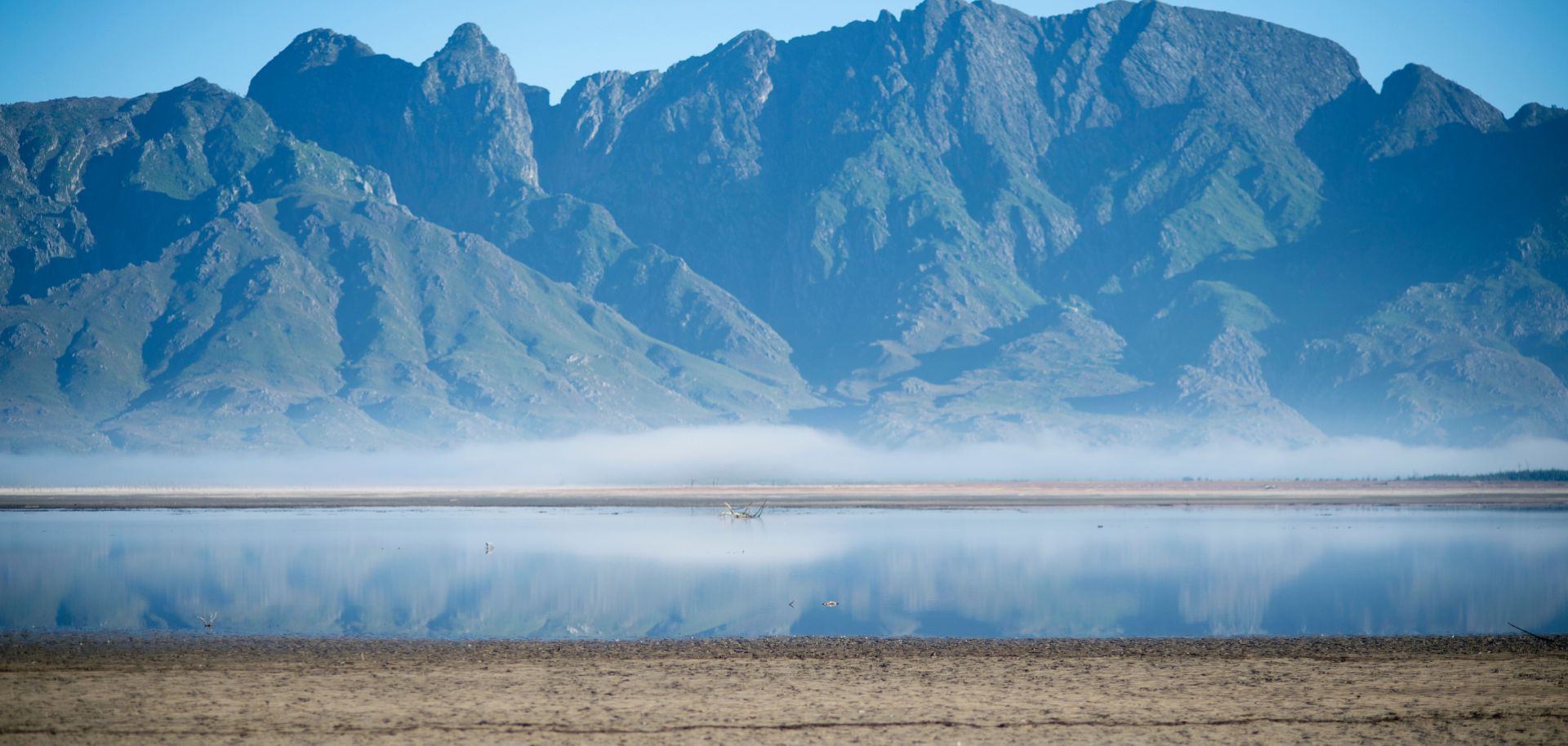
The Theewaterskloof Dam, which supplies Cape Town, was at less than 20 percent of its capacity in May 2017. Only half of that can be used for human consumption; the last 10 percent is undrinkable due to the silt content.
It sounds like the title of a disaster movie, but the reality is a bit more muted. Still, for the residents of South Africa's second largest city, the approach of "Day Zero" is already inducing a certain degree of panic. In a little over two months, local officials will shut off the taps of Cape Town if the city's reservoirs drop too low amid a drought aggravated by political infighting and aging and inadequate infrastructure. With water conservation efforts drawing only a lukewarm response, local authorities are likely to enforce ever-stricter rationing measures. But even if the city eventually finds some respite, the ramifications of the crisis are likely to have lasting effects on all aspects of life in the region and the country.
Seeking Water in the Desert
Water scarcity has constrained South Africa's people and economy for many years now. Residents of Gauteng province, which is home to Johannesburg, felt the dual pressure of an arid environment and dilapidated infrastructure in 2014 when pumping failures caused temporary outages. Projected demand has outstripped the supply, meaning that a prolonged drought could eventually push all of South Africa over the edge. The 2030 Water Resources Group, a public-private-civil society group that works on water insecurity, previously designated Cape Town as a high-risk region, and now a long dry spell is turning that risk into a reality.
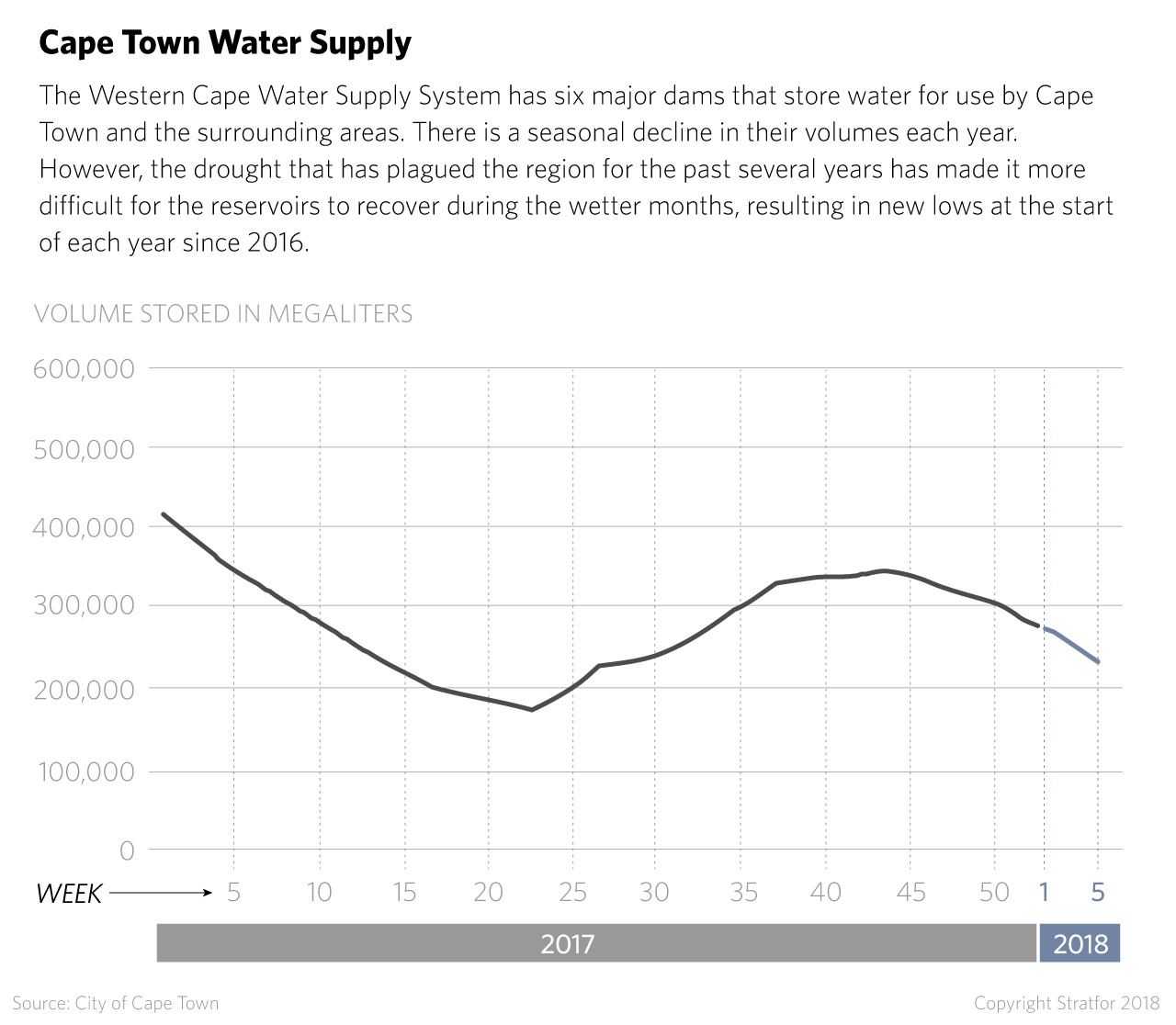
April 16 looms large for the city's residents, because officials have declared that they expect they will have to turn off the taps on that date. Dam storage levels in the Western Cape Water Supply System, which includes the major reservoirs surrounding the city, are expected to fall then to a paltry 13.5 percent (as of the end of January, they were at 26 percent and falling). But Day Zero, as city officials are dubbing it, is not set in stone. Instead, it is a moving target that changes often (officials are continually recalculating all the factors involved) due to a variety of issues, including conservation efforts and unexpected precipitation, which offered the city a reprieve in December 2017. On Day Zero, authorities will turn off the region's normal water infrastructure and establish approximately 200 collection sites around the city to issue residents a comparative meager 25 liters (6.6 gallons) per day. According to the World Health Organization, one person requires 20 liters (5.28 gallons) per day to meet basic hygiene and food preparation requirements. By contrast, the average U.S. citizen consumes between 300 and 400 liters (79 to 105 gallons) per day, according to the U.S. Geological Survey. In the meantime, the city is also racing to secure alternative sources of water, primarily through desalination, but also by tapping the aquifers beneath the region. Many of those projects, however, remain behind schedule.
The arrival of Day Zero does not entail the exhaustion of all of Cape Town's water resources. The taps of many citizens will be dry, but water will continue to flow in hospitals and clinics. There will also be exceptions for schools and communal taps in poor areas to prevent public health problems. In fact, numerous businesses and tourist destinations could retain access to water during the first stages of the shut-off. Nevertheless, the lead-up to the day will continue to deal a severe blow to Cape Town's social, political and economic life.
The city is already seeing potential economic consequences. Revenue from water consumption provided an estimated 10 percent of the city's operating income in 2017, while tourism and agriculture — two water-thirsty industries — are expected to suffer due to the restrictions. The water crisis has also attracted the attention of Moody's Investors Service, which is contemplating a downgrade that would reduce the city's bonds to the junk level. Accordingly, the economic consequences of the water crisis are likely to last long beyond the shortage — to the extent that Cape Town's financial health will be slow to recover. But compared with the economic ramifications, the political and security implications of the crisis might be more acute.
Whiskey Is for Drinking, Water Is for Fighting
Ahead of a general election next year, the ruling African National Congress (ANC) is struggling internally. Cape Town, in contrast, has been in the hands of the opposition Democratic Alliance for more than a decade. Accordingly, in the lead-up to the general elections in 2019, the ANC is likely to use the crisis as a political lever against the alliance — in rhetoric and even in action. On Jan. 26, the national Water and Sanitation Department announced that it would not provide any monetary assistance to Cape Town for the crisis. Now, despite the withdrawal of calls for a no-confidence vote against Mayor Patricia de Lille, the local ANC asked on Jan. 31 for the national government to intervene. President Jacob Zuma, an ANC member, has also withheld aid to the city, refusing to declare the event a national emergency, which would automatically activate financial assistance mechanisms.
And with limited amounts of water available and roughly half the population not complying with conservation measures, the potential for neighbor to turn against neighbor remains. The fight over water could also exacerbate the severe inequality in the city and foment protests and violence, because service failures have sparked fierce unrest in the recent past. The longer the crisis continues and the longer agriculture and tourism remain under threat, the greater the potential for violence becomes as jobs and incomes are lost.
Cape Town, however, is not in a unique predicament. Sao Paulo faced a similar situation in 2014 and 2015. As in Sao Paulo, wealthier Capetonians are better equipped to find alternative water sources should the need arise — which could also increase the potential that inequality ignites unrest. But as its reservoirs dipped to dangerously low levels, Sao Paulo explored several inventive measures, including putting into circulation water that had previously always remained in the reservoirs, to secure the city's water supply. Eventually, the clouds rolled in and the Brazilian city found relief.
And that is what Cape Town waits for: relief. Even if Cape Town does experience the trials and tribulations of Day Zero sometime in April, the day will not usher in the apocalypse; barring misfortune on a grand scale, the rainy season will arrive later that month or sometime in May. However, the factors that led to the present water scarcity are underlying and long-standing. Even when the present crisis evaporates — together with the potential for violence and the political ambition that accompany it — Cape Town and much of the rest of the country appear destined to experience the constraints of water scarcity in the years and decades to come. Unless authorities enact fundamental changes in the distribution, use and maintenance of infrastructure, these acute crises are likely to occur periodically.
