

This photo taken on May 19, 2014, shows a bus on a mountain road in Chin state, Myanmar.
Southeast Asia is a region defined by its fractures: Mountain ranges and jungled highlands carve up its land masses internally, while numerous seas and littoral waterways divide them from one another. This is no less true inside each country, as borders include numerous smaller geopolitical spaces — many of which have strong ethnic or historical ties with neighboring countries. The fact that many borders are porous, disputed or born of colonial machinations only complicates the situation.
For those governing these countries, the struggle of the 20th century — and now the 21st — has been to manage these fractures, as well as achieve stability and the ability to pursue external geopolitical goals. More often than not, this has entailed asserting strong central control to root out forces that have threatened to pull apart the nation-state. To some degree, however, all of these governments have experimented with some level of local control in an effort to manage separatist sentiments by reorienting them toward national goals. The issue takes many forms, but in constitutional terms, it largely hinges on the difference between a unitary state with sovereignty concentrated in the central government and a federalist state that divides power among local regions. Now, Myanmar and the Philippines have signaled the possibility of broader experiments in federalism with far-reaching constitutional overhauls. But the path to such changes is fraught with potentially insurmountable obstacles, while achieving them runs the risk of inflaming deep geographic tensions.
Finding the Right Balance
Federalism is a system that shares sovereignty, and therefore power, between the central government and local bodies such as states or provinces. The United States has a classically federalist system of government, as does Canada, Russia, India and numerous others. In practice, the extent of power sharing varies, but the system of governance ensures that smaller geopolitical units enjoy greater clout in determining domestic policy. While some Southeast Asian countries, such as Indonesia and Myanmar, grant some power to special autonomous regions, only Malaysia is officially "federalist," even though the country operates as a unitary state on many levels.
The benefits of centralization are enticing to many countries. If a central government is weak, it will struggle to implement coherent political or development schemes across poorly governed spaces or even to put the weight of the nation behind a broader geopolitical strategy. Without centralization, local groups can more easily derail initiatives such as trade policies, infrastructure projects or minority protections. However, this top-down approach has its downsides, as clamping down on local groups too tightly has frequently fueled the political narratives of more extreme elements. Federalism offers space for those groups who cooperate with the central government to achieve legitimacy, while sidelining others that represent a greater threat to the state. The system can also open avenues for experimentation with different social or economic policies that might not work nationwide. Carving out some space for local grievances can help calm disputes and free the central government to address external threats and strategic issues.
The Pitfalls of Change in Myanmar
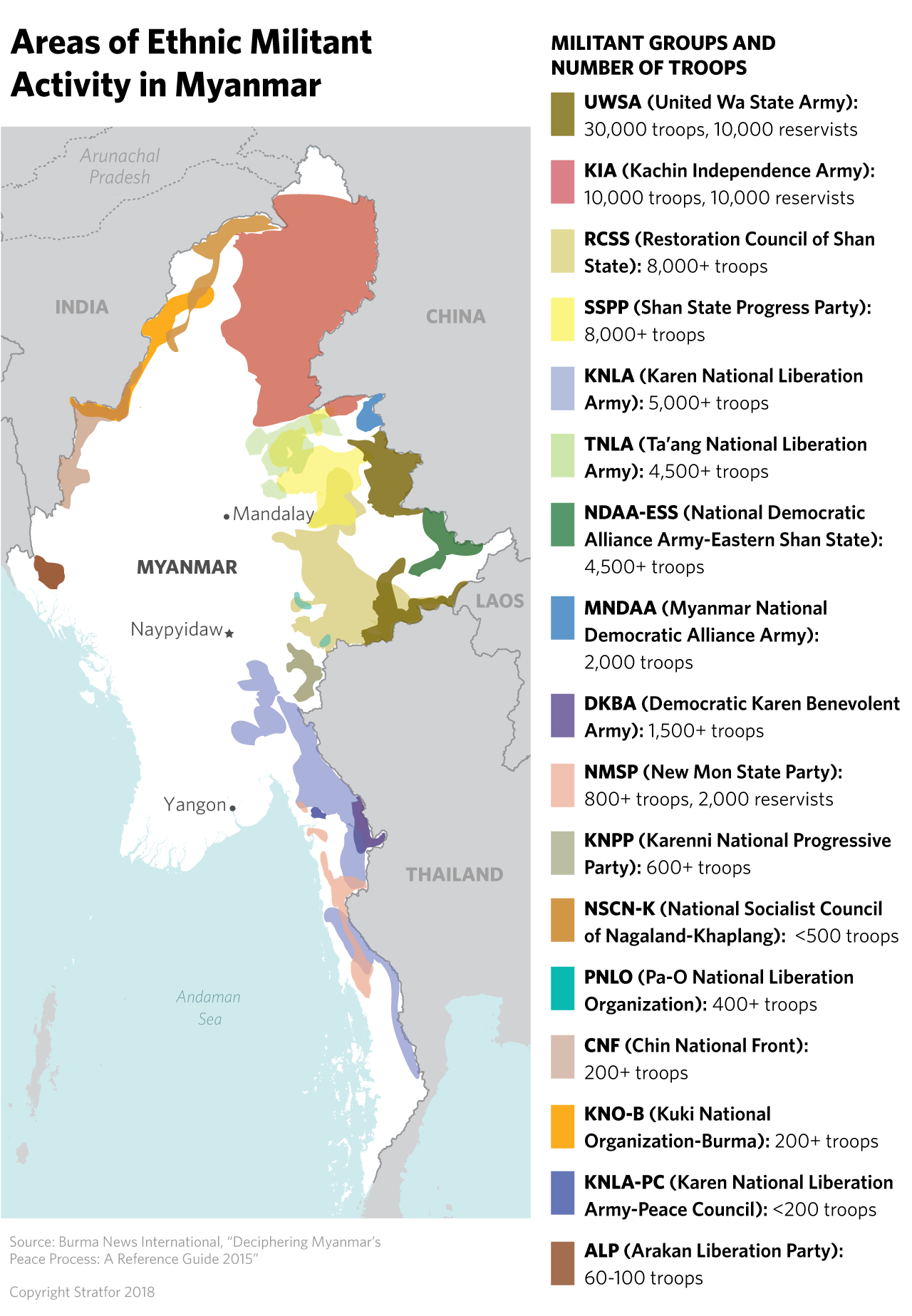
Since independence, Myanmar has struggled to overcome its deep ethnic divisions. Post-independence ethnic and communist insurgencies laid the groundwork for five decades of rule by a military whose primary goal was to maintain national unity and root out separatism. The military’s continued strong hand in politics following the 2010 political transition is justified by this objective – and by the threat posed by the ethnic wars that continue to grind on.
The Punisher’s Search for a Panacea
In the Philippines, by contrast, the process may have already started. In mid-January, the country’s lower house voted to transform itself into a constituent assembly to revise the constitution into a federalist system. Although resistance from the Senate and Supreme Court remains a possibility, Philippine President Rodrigo Duterte — dubbed "The Punisher" — campaigned on promises to enact federalism in 2016 and currently boasts a strong hand politically. And as the first president from the far-flung southern region of Mindanao to install himself in "imperial Manila," he has every reason to decentralize the system and reduce the capital’s influence. Furthermore, such action could even enhance his standing as a strongman by diluting the power of other national-level leaders.
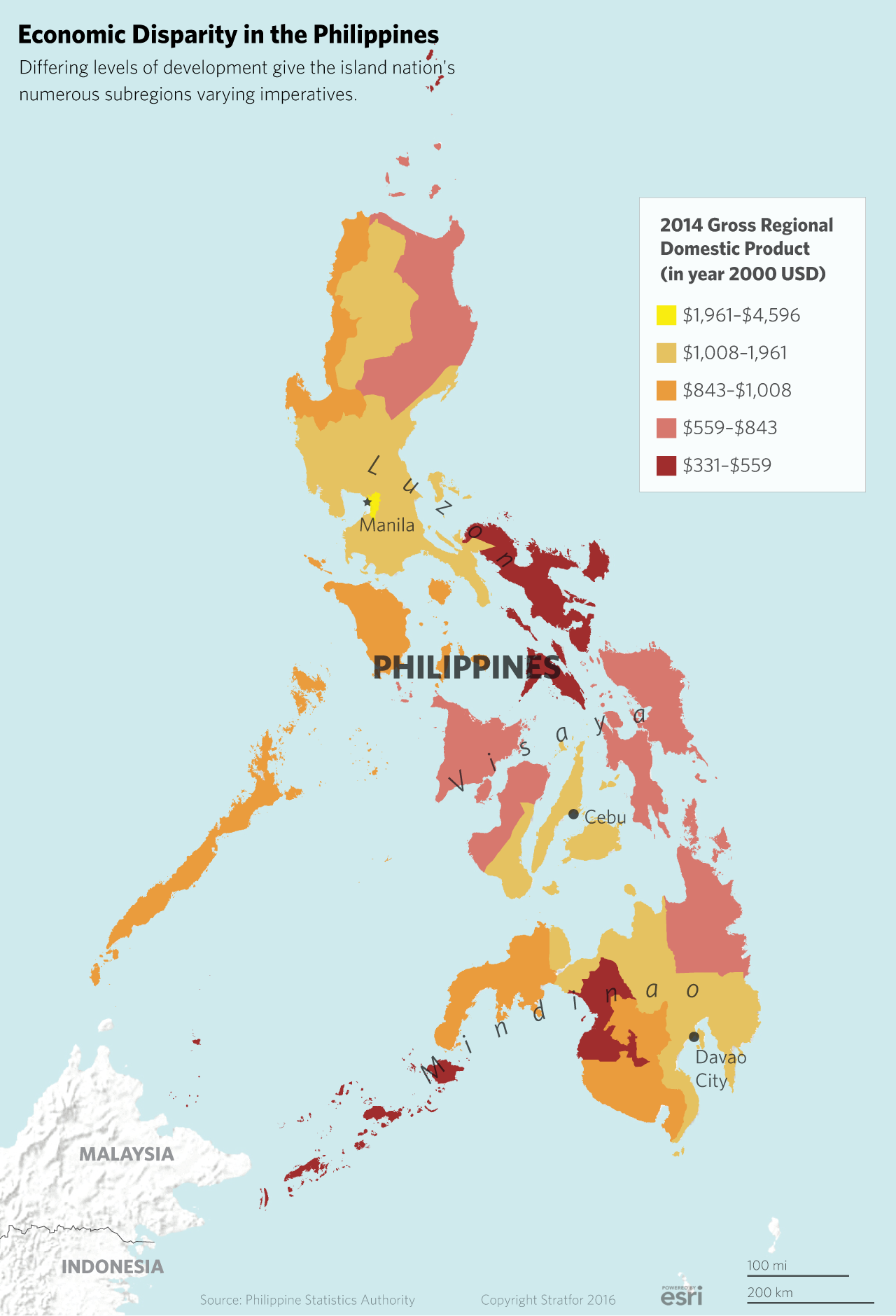
Calls for federalism have long emanated from certain quarters of Philippine politics, and the case for a reorganization of governance is clear: Central administrations in the Philippines have found it difficult to square the often-conflicting interests of the groups residing on the country's 7,000 different islands. With the islands grouped into three rough regions, Manila possesses little room for maneuver to satisfy the country’s numerous ethnic, clan and economic interests. Efforts to rein in these centrifugal forces have spawned numerous insurgencies, most notably Muslim Moro groups in Mindanao and the communist New People’s Army, which operates nationwide in peripheral spaces. This internal chaos has forced the Philippines to draw inward and sacrifice its foreign policy goals. Since 2016, for example, in an effort to free resources to resolve internal matters, the Philippines has pursued a conciliatory tack toward China, which has been aggressively laying claim to areas of the South China Sea. By introducing federalism, Duterte hopes to quiet these local grievances once and for all so that the central government can finally direct its energy toward asserting itself in the region.
Philippine officials have already sketched a rough draft of a federalist solution for the country. Currently, the Philippines is governed according to a unitary system with power flowing from the central government to 81 provinces in 17 regions, the capital region and independent cities. Local budgets are subject to central approval, and provinces can collect revenue only in the forms of real estate taxes and business permits. As author David Martinez quipped, "Not a leaf can fall in our country without [central government] permission." Federalism would shrink the number of local bodies — perhaps to as few as five states. These states would control their own police forces, exercise the power to impose taxes, regulate businesses and run courts, as well as govern education, healthcare, transportation, industry and culture. Federalism would also enhance the revenue-collecting capabilities of localities to permit them to collect mineral taxes and benefit from other funding streams. The issue has become extremely pertinent due to the recent outbreak of Islamic State activity on Mindanao.
Regardless of the future couse of the federalist debate in Myanmar and the Philippines, calls for localized control will continue across the region. With many of Southeast Asia’s borders set by colonial authorities — and others still in dispute or poorly controlled — these countries will continue to bleed around their edges. Ceding power to such areas is intended to co-opt and appease separatist forces but risks empowering them to seek more independence and start redrawing the map. And in a contentious neighborhood at the nexus of great powers, redrawing the map could have huge implications for regional and global stability.
