

People in Barcelona walk past posters for various parties in the upcoming regional elections. But regardless of who wins Catalonia's regional elections, the issue of independence will not disappear.
Shortly after Catalonia held its controversial referendum on independence, the region's citizens will be heading to the polls once again. The Catalan regional elections will be held on Dec. 21, just a month and a half after Spain's central government dissolved Catalonia's government and took direct control over several of its institutions. Opinion polls show a divided electorate, with parties for and against Catalan independence achieving similar levels of popularity. If the pro-independence camp wins a majority of seats in the regional parliament, their primary goal will be to negotiate a legal independence referendum with Spain's government. But Madrid is unlikely to authorize such a referendum, which could lead to future friction between Catalonia and the Spanish government.
The upcoming elections follow the Catalan parliament's proclamation of an independent Catalan republic on Oct. 27. Just minutes later, Spanish Prime Minister Mariano Rajoy announced that he was dissolving Catalonia's government and that regional elections would be held to elect a new one. In the days that followed, several members of the dismissed Catalan government were arrested, including former Vice President Oriol Junqueras, while others, including former President Carles Puigdemont, fled to Belgium.
Madrid's decision to hold regional elections before the end of the year was intended to avoid a prolonged intervention in Catalonia and reduce the risk of social unrest and civil disobedience. In that regard, the strategy worked, as there have been no significant episodes of unrest in Catalonia. However, Madrid has not made any proposals for institutional or economic reform that might help win back the support of Catalans who want independence. Instead, it has focused its strategy on warning voters about the negative political and economic consequences of a continued push for independence. So while Madrid may have been able to keep Catalonia relatively stable, the Catalan electorate is as divided today as it was when its previous government was dismissed.
The Starting Lines
Three pro-independence parties are competing in the elections: the centrist Together for Catalonia, the center-left Republican Left and the left-wing Popular Unity Candidacy. These parties have all criticized Madrid's intervention in Catalan institutions and have called for the jailed former government officials to be released. Though Together for Catalonia and the Republican Left want to negotiate a legal independence referendum with Madrid, the Popular Unity Candidacy party supports a continued, unilateral push for independence.
Meanwhile, there are also three anti-independence parties: the centrist Citizens, the center-left Socialist Party of Catalonia and the center-right Popular Party. These parties have promised to restore political and economic stability to the region and to negotiate with Madrid for more funding rather than a referendum. Instead of focusing on independence, these parties have promised to concentrate on social policies and economic reforms. In addition, the Citizens and Socialist parties have proposed reforming the Spanish constitution to grant more autonomy and economic resources to Catalonia.
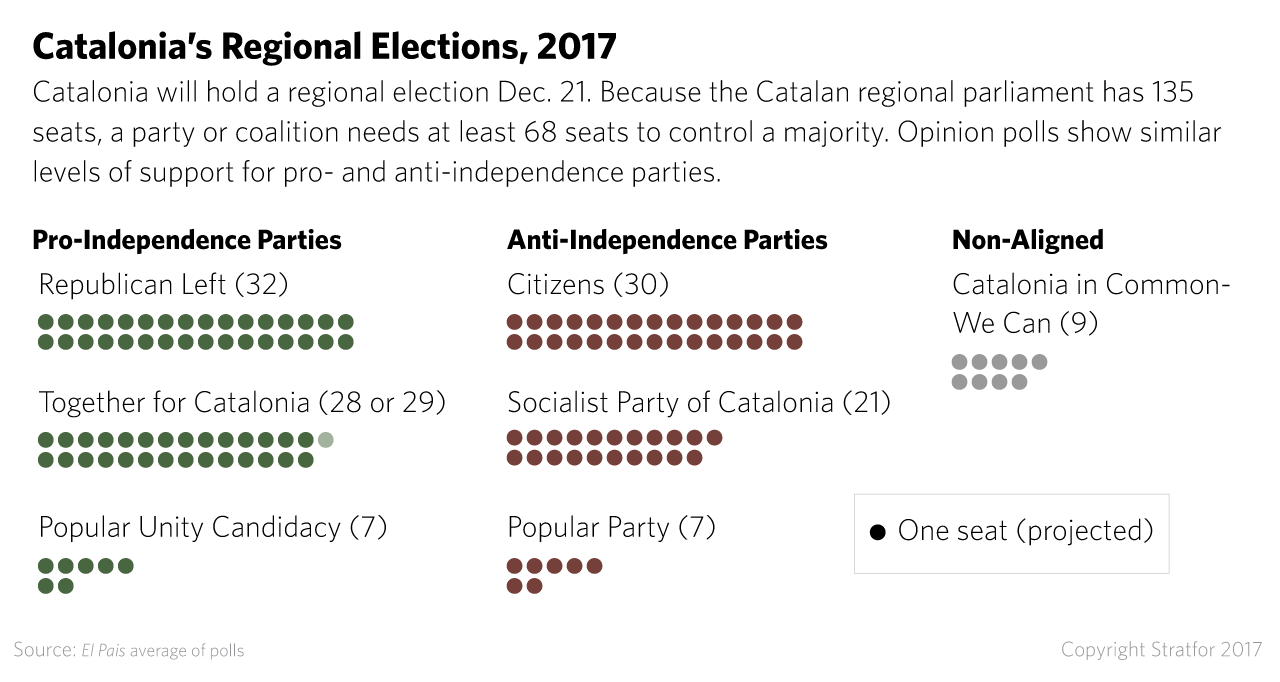
In the middle lies Catalonia in Common—We Can, an alliance of center-left parties which has sought to remain between the camps for and against independence. Though the alliance is critical of the Spanish government and defends Catalonia's right to decide its own future, the party is internally divided on independence. Because the elections could produce a highly fragmented parliament, Catalonia in Common—We Can could end up becoming kingmaker in the negotiations to form a government.
The Coming Hurdles
Even with a divided Catalan electorate, it's still possible for one of the two sides to come out on top. Because of Catalonia's electoral system and district design, one side could win less than 50 percent of the popular vote and still control more than half of the seats in the region's parliament. This happened in 2015, when pro-independence parties won 48 percent of the vote but controlled a majority of seats in parliament. From their perspective, this was enough to move forward with their roadmap to independence.
If the pro-independence parties manage to form a government, they will be less inclined to make unilateral moves toward secession than in the previous legislature for at least three reasons. First, the failed independence attempt in October showed that the secessionists do not have the institutional or political resources to build an independent country. In addition, it was revealed that much of the region's economic establishment opposes independence when, fearing secession, thousands of companies moved their legal seats from Catalonia. Finally, the European Union has shown little sympathy for the Catalan cause, despite promises from the pro-independence camp that the region would be able to join the bloc quickly (or even immediately) after declaring a republic.
If secessionists win a majority of parliamentary seats but less than 50 percent of the popular vote, they will definitely be less willing to confront Madrid than they were last time. While they won't stop wanting independence, they would probably refrain from any moves that could lead to more arrests of officials or increased intervention from Madrid, at least initially. And even if pro-independence parties get more than 50 percent of the popular vote, their first strategy will probably be to meet Madrid at the negotiating table. But just as before, the Spanish government will likely refuse to authorize any legally binding referendum, opening the door to future conflicts.
Anti-independence parties will also face significant challenges if they win a majority of seats. Other than their desire to remain in Spain, these parties have little in common. Their differences will make it difficult for them to form a government and, if they do, they will still struggle to get the reforms they want. Several politicians and analysts have suggested reform to the Spanish constitution over the years, but Rajoy, who leads a minority government, has expressed skepticism. His opposition, for its part, has conflicting ideas on what reforms should be introduced. Because of this, the current political climate makes constitutional reform unlikely.
After the elections, the Catalan regional parliament could be so fragmented that no coalition government is possible. If lawmakers are unable to form a government after three months, the region's citizens could be asked to vote again in March.
Regardless of who leads Catalonia next, the regional government will have to deal with the social, economic and political consequences of the independence process. Catalan society is divided, and an election probably won't change that. Some 3,000 companies have moved their legal seats out of Catalonia in recent months and recently released statistics from Spain's official statistics agency also indicate a dip in tourism in the region, likely due to political uncertainty. Thus, the next Catalan government will, above all, need to generate stability. And even if the separatists fail to form a government, or decide to temporarily refrain from making unilateral moves, the issue of Catalan independence will continue to raise questions about Spain’s political and territorial model.
