
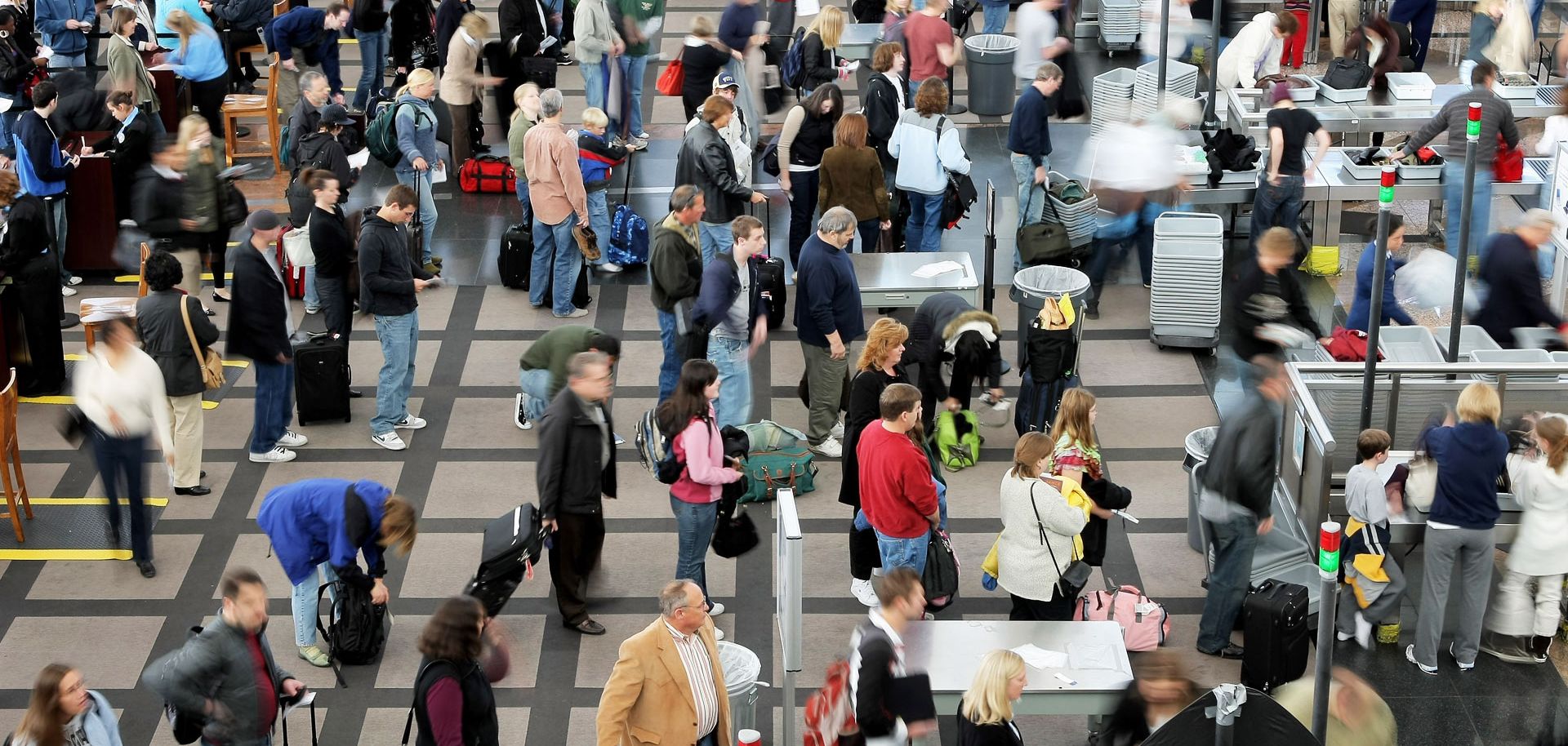
Last Thursday, everywhere from the Arctic Circle to the tropics, Americans gathered to give thanks for all the good things in their lives. So seriously did they feel about this that some 49 million of them — the most since 2007 — braved congested highways and overbooked aircraft to be with their loved ones for the annual festival of Thanksgiving. (Although, admittedly, the single most popular air destination was Las Vegas.)
Thanksgiving brings out remarkable behavior, but I suspect that what would most surprise an anthropologist from another world is the fact that so many Americans insist they have little to be thankful for. An October Gallup poll found that 70 percent of Americans thought that the country was heading in the wrong direction (back in July, 82 percent felt this way). According to a Politico poll, millennials (i.e., people aged between 18 and 29) split almost evenly when asked whether the American dream was dead (48 percent yes, 49 percent no), with 56 percent of those who voted for Sen. Bernie Sanders in the presidential primaries saying yes, along with 61 percent of those who voted for Donald Trump. Trump himself went further, insisting that "Our African-American communities are absolutely in the worst shape that they've ever been in before … Ever, ever, ever." Meanwhile, 41 percent of Americans — the highest figure ever — told Gallup that climate change poses "a serious threat" to their way of life, and 65 percent — another record — blamed it on human activity. It sounds as if most Americans think Thanksgiving is just a bad joke.
I have repeatedly suggested in these columns that making sense of the great issues of our time requires us to see them as parts of longer-term histories. Here I want to add the Thanksgiving paradox to the list of these issues, although in this case we need to look back only a few centuries to realize how much there is to give thanks for.
What the First Thanksgiving Looked Like
Just 100 years ago, the average American man died just before his 50th birthday, and the average woman just after her 54th. Today, average lifespans are nearly 76 years (male) and over 80 years (female). Even if nothing else had gone well in the 20th century, a 50 percent increase in our lifespans would surely be reason enough to celebrate. But greater longevity, of course, is just the beginning of the story. Across the same 100 years, the average American's lifetime earnings have grown roughly tenfold in real terms. Because of this, we are so much better fed that the typical adult of either sex is four inches taller than a century ago. We are also freer: In 1916, the U.S. Constitution did not guarantee women the right to vote, and although it did guarantee this right to black men, some states prevented them from exercising it (prompting the sitting president, Barack Obama, to wonder whether his successor had "missed that whole civics lesson about slavery and Jim Crow"). By 1916, the tide was turning against lynching after a record 161 blacks had been murdered in 1892. However, as late as 1921 rioters in Tulsa, Oklahoma, would kill 26 blacks and burn 1,256 homes. Nor were blacks the only Americans facing violent death: The murder rate was twice what it is now, and in 1917-18 the United States would lose 67,000 citizens in World War I (plus another 43,000 in the 1918-19 influenza epidemic).
These are just the headline events. Behind them are many little things for which we should also give thanks every day. In 1916, almost no American homes had refrigerators (the first Frigidaire went on sale in 1923), electric washing machines (which became affordable only in the late 1920s), vacuum cleaners or electric irons (both made affordable in the 1930s). Aspirin had been on sale since 1897, and electric hearing aids since 1898, but consumers would have to wait until 1920 for rubber condoms. Prozac, Viagra and contraceptive pills would continue to seem like magic for decades to come.
If we look back a little further, to the original Thanksgiving in 1621, the contrasts with today are even more astonishing. Back then, life expectancy at birth in England was barely 30 years, and of the 132 settlers who came to Massachusetts on the Mayflower, only 53 survived to share in that first turkey feast. The typical Puritan earned the equivalent of about $1,000 a year in 2016 values (just slightly more than the average Somali worker today), and although we cannot calculate rates of violent death with any precision, they probably ran 20 times higher than they did this year. Convicted witches could still be hanged (32 were executed during the 17th century and five more died in prison). Most European immigrants arrived in New England as indentured servants, and the enslavement of Native Americans and Africans was perfectly legal. To be sure, the Pilgrim Fathers did not have to worry about global warming, but that was because they were struggling with the equally severe problem of what climatologists call the Little Ice Age. By 1650, North American temperatures had reached a low point of about 2 degrees Fahrenheit cooler than today, and shorter growing seasons led to famines, declining living standards and food riots.
A Sense of Perspective
All things considered, there is a lot to be thankful for. So what are the Cassandras complaining about?
The discussion about whether the glass is filling up or getting emptier comes down to whether we take a long-term, large-scale view or a short-term, small-scale one. The shorter and smaller our perspective, the worse things seem. Alarming as the rising temperatures of recent decades have been, for instance, looking at the longer term reminds us that people in the past have showed astonishing adaptability and resilience. I mentioned a moment ago that the world was 2 degrees cooler in the 17th century than it is now, but in the 12th century it was about 1 degree warmer than it is in the 21st century. The world was also hotter in 1500 B.C. than today, and even more so around 6000 B.C.
Adapting to climate change has never been easy, but humanity has managed it over and over again, and there are signs that we are currently repeating the trick. According to BP, 86 percent of the world's energy still comes from fossil fuels and just 2 percent comes from renewables. But many energy analysts think we will reach a tipping point in the 2020s, when the incremental supply of renewables will make up all the new energy demand. After that, the quantity of fossil fuel being burned will decline. The costs of batteries for electric vehicles are already just 20 percent of what they were in 2008, and global sales of electric vehicles soared by 70 percent in 2015 (in China, they tripled). Individual governments can help or hinder the process, of course, but none can reverse the relentless gains in efficiency.
Trends in income also look more depressing on the short and small scale than on a long and large one. After growing by an unprecedented 91 percent in the 25 years between 1948 and 1973, American workers' real wages only rose by 9 percent in the 40 years between 1973 and 2013. Worse still, a 9 percent real-wage increase across these 40 years would have seemed like a godsend to most Americans: While someone in the 95th percentile of the income distribution has seen his or her real salary go up by 41 percent since 1979, the median worker received just a 6 percent raise, and one in the 10th percentile took a 5 percent pay cut. Adding insult to injury, the typical CEO's salary ballooned from being 20 times as big as the typical nonsupervisory worker's in 1965 to being 296 times as big in 2013 (it peaked at 383 times as big before the Great Recession).
While almost every major country has seen income inequality increase since the late 1970s, at the global scale the trends run in the opposite direction. Between 1900 and 1950, economic inequality fell sharply in the United States but rose just as sharply around the rest of the world, because countries that had industrialized (mainly in Western Europe and North America) were pulling away from those where the Industrial Revolution had barely begun. Consequently, while the average American worker was 7.5 times as productive as the average Chinese worker in 1900, the gap had increased to 21.3 times by 1950. But between 1950 and 2000, although inequality rose within China as well as the United States, it slowed at the global level as other countries (especially in East Asia) finally had industrial revolutions of their own. By 2000, American workers were just 8.3 times as productive as Chinese workers. Since 2000, global inequality has actually fallen because more than a billion people (chiefly in Asia) have seen their wages rise out of what the World Bank classifies as "extreme poverty" (less than $1.90 per day). An economic miracle is underway, for which everyone should give thanks.
A Reason for Optimism
Long-term history largely explains what is going on. There have been three great transformations in the roughly 100,000 years since modern humans evolved: the invention of agriculture, the rise of the state and the Industrial Revolution. Each began at a particular time and in a particular place, and each gave early adopters massive advantages over everyone else. Farming, for instance, began between 9500 and 7500 B.C. in what we now call the Middle East. It supported massive increases in population, wealth, organization and the stock of knowledge, with the result being that big, rich, complex and literate farming societies overwhelmed the small, poor, simple and illiterate foraging societies around them, in part by killing their men and stealing their women, children and land. Farmers took over the planet except for the places they did not want, such as frozen Siberia or the arid Kalahari Desert. In the process, though, the geostrategic imbalance between the original heartland of farming and everyone else evened out as places such as China and Europe proved to be just as well suited to agriculture as the Middle East.
Similarly, when the first states appeared between 3500 and 3000 B.C. in Egypt and Iraq, they supported a new round of increases in population, wealth, organization and the stock of knowledge. This set off another round of expansion as state societies overwhelmed their non-state neighbors, and then a further round of evening out as Persia, Rome and other states created governments and bureaucracies that were even more effective than the first pharaohs or Sumerian city-states.
Finally, the Industrial Revolution that began in Britain around A.D. 1750 set all these cycles in motion once again. The early adopters — what we now think of as the Western world, concentrated around the shores of the North Atlantic — had much to be thankful for in the 19th and 20th centuries, but in the 21st we find ourselves in the evening-out phase. East and Southeast Asia have already shown that they can compete economically with the West, and South Asia, sub-Saharan Africa and Latin America may well follow suit. For two centuries the West (and above all, the United States) has enjoyed a golden age, but its free ride is now approaching its end. Challenges are mounting, and tried-and-true political formulas that worked well for two centuries seem to be failing.
Yet there is still plenty to give thanks for. The West is still the richest, freest and most creative part of the world. If the calculations I made in my book, Why the West Rules — For Now, are even approximately right, it will remain so for another generation and probably for another two (although likely not for another three). And even when the West's global leadership is eclipsed, its citizens will continue to enjoy lengthening lifespans, rising income, declining violence and expanding knowledge. The more that we take a long-term, large-scale view, the more clearly we can see the causes for optimism. British Prime Minister Theresa May recently said, "If you believe you are a citizen of the world, you are a citizen of nowhere," but she neglected to add that you are also likelier to find more to give thanks for.
