

In Yemen, a largely stagnant battlefield hides an active political scene throughout the country, in which the Saudi-backed government of President Abd Rabboh Mansour Hadi is vying for control of the country against an opposition alliance. To the north, in the capital city of Sanaa, the cooperation between the forces loyal to former President Ali Abdullah Saleh and the Iran-backed Houthi rebels has the potential to unravel. This month, for instance, Saleh reportedly received medical treatment from a Russian team of doctors, which could indicate the extent that Saudi Arabia would be willing to incorporate Saleh in a political settlement. However, in seeking to curb Iranian influence in the region, Saudi Arabia would likely require that the Saleh loyalist severe their ties with the Houthi rebels.
Taking advantage of the political turmoil that has enveloped Yemen, Islamist groups such as al Qaeda and the Islamic State have fortified their strongholds in southern Yemen. For this reason, the United States has conducted several counterterrorism operations to roust the militants from the country. Last month, U.S. forces, for the first time, targeted Islamic State militants in Bayda province (a traditional hotbed of al Qaeda activity that has witnessed increasing activity by those militants).
Often separate from U.S. efforts, the United Arab Emirates has trained numerous militia forces in southern Yemen who are loyal to the pro-Saudi Hadi government and has skirmished with other local militias, including those backed by the Islamist Islah party, for control of the area. Earlier this month, in Taiz province, a leader of the Islah party called upon local fighters to return to Taiz city and prepare for further combat against the UAE-backed forces. In response to Islah threats, the UAE-backed forces detained Islah leaders and raided one of its party headquarters in Aden.
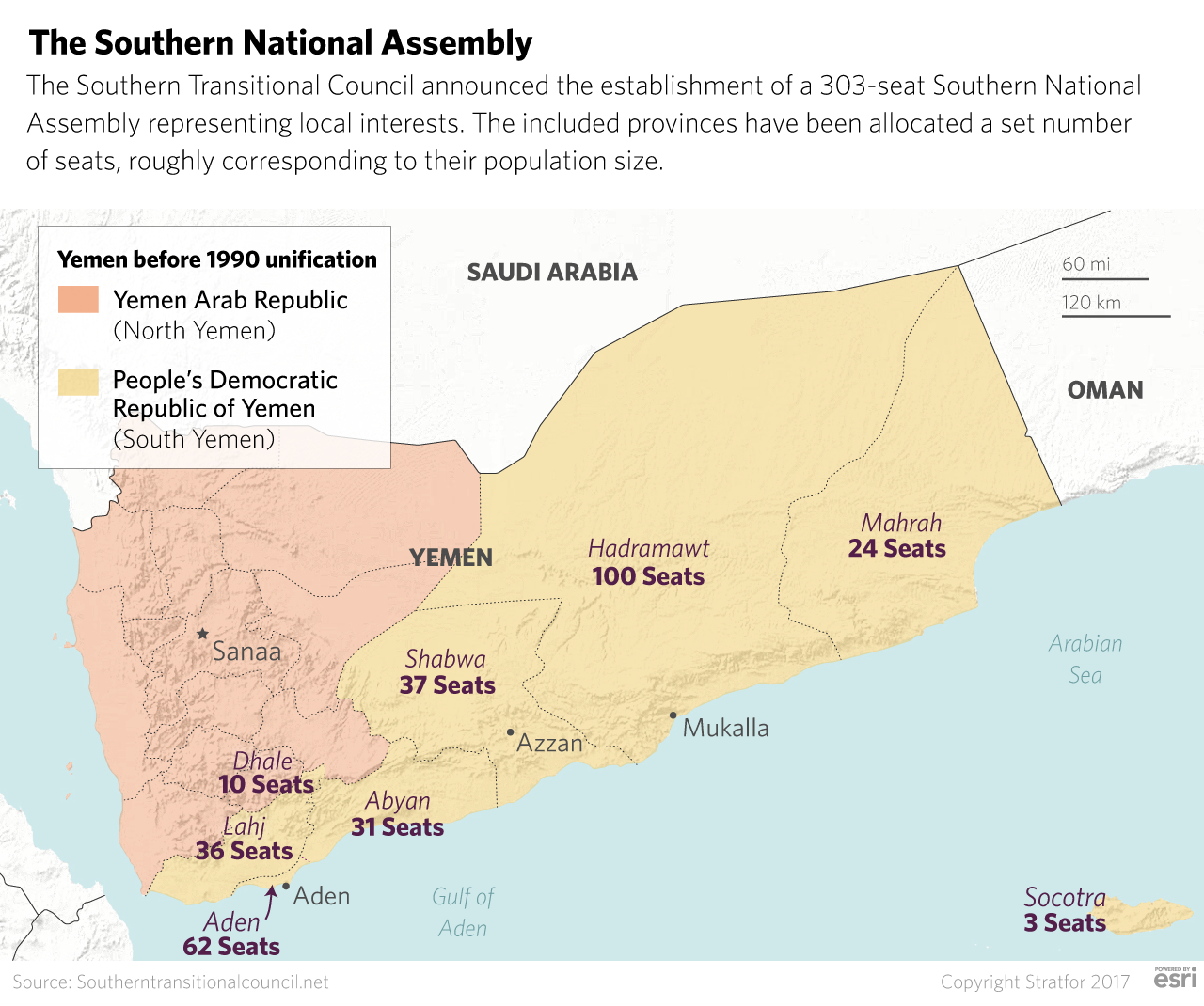
Meanwhile, Yemen's troubles have compounded as a southern separatist movement gains strength. The Southern Transitional Council (STC), founded by former Aden govenor, Aidarous al-Zubaidi (a staunch anti-Islah politician), has launched a political tour of southern Yemen to build up popular support for the council and a new political assembly. As the STC continues its political tour in the southern and eastern provinces, its role as an official body clearly calling for southern secession could become more coherent. Still, the council and the new assembly have yet to offer any substantial public services that could challenge the Hadi government's official authority.
