
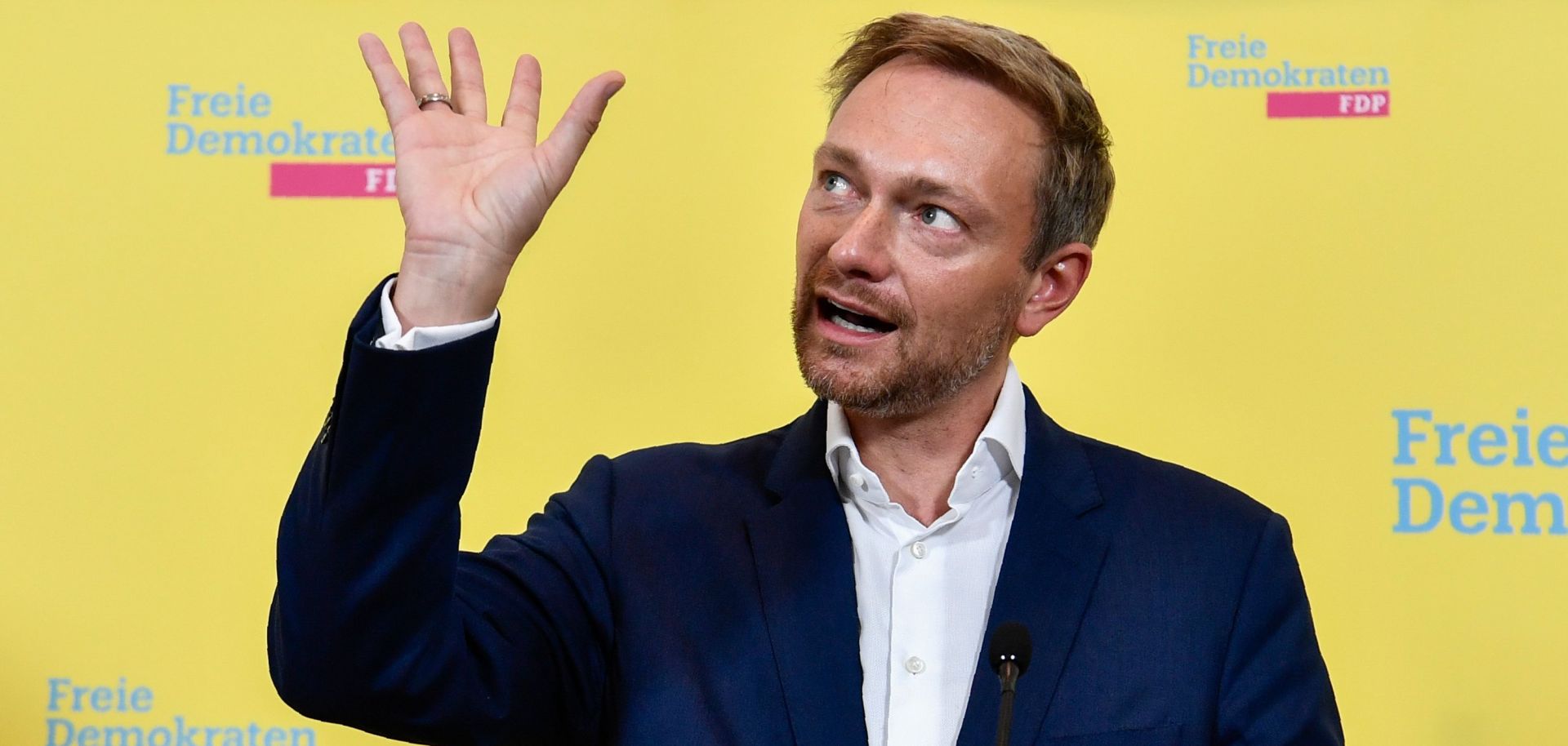
(JOHN MACDOUGALL/AFP/Getty Images)
Since the electoral fiasco of 2013, the Free Democratic Party has tried to rebrand itself and to become more attractive in an increasingly competitive landscape. Part of the strategy was to appoint 38-year-old Christian Lindner as party leader and chancellor candidate.
If opinion polls are to be trusted, the Bundestag that emerges from the Sept. 24 general election in Germany could be the most fragmented in decades. As many as six political parties stand a chance of entering the lower chamber of the German Parliament — up from the four currently represented. Germany's largest parties, the center-right Christian Democratic Union (CDU) and the center-left Social Democratic Party (SPD), have been governing together since 2013, but after the election, they will try to form governing alliances with other parties. This will give smaller political forces an important role when it comes to deciding who will be in charge of the federal government. Of all of Germany's potential kingmakers, one has the most experience in the role: the centrist Free Democratic Party (FDP).
The FDP was created in the late 1940s as an association of several liberal parties. Because of its centrist and somewhat flexible ideology, the party has been a member of coalition governments with both the center left and the center right, showing a remarkable ability to adapt to political circumstances. The FDP was a member of the coalition governments led by the conservative Chancellors Konrad Adenauer (1949-63) and Ludwig Erhard (1963-66). Confirming the FDP's influence during this period, one of its founding members, Theodor Heuss, became the first president of West Germany in 1949.
These were foundational years for postwar Germany, and the FDP defended market economy policies and acted as a counterbalance to the CDU's positions of the time, which were more sympathetic of a "third way" between socialism and capitalism. But the FDP also had to deal with right-wing views within its ranks; some members were against the de-Nazification policies introduced by the Allies and supported by the biggest parties.
Winds of Change
As the political winds started to blow in a different direction in the late 1960s, the FDP helped Willy Brandt to become the first SPD chancellor of the postwar era in 1969. During this period, the FDP supported Brandt's controversial policy of normalizing relations between West Germany and Eastern Europe. But the FDP changed its alliances again in the early 1980s and helped appoint the conservative Helmut Kohl as chancellor (1982-98), confirming the party's role as kingmaker. This was a controversial move, leading many FDP voters to migrate to the SPD and other smaller parties in protest of its change of position. But during Kohl's tenure, FDP Foreign Minister Hans-Dietrich Genscher became one of the architects of Germany's reunification after the fall of the Berlin Wall in 1989. He was also a vocal supporter of the plans to restart European integration in the late 1980s.
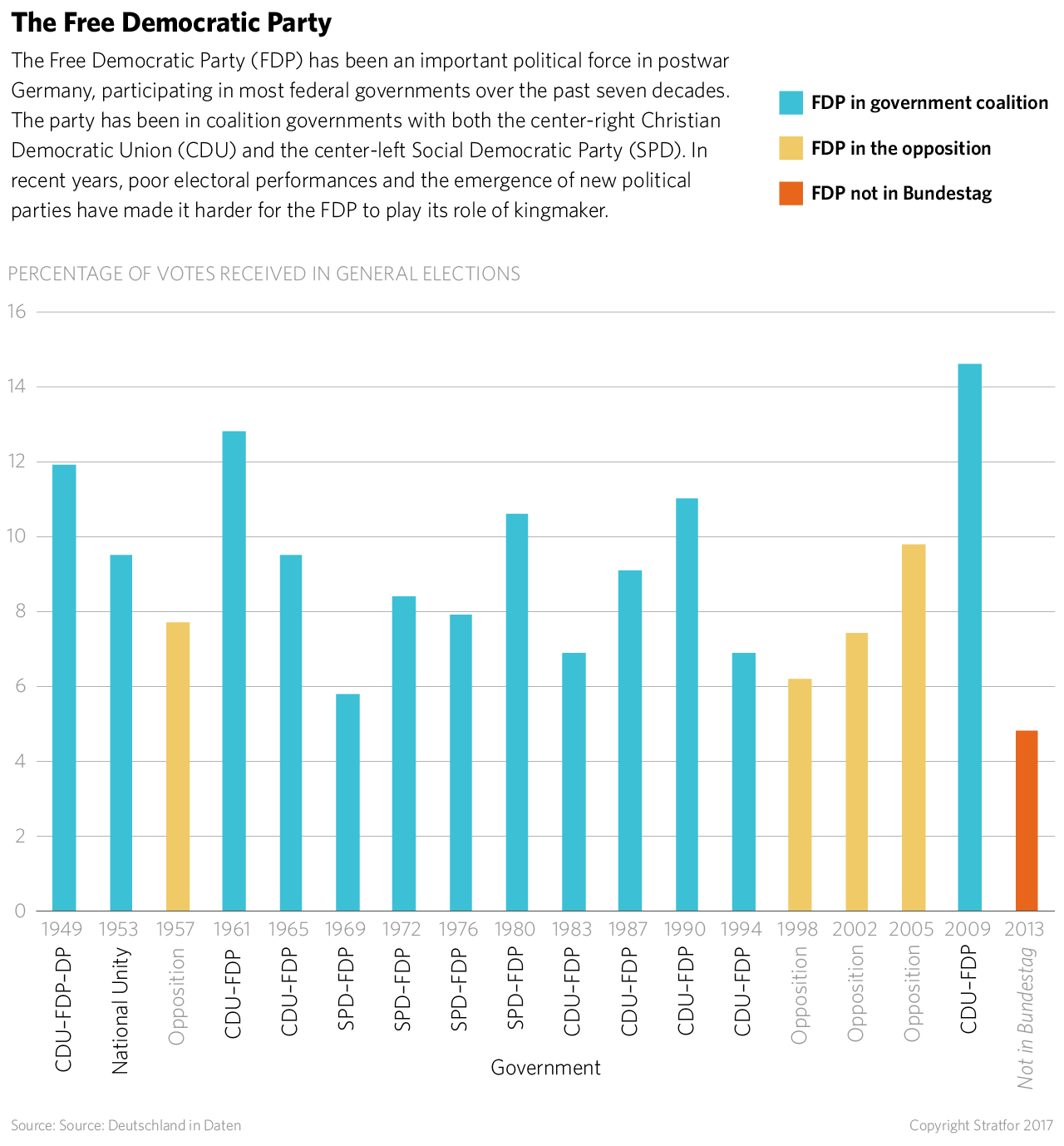
The 2000s were difficult times for the FDP, as the party found itself in the opposition during most of the decade. In 1998, SPD leader Gerhard Schroeder chose to form a coalition with the environmentalist Greens, a relative newcomer to German politics. This was an early sign that the political landscape was becoming more fragmented in Germany and that new parties were ready to dispute the FDP's traditional role of kingmaker. In the mid-2000s Germany's political landscape fragmented further with the emergence of the left-wing Die Linke (The Left) as a relatively important political force.
The FDP returned to power in 2009 as a part of Angela Merkel's second government. But the experience was short-lived and traumatic. The European crisis put most of the FDP's campaign promises of economic liberalization on hold. More important, the party supported controversial rescue programs for eurozone countries such as Greece and Portugal, which irritated significant parts of its electoral base. The FDP paid the price in 2013's general election, when it failed to enter the Bundestag for the first time since 1949.
The Modern FDP
Since that fiasco, the FDP has tried to rebrand itself and become more attractive in an increasingly competitive electoral landscape. Part of that strategy was to appoint 38-year-old Christian Lindner as party leader and chancellor candidate. The telegenic Lindner has tried to erase FDP's power-hungry image, focusing on political positions rather than on potential coalition partners. Faithful to the party's roots, Lindner defends a free-market economy in which the federal government doesn't get too involved. In the FDP's platform approved in April, the party promises to focus on the digital economy and to introduce tax cuts of about 30 billion euros ($35.8 billion). These proposals are not very different from those of the CDU, which explains why both parties would be natural allies after the election.
But the FDP's most potentially problematic views are connected to foreign affairs. The party is critical of helping southern members of the eurozone, and Lindner recently said that Greece should leave the currency union if it wants to receive debt relief. Lindner has also criticized proposals by French President Emmanuel Macron to increase spending at the European Union level and to introduce measures to share financial risk among the members of the eurozone. The FDP chairman recently said that eurozone countries should be responsible for their own fiscal policies and warned against making "new pots of money" available for the members of the currency union. He also said that the European Union should not require non-eurozone countries in Central and Eastern Europe to join the currency area. As a result, a government including the FDP could be more skeptical of eurozone integration and make it harder for Berlin to find compromises to bridge the tensions between Northern and Southern Europe.
In early August, Lindner caused controversy when he said in an interview that the issue of Russia's annexation of Crimea should be "encapsulated" so progress could be made on other issues. According to Linder, the European Union should not link the removal of sanctions against Moscow to the full implementation of the Minsk peace agreements. Instead, he said, the Kremlin should be rewarded for making "positive intermediary steps." The controversy that followed the interview forced the FDP to issue a statement calling Russia's annexation of Crimea a human rights violation and a threat to peace in Europe. While the FDP's official party manifesto calls for Russia to put an immediate end to "the illegal occupation of Crimea and the war in Eastern Ukraine," it also says that in the medium term, Germany's goal should be to achieve "a reliable partnership with Russia through dialogue and confidence-building measures."
Lindner also supports reaching a Brexit deal with the United Kingdom, saying that his party wants "a strong and economically prosperous Britain." From his point of view, the European Union should be ready to reach compromises with London. Having the FDP in the German Cabinet would mean that German businesses (which are particularly interested in a deal that keeps the closest possible trade ties between the United Kingdom and the European Union) would have a stronger voice in the process as the United Kingdom leaves the Continental bloc. While most German political parties are supportive of a mutually beneficial deal with the United Kingdom, the SPD tends to be particularly vocal in its defense of the integrity of the EU single market, in part because its candidate for chancellor, Martin Schulz, is a former president of the European Parliament. As a result, a coalition between the CDU and the FDP would be the desirable outcome for the British government.
A Junior Coalition Partner
The FDP is a natural coalition partner for Merkel's conservatives. The FDP's views on issues such as the eurozone, immigration and foreign policy are similar to those of some members of Merkel's team. For example, Finance Minister Wolfgang Schauble has long defended the view that eurozone reforms should include greater oversight of the fiscal policies of its member states. Some FDP views are also close to those of the Christian Social Union (CSU), the CDU's sister party in Bavaria. CSU members have suggested that Berlin improve its ties with Moscow and have pressured Merkel to toughen her migration policies.
Over the past four years, German conservatives had to be accommodating with their policy positions to reach compromises with their coalition partners in the center left. In other cases (such as the Greek bailout) Merkel herself overruled some prominent members of her party to impose her own policy views. After Sept. 24, a more ideologically cohesive German government could make policy less subtle.
However, things may not be so easy. Opinion polls show that a coalition between the CDU and the FDP may not control enough seats in the Bundestag to appoint a government, meaning they would need additional partners. The Green party could be a potential ally, but the FDP has spoken against entering a coalition with it. The Greens tend to be more protectionist and to defend a progressive agenda on fiscal issues, which could be hard for the FDP to digest.
Should coalition talks between the CDU and smaller parties fail to produce an agreement, the conservatives may have no choice but to revisit their current alliance with the center left, which could again leave the FDP in the opposition. In the coming general election the FDP could make a comeback after four years outside the Bundestag, and again be Germany's kingmaker. But if opinion polls are proved right, its ability to influence political events in the country may not be as strong as it used to be.
