
The world has consumed rice for centuries, but it has traded the grain for only a fraction of that time.
To most of the world, rice is more than just a food; it's a staple of national history and cultural identity. Across South Asia, Southeast Asia and Africa, the grain is a key ingredient in the everyday diet and a cornerstone of regional economies. But in addition to being one of the world's most popular commodities, rice is among the most vulnerable. Rice exports are currently concentrated among a handful of producers, protective trade measures are rampant in the sector, and the grain's variants cannot be easily substituted for one another — all factors that make the industry highly susceptible to disruptions in the market. These risks are unlikely to lessen in the near future, as rice seems all but certain to remain a sticking point in upcoming trade negotiations that involve the United States or its Asian competitors.
A Hot Commodity
The world has consumed rice for centuries, but it has traded the grain for only a fraction of that time. Unlike wheat and corn, which have been incorporated into cross-border commerce for hundreds of years, rice didn't make its entrance into the global market until the tail end of the 20th century. The passage of the General Agreement on Tariffs and Trade in 1947, followed by the establishment of the World Trade Organization (WTO) in 1994, breathed new life into the international exchange of goods and services.
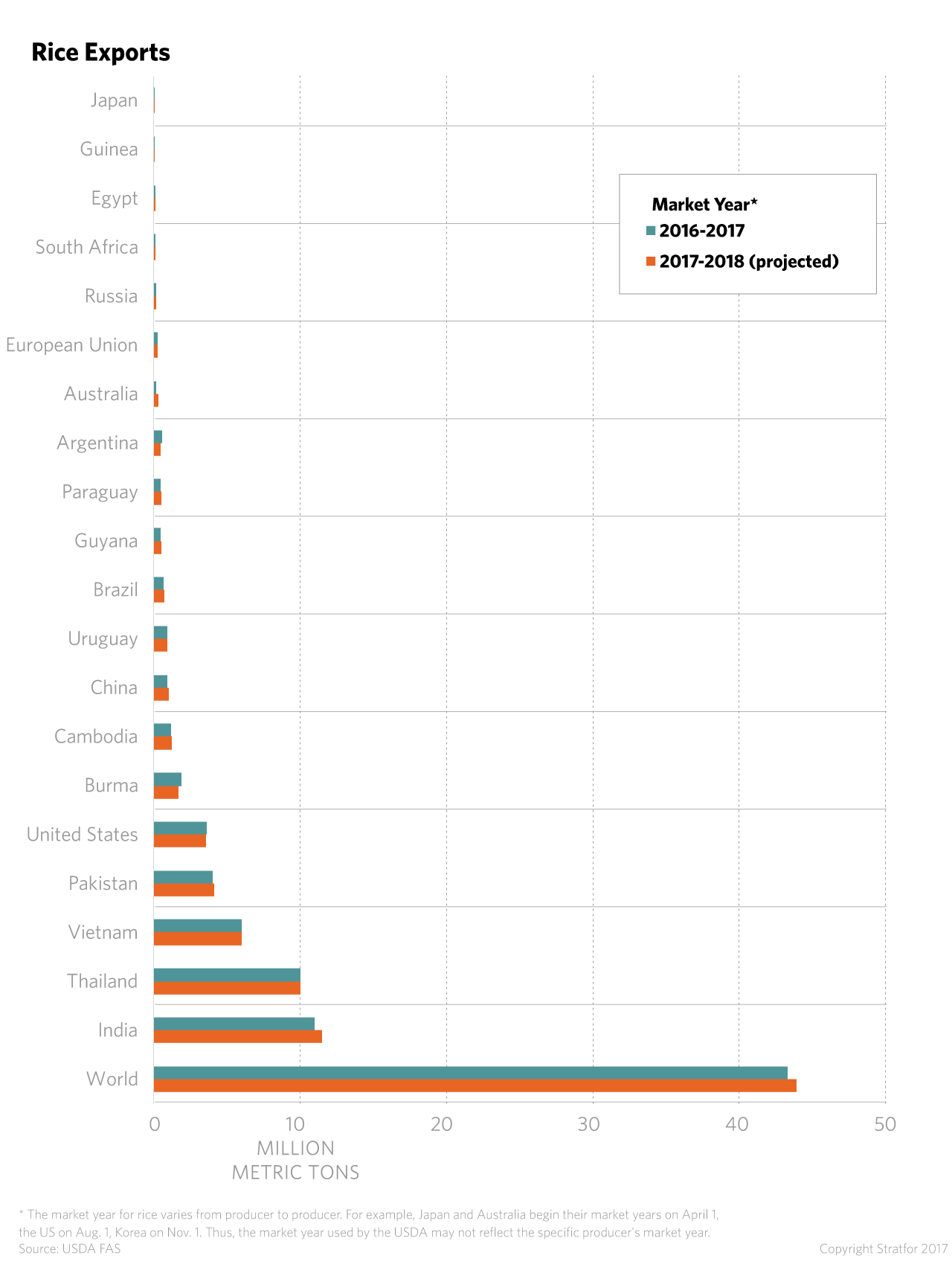
Though the dawn of this liberal economic order has caused the global rice trade to quadruple since the 1980s, those exchanges still involve less than 10 percent of the globe's total rice output. Instead, a few producers — all of which are located in South Asia and the Asia-Pacific, with the exception of the United States — dominate rice exports worldwide. And in a region where government performance is often closely intertwined with the production and cost of rice, Asian officials have every reason to ensure that output and supply levels stay steady.
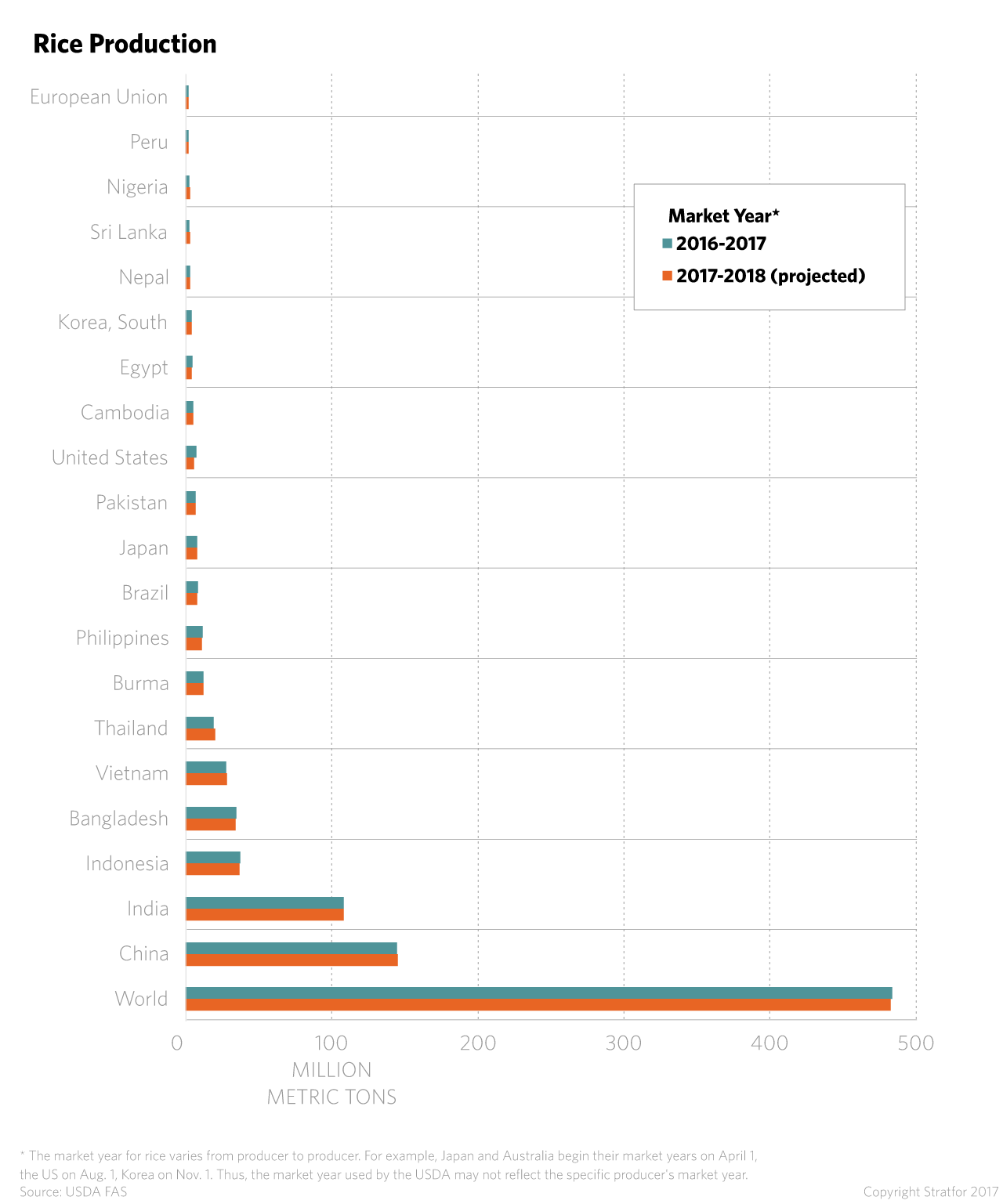
Of course, not all rice is created equal, at least in the eyes of the consumer. The grain boasts more than 20 different variants, broadly categorized as fragrant or non-fragrant, and buyers aren't always willing to trade one for another. Such preferences matter, since producers specialize in cultivating different strains. India and Pakistan, for instance, have a clear lead in the export of basmati rice (which, along with the jasmine variety, is one of the two most prominent types of fragrant rice) to the Middle East and Europe. In fact, thanks in large part to Indian exports, basmati rice production has exploded in recent years. Meanwhile, jasmine producers are clustered in Southeast Asia, where Thailand has long held the edge in output, though it has been joined by up-and-comers Vietnam and Cambodia in recent years.
As is true for many products, rice consumers also put a premium on quality. Producers whose grain is typically deemed lower quality, such as Vietnam, often compensate by trading their goods at a discount to those of higher-quality producers like Thailand. Governments routinely wade into the industry as well, propping up otherwise-uncompetitive growers and implementing price controls to protect local farmers. According to the Organization for Economic Cooperation and Development, rice producers received $60 billion in subsidies in 2014 — a staggering figure, considering the total value of rice traded globally that year was roughly $20 billion.
Ingrained in Global Tradition
Over the past few years, these protective measures have led to several important shifts in the international rice market. India, which has always been a large rice producer, surged to the top of the world's rice exporters with the help of subsidies and a weak rupee. The expansion of crops has only added to the considerable strain on India's water resources, and New Delhi will find it increasingly difficult to meet the industry's irrigation needs if it does not quickly enact water use reforms.
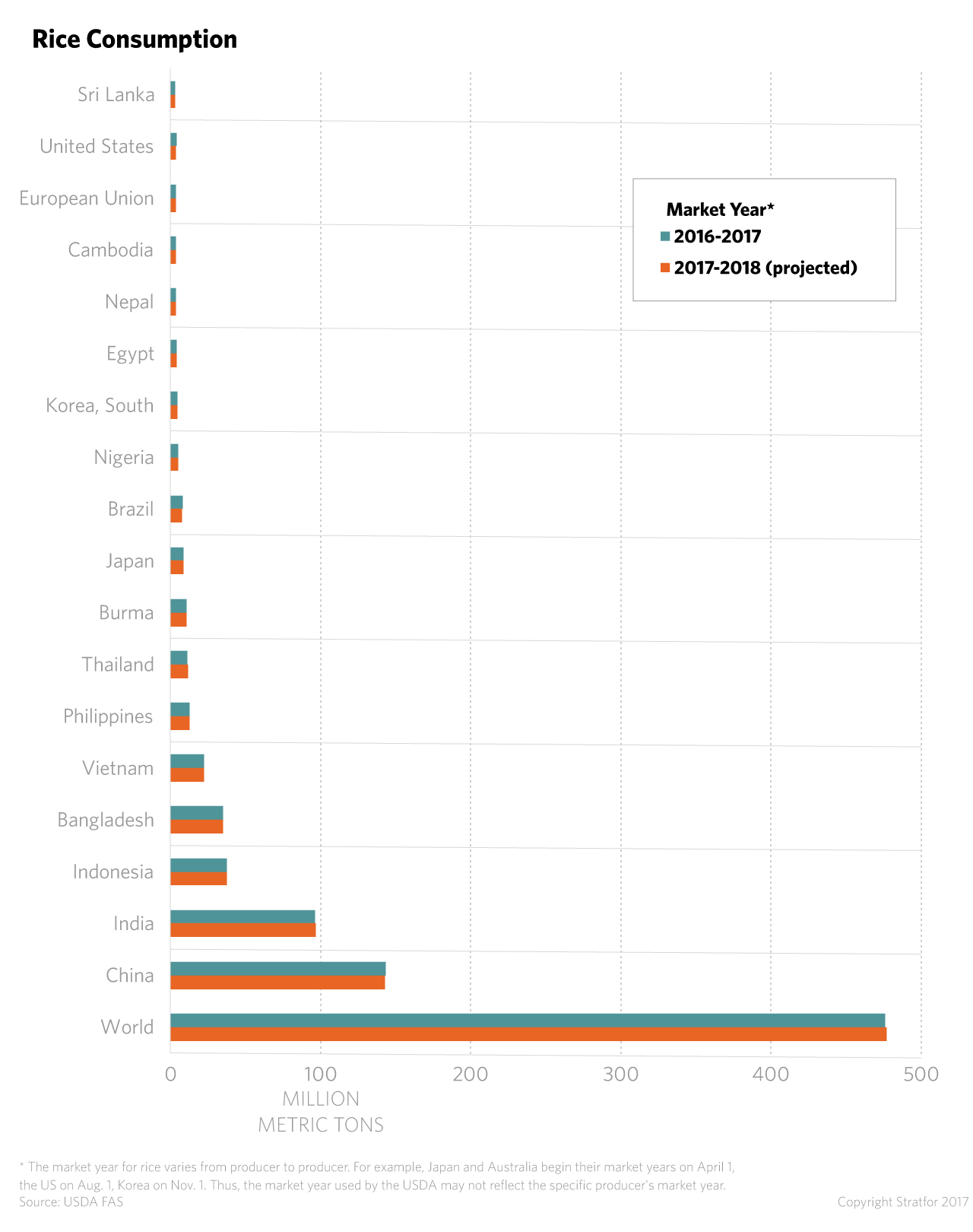
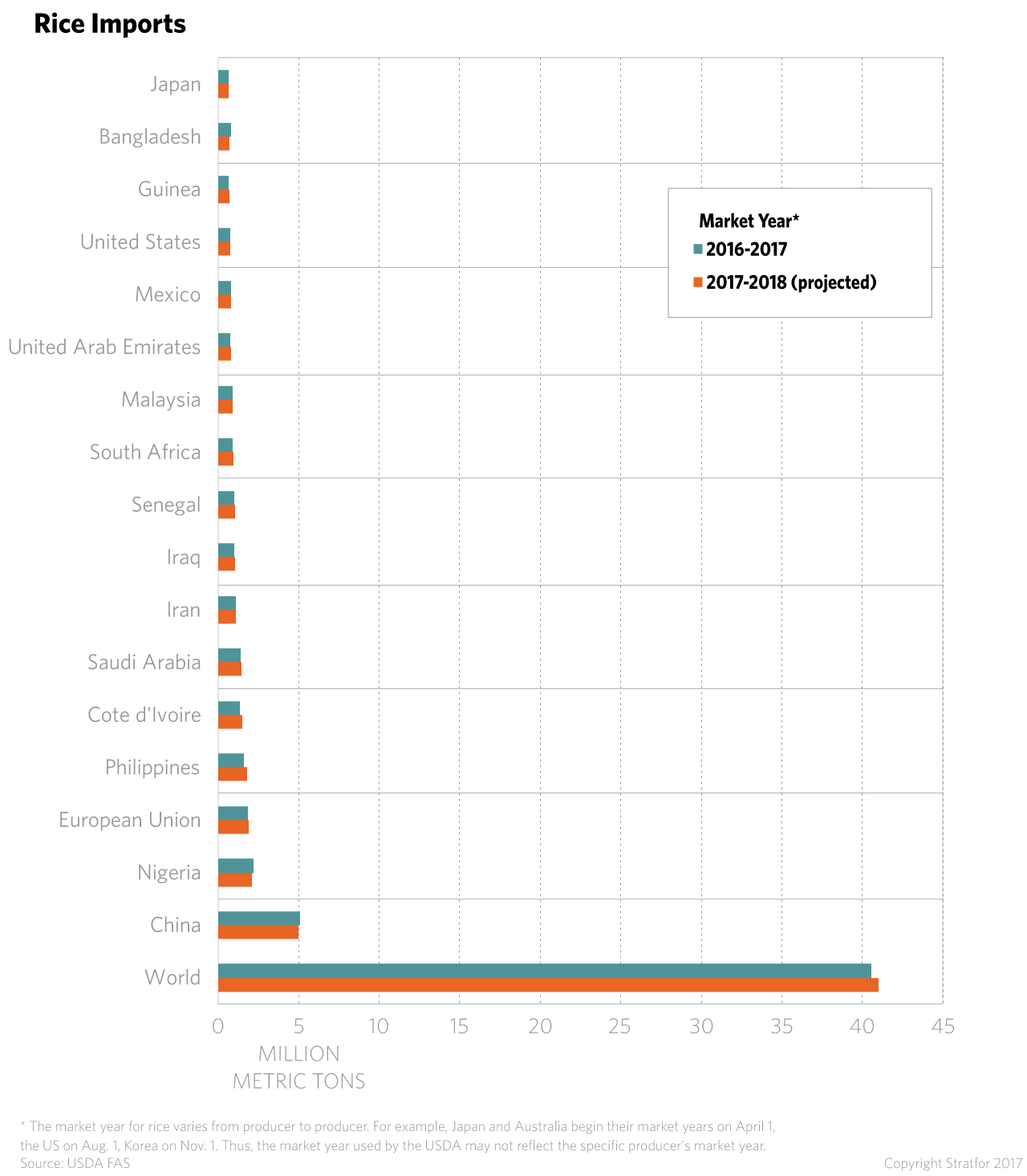
Much like India, China has also taken steps to bolster domestic rice production. But high rice prices buoyed by government funding, coupled with rising consumption at home, ironically have transformed China into one of the world's biggest rice importers. Despite the restrictive import quotas Beijing has implemented, rice grown outside China's borders is simply much cheaper than rice grown within them. So while the government's regulations have ensured that rice grown abroad accounts for a small percentage of the country's consumption, the sheer size of the Chinese market has guaranteed the nation a crucial role in the global rice market.
China's insatiable demand for imported rice won't disappear anytime soon. Nor will the subsidies Beijing provides for its farmers, though the government is expected to lower artificially high prices by 1.5 percent in the 2017-18 growing season. Determined to pry open the Chinese market, the United States filed a suit against China in the WTO late last year, citing Beijing's import quotas for rice, wheat and corn. But although Washington may have some success in gaining access to other grain products, rice is likely to remain closely protected because of its significance to Chinese culture. And given China's status as the world's largest rice importer, it will have the heft to dictate many barriers in the industry, including phytosanitary regulations — a type of measure that will likely be at the center of Beijing's future trade talks with Washington. Meanwhile, China's influence over global rice production reaches beyond its own consumption patterns and protective measures. Rice farmers in Thailand and Vietnam, for instance, rely heavily on the Mekong River to irrigate their crops, but China has sought greater control over the water source in hopes of boosting its influence throughout the region.
Nevertheless, Southeast Asian rice producers may pose a bigger threat to themselves than China does. The success of many regional governments is intimately linked to that of rice, and administrations often use aid for the sector to shore up their support among rural communities. Thailand, for example, spent $16 billion between 2012 and 2014 to prop up local farmers in the face of growing competition from its neighbors and stubbornly low commodity prices abroad. The country's unstable political structure and dwindling funds, however, have led to numerous adjustments in the subsidy scheme, introducing more uncertainty into the market. And in countries where rice is part of a society's cultural fabric, such as Thailand, officials could try to keep the sector's subsidies in place long after they have proved financially unsustainable — to the detriment of domestic rice producers in the long run.
The heavy subsidies of the past few decades have already spurred overproduction in the international market. Despite attempts by the Thai and Vietnamese governments to persuade rice farmers to switch crops, global output has swelled to just over 42 million tons — lower than levels seen in 2014, but higher than those in 2016. Much of this year's growth can be attributed to Vietnam, whose rice production has risen alongside Middle Eastern demand. Because the populations of the Middle East and Africa are poised to increase in the years ahead, competition will intensify among the world's major rice producers as they seek to carve out a share of both markets.
The Root of Asian Trade Talks
Protectionism isn't reserved for the developing world, either. Though Japan and South Korea play only minor roles in the global rice trade, each has tariffs of 200 percent or more in place in the sector and spends billions of dollars per year on rice subsidies. By comparison, producers in the United States, which is the only developed country with a place among the world's top five rice exporters, receive less political and social support than their Asian peers.
Because the United States grows far more rice than it consumes, American farmers rely on exports — and by extension, advantageous trade agreements — to make ends meet. This explains why U.S. rice producers were disappointed with the Trans-Pacific Partnership when it was initially signed: They gained little new access to the Japanese market, which was already prone to devaluing American rice by leaving it in storage or including it in food aid shipments. Moreover, Mexico agreed to eliminate duties on rice imports from Vietnam — one of the United States' main competitors in the Mexican market. Though Washington ultimately withdrew from the multilateral pact, its history is telling of the challenges that lie ahead for the bilateral trade talks meant to replace it.
The United States' trade pact with South Korea is one such deal up for renegotiation — at least, Washington hopes. Seoul has already promised to reject any changes to the two countries' existing agreement that are not recommended by an objective joint commission. Should the talks reopen, however, rice may prove to be as sticky an issue as it was in 2007, when negotiators took the topic off the table to ensure the deal's initial implementation.
In the coming months, rice will remain at the heart of trade negotiations involving Asia's biggest rice producers and consumers. As we have seen in recent bilateral deals between the European Union on one hand and Japan, Mercosur and Canada on the other, even small points of controversy can delay or derail trade agreements, particularly when it comes to agriculture. And rice is no small matter to most Asian nations. Still, while some countries may be tempted to exclude the sector from trade talks in order to push them forward, the global rice market will continue to be plagued by the volatility and inefficiency that come with excessive subsidies if steps are not taken to moderate them.
