
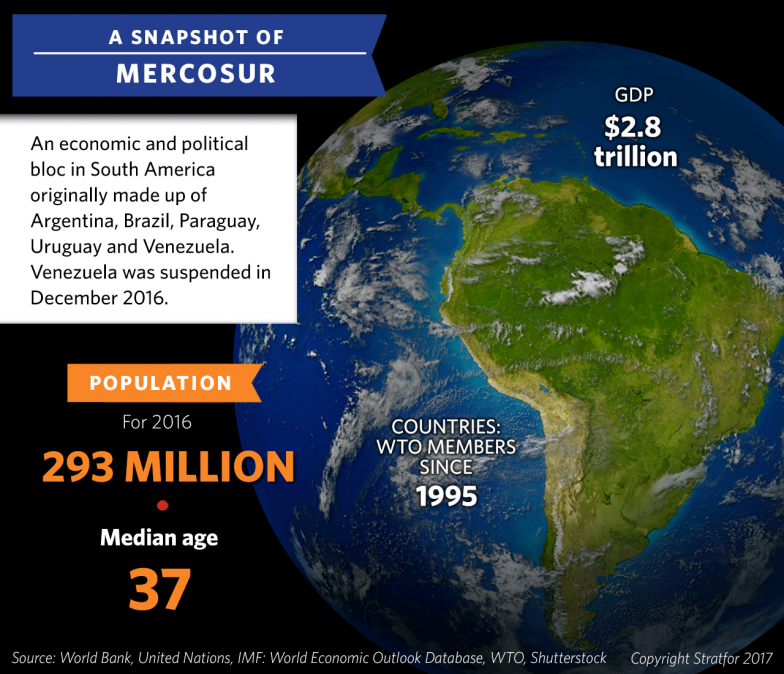
Internal divisions are again on display in the Common Market of the South, commonly referred to as Mercosur. Uruguay's Foreign Minister Rodolfo Nin Novoa announced Aug. 14 that South American custom union will call a meeting to discuss Brazil's recent labor reform, which Uruguay opposes. While an exact date for the meeting is not yet set, Novoa is invoking the trade bloc's authority to argue that the Brazilian labor reform violates Mercosur's Social and Labor Declaration because it enables Brazil to be more competitive at the expense of labor rights.
Brazil's revised labor rules include changes that effectively reduce the exposure of companies to labor lawsuits. On Aug. 15, the Brazilian government requested Uruguay submit an explanation for the proposed Mercosur meeting, arguing that its labor reform is aimed at modernizing labor laws and doesn't necessarily take away labor benefits.
The dispute shows how Brazil's economic reform is putting pressure on its Mercosur trade partners to implement similar policies. It's unlikely that Brazil will reverse its reform because of Uruguay's demands. Moreover, Mercosur's labor declaration isn't a treaty enforceable by the bloc. It's more likely that Brazil's labor reform will encourage other member countries, such as Argentina, to follow suit and implement similar policies.
In fact, Argentine President Mauricio Macri plans on sending to its Congress a similar labor reform proposal making its country's labor rules more flexible. Some of the changes would include more flexible collective labor agreements or the possible replacement of these agreements with individual employer-employee contracts. Of course, Argentina's influential labor unions will strongly oppose this kind of labor reform. The October legislative elections will be key for Macri to strengthen his ruling coalition in both houses and to move forward with economic reforms.
Uruguay, meanwhile, refuses to follow suit because there aren't favorable political conditions in the country to move forward with such proposals. But Montevideo won't have many options within Mercosur this year to oppose Brazil and Argentina as they push toward economic liberalization. Uruguay likely hopes a center-left Brazilian president is elected in 2018. Even a populist revival in Argentina in 2019 could reverse the region's trend toward economic liberalization, benefitting Uruguay.
Brazil's labor reform will, in the short term, force more Mercosur members to try to implement similar proposals rather than reverse it. They'll have to if they wish to remain competitive in the marketplace. Regardless, Mercosur's largest economies are taking small steps toward economic liberalization, and labor reform is part of it.
