
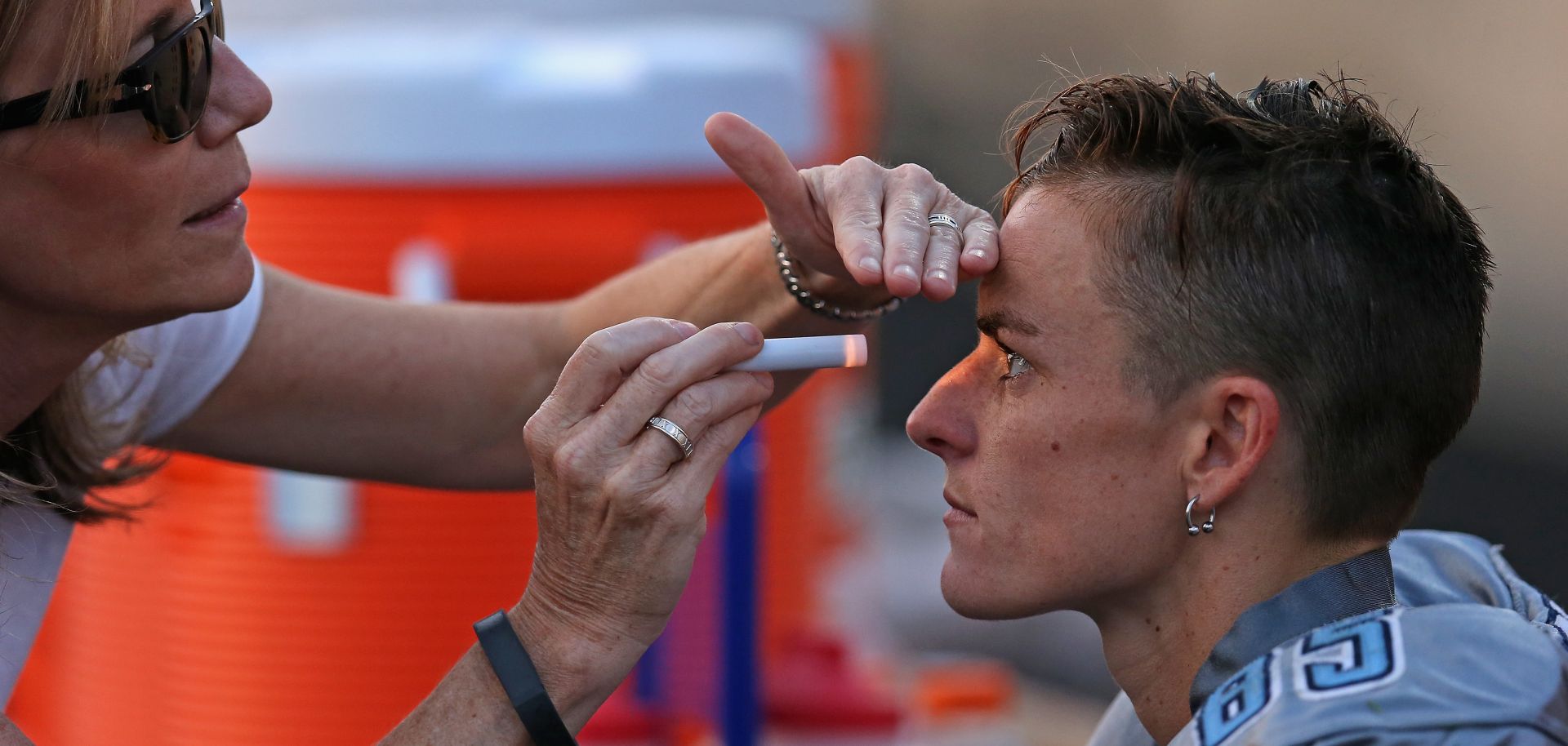
Holly Peterson, #85 of the San Diego Surge, submits to a concussion test on the sidelines during the Women's Football Alliance National Championship game against the Boston Militia at Lane Stadium on Aug. 2, 2014 in Chicago, Illinois. The Militia defeated the Surge 69-34.
We tend to celebrate sports as a domain of the unexpected, but the past month has been a reminder of the cosmic balance, when moments that shock are offset by the all-too-predictable. In July, 37-year-old Venus Williams made an unexpected Wimbledon finals appearance, and Major League Baseball's All-Star Game wound up being an unusually low-scoring affair. Perhaps the most surprising moment of the month was the announcement that Vice Sports — part of the burgeoning Vice Media empire and one of the best outlets for sports journalism to recently emerge — was shutting down. Of course, counterbalancing those eyebrow-raising developments was a bit of business as usual: British cyclist Chris Froome claimed his third straight Tour de France title, his fourth in five years.
For many fans, however, the month's biggest stories merely confirmed the ugly truths lurking behind two of the world's biggest and most popular sports: Big-time soccer is patently corrupt and American-style football is bad for the brain.
Another Day, Another Soccer Scandal
Just like the English national soccer team's tendency to lose a big match on penalty shots, high-level corruption has become a predictable facet of the beautiful game: From the dubious bidding process that steered the 2022 World Cup to Qatar to the sweeping FIFA corruption scandal of 2015, scandal is all but the norm. This month, in a case that will inevitably be linked to the ongoing imbroglio engulfing soccer's international governing body, Spain's highest-ranking soccer official was jailed on a broad range of corruption charges. On July 18, Spain's Guardia Civil arrested Royal Spanish Football Federation President Angel Maria Villar and four of his deputies, including his son Gorka Villar. A week later, with the men showing no signs of stepping down from their posts, the Spanish government suspended the group, ending the elder Villar's three-decade reign as the head of one of the world's leading federations. The yearlong suspensions are subject to revision as evidence is gathered.
To soccer fans, the laundry list of charges will ring familiar: improper management, misappropriation of funds, corruption and falsifying documents. At the heart of the case is the allegation that Villar channeled money to the federation's regional bodies in exchange for the votes that kept him in power for eight consecutive terms. While this brand of belligerent mismanagement may no longer be particularly shocking, the story highlights the unabashedly incestuous world of global sport governance. In addition to being head of the Spanish football association, before he resigned those positions on July 27, Villar was also a senior vice president of both FIFA and UEFA (European soccer's governing body). Yes, he was on the board that governs his federation and on the board that governs the federation that governs his federation. No, this is not a particularly unusual arrangement. The younger Villar made the family business intercontinental, previously serving as legal director and director-general of the South American Football Confederation. Both men have been closely linked to individuals indicted by the U.S. Department of Justice in the aforementioned FIFA corruption probe.
Like most cynical fans, I expect little meaningful change will emerge from this most recent scandal. The accused will be lambasted for corrupting the fundamental good of the sport, the legal proceedings will drag on, the cronyism will continue, and we'll keep tuning in. The final score may be the only thing that remains unpredictable.
A Jarring Finding for NFL Players
In equally depressing news, a recent study in The Journal of the American Medical Association added to the mounting pile of evidence linking American football and chronic traumatic encephalopathy, or CTE, a degenerative disease of the brain believed to be caused by repeated head trauma. CTE has been linked to a host of symptoms, including depression and dementia, and it has been cited as a potential risk factor in suicide.
Neuropathologist Dr. Ann McKee, the author of the study and director of the CTE Center at Boston University, has emerged as the leading expert on the condition. The study examined the brains of 202 deceased football players from all levels, including 111 who had played in the NFL. All but one of the former NFL players were found to have CTE. McKee did note that the findings carry a "tremendous selection bias," as the brains of many of the subjects studied were donated by families because the athletes had demonstrated symptoms of CTE. Nonetheless, the incidence of the condition is staggering. As Joe Ward noted in The New York Times, "About 1,300 former (NFL) players have died since the B.U. group began examining brains. So even if every one of the other 1,200 players had tested negative — which even the heartiest skeptics would agree could not possibly be the case — the minimum CTE prevalence would be close to 9 percent, vastly higher than in the general population."
The study's findings on non-NFL players also seem to confirm that CTE is a cumulative condition: The brains of former high school players showed fewer signs of the condition than those of collegiate and professional players. The buildup of damage over time is arguably the most damning aspect of the findings for the NFL. After years of denial, the league has recently acknowledged the link between the sport and the condition. It has focused its safety efforts on reducing major head trauma and improving concussion protocols. Meanwhile, equipment manufacturers are regularly introducing helmet technologies to try to address the situation. While these efforts are commendable, they may amount to little more than an adhesive bandage on a bullet wound. The work of McKee and other researchers increasingly points to the relationship between repeated, sub-concussive blows to the head and CTE. These less severe hard knocks occur on almost every play of every game; nothing short of completely changing the game could eliminate them.
In some ways, the average fan's perspective is much the same as it is in the soccer world: We begrudgingly accept this reality. We know that such a brutal game couldn't be good for the people who play it. But the mounting evidence suggests that we have greatly underestimated the risks, noting visible orthopedic damage while ignoring the unseen misery beneath the surface. Thus, it seems that those who love the game and don't want it to go away must embrace the ugly truths of the emerging science and hope that the work of people like McKee eventually leads to viable solutions for treatment and prevention of CTE.
For now, I've got my fingers crossed for a less predictable August.
