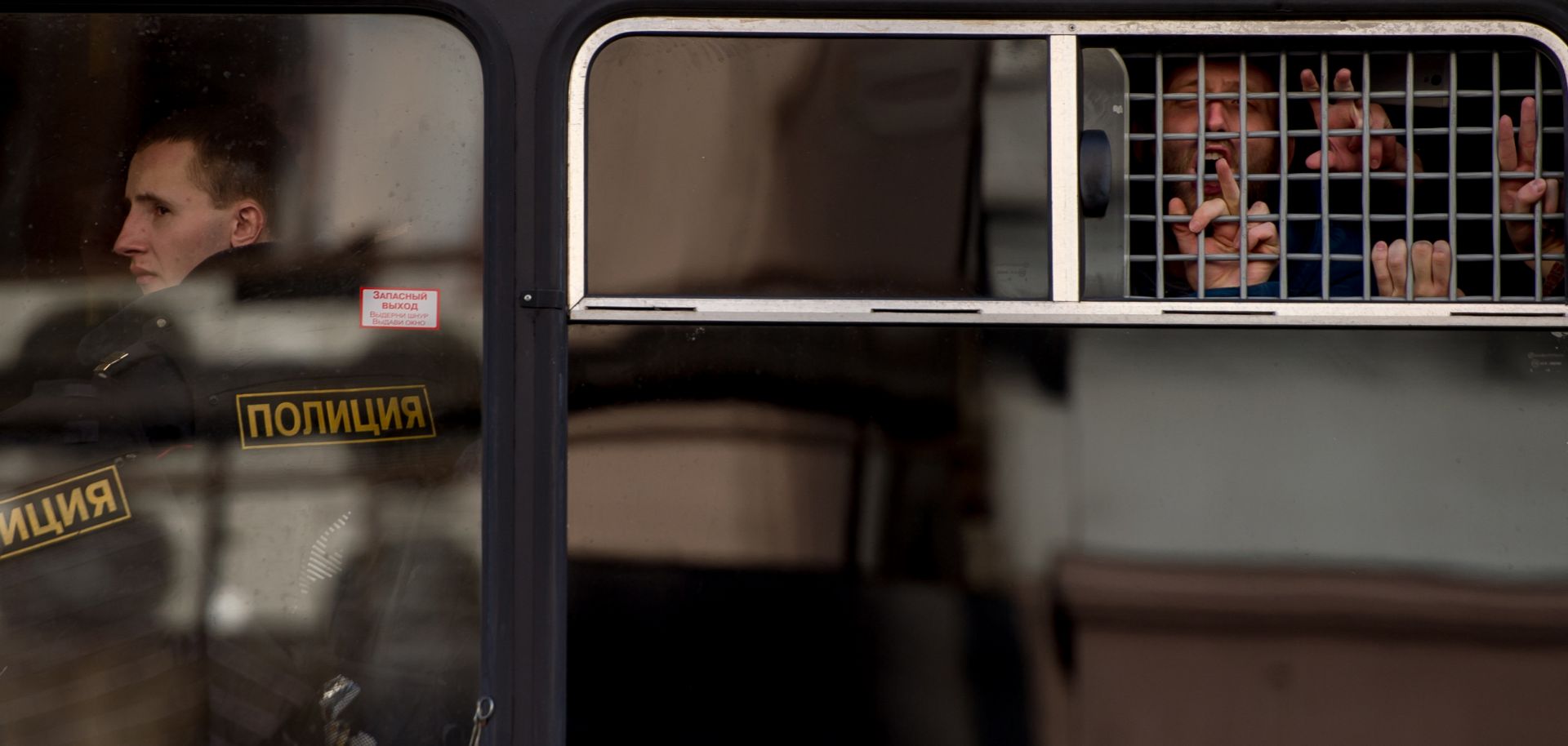
Protesters gesture from a police bus after being detained during an unauthorized anti-corruption rally in central Moscow on March 26. Thousands of Russians continue to demonstrate across the country to protest against corruption, defying bans on rallies called by prominent Kremlin critic Alexei Navalny -- who was arrested along with scores of others. Navalny called for the protests after publishing a detailed report accusing Prime Minister Dmitry Medvedev of controlling a property empire through a shadowy network of non-profit organizations.
Protests in Russia have expanded over the past few months. This is an evolution of a yearlong trend toward frequent demonstrations in response to a weakened Russian economy that has fallen into recession and stagnancy. The political system set up under Russian President Vladimir Putin is also starting to buckle under the strain. The
mass protests of 2011-2012 were leveled squarely against election rigging and Putin's return to the presidency. They also drew support from across the entire political spectrum. The current demonstrations similarly stem from all parts of Russia's diverse population, but the difference this time are the various agendas at play.
The protesters can be broken down into distinct groups, though the borders between some elements are increasingly blurred.
Truckers
The protest by
Russia's haulage community, also known as Plato or Platon, is led by long-haul truck drivers that oppose the federal tax hike on cargo. Thousands of truckers are either not showing up for work or forming protest camps. The demonstrations have already disrupted Russia's supply chain in at least 30 regions. Dagestan is among the worst hit republics, with bakeries shutting down because no flour is getting delivered.
Navalny and the Grassroots Movement
In March,
opposition leader Alexei Navalny organized an ongoing remonstration against government corruption. The politician stirred up anti-corruption sentiments across six Russian cities, leading to protests. The movement metastasized through social media, spreading beyond Navalny's platform and messaging and eventually prompting thousands hit the streets in nearly 80 of the 85 Russia-recognized regions. Navalny's efforts have galvanized a
non-Soviet generation of young Russians to express their displeasure, using social media to organize beyond Kremlin control.
Open Russia
Hundreds of people protested on April 30 against Putin himself. They were organized by former opposition leader Mikhail Khodorkovsky's Open Russia, an anti-Kremlin group banned in April. Though Khodorkovsky is no longer in Russia, he still has a strong following among Russian liberal reformists. Despite sharing similar viewpoints, Khodorkovsky and Navalny's factions tend to compete rather than cooperate. As Khodorkovsky put it, Navalny cannot have a "monopoly on the opposition."
The Kremlin's greatest concern is not the individual groups themselves, but the potential for a mass protest movement to emerge, unified and coordinated using modern technology. The crossover of Navalny and the grassroots movement has already sparked concern. Still, the Kremlin has not figured out a way to challenge dissenting attitudes among the younger generation, nor how to prevent non-Kremlin messaging from spreading on social media.
It's important to note that previous mass protests were sparked by single events, whereas the current protests are in response to deeper problems related to the economy and Russia's political system. This is something the Kremlin cannot simply ignore. Yet, as of now, Moscow continues to crack down on protest movements instead of addressing the underlying issues fueling the unrest.