
West Africa has been home to many empires throughout history. The Mali Empire established itself as a regional powerhouse in medieval times through of its exports of gold, as well as salt, and its control over the Sahara trade routes from West Africa. The region later became a prized possession in France's colonial holdings and served as a haven for the country's troops to recover from their initial losses in World War II. Today, Nigeria has assumed an increasingly influential role in West Africa thanks to its oil wealth and vast population. The Niger River basin nourished these powers, providing the resources necessary to build and sustain empires. And its natural advantages will continue to make West Africa a seat of power, if the region's longstanding problems don't get in the way.
A River Runs Through It
Four distinct geographic zones make up West Africa, each offering its own set of challenges and opportunities. The arid Sahara desert dominates the northern area, contained mostly in modern-day Mauritania, Mali, Niger and Chad and sparsely inhabited by nomadic peoples such as the Tuaregs. The Sahara has played a significant role for West African empires at various points in history, serving as a conduit alternately for trade and for invading forces from the surrounding region or beyond. Just south of the desert area lies a belt of savanna whose hospitable climate and wealth of arable land have made it one of West Africa's natural population centers. Agriculture becomes more difficult, and the population less dense, in the stretch of rainforest a bit further south. But fishing and trade opportunities along the Atlantic coast sustain another population center in the southernmost region.
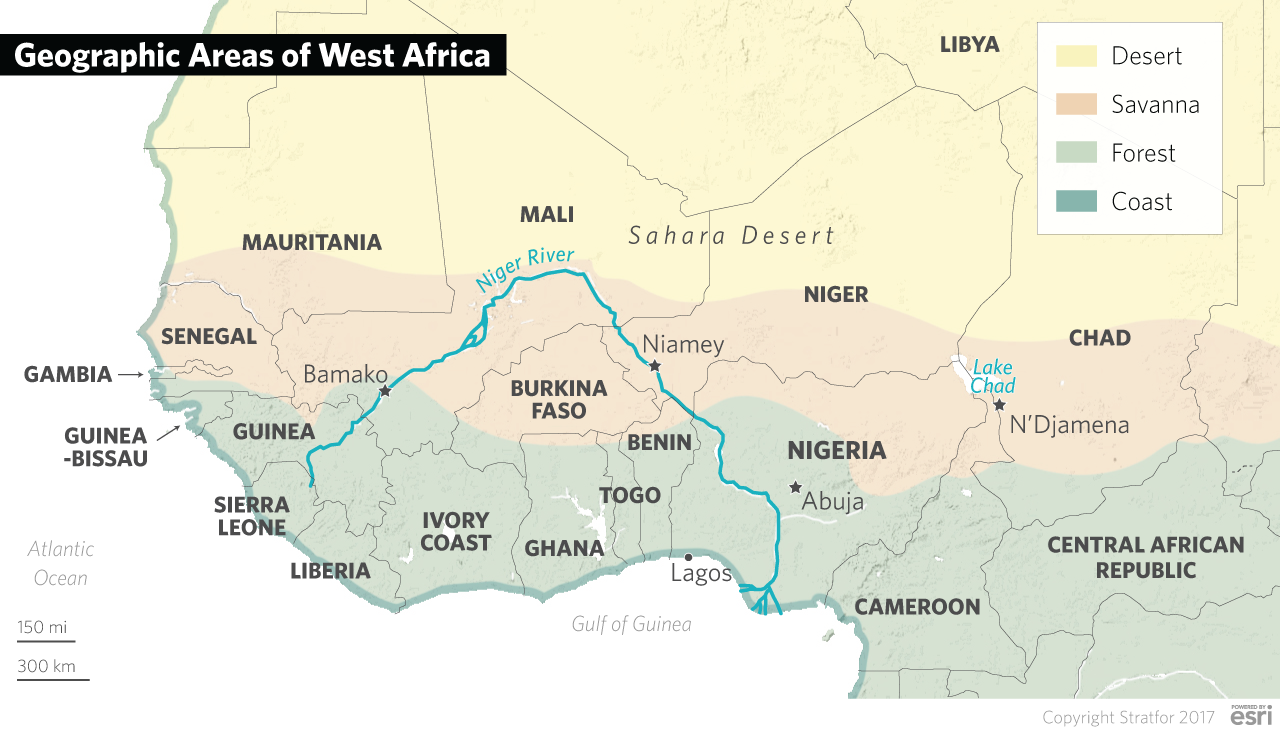
Through much of this varied and expansive landscape flows the Niger River. The river has facilitated movement between West Africa's major population centers, but perhaps more important, the surrounding basin with its network of tributaries fuels agriculture and sustains the region's inhabitants. The Niger River Basin also borders right on the Lake Chad Basin, which has likewise supported powerful civilizations past and present.
Empires in Seclusion
Despite its internal connectivity, West Africa is largely secluded from other parts of the continent. The barren Sahara desert buffers the region to the north, while thick rainforests insulate it to the southeast. These natural borders have historically kept West African civilizations focused on projecting their power inward rather than outward on neighboring populations. They have not, however, stopped conflict from breaking out, either among rival regional powers or between West African and encroaching foreign forces. As West Africa's borderland — and a strategic outpost for the French military — Chad has been the site of many such clashes. The country's forces fought off the Libyan army in the 1980s when it tried to invade Chadian territory. And its eastern border later became the frontline in a persistent battle with Sudan until the two countries normalized their relations in 2010.
Other countries in the region, such as Mali and Niger, have also struggled with security challenges throughout their history. The nations' nomadic Tuareg populations have long posed a danger to their stability, staging periodic rebellions over the years. But since the Libyan government collapsed in 2011, the proliferation of arms and Islamist groups in the countries' desert expanses has compounded their security problems. The vast and forbidding landscape of the Sahara desert is difficult for the resource-poor Malian and Nigerien governments to control and easy for militant groups to exploit. The situation was especially grave in Mali, where French forces led an intervention in 2013 to curb the expansion of Islamist groups.
Sustaining the Future
Nigeria, too, faces considerable security challenges at home, though it is far and away West Africa's strongest state today. The country, the region's most populous, has reaped the economic benefits of its abundant oil reserves. Unlike other contemporary or historical African powers such as South Africa or Ethiopia, though, Nigeria has never managed to wield its clout beyond its immediate surroundings. Instead, it has exerted its influence regionally through its role in the Economic Community of West African States, for example, or its involvement in United Nations peacekeeping operations. The country has also intervened in nearby states such as Gambia, Liberia and Sierra Leone during times of crisis in an effort to maintain regional security. But its future as a leader among West Africa's countries is not guaranteed. Unless the country can find a way to break its dependence on oil exports to sustain economic growth, its influence may well wane.
Nigeria's precarious position exemplifies a problem that has plagued West Africa throughout history: The region's prosperity relies on extractive industries. Gold and salt built the Mali Empire, and though oil has mostly superseded these goods over the last century, the gold industry is still crucial for several West African states. (The region's population centers show promise for low-end manufacturing, but industry has yet to make significant inroads.) By staking their futures on commodities, the nations of West Africa have left themselves vulnerable to fluctuations in global trade. And their future sway on the continent and in the world will depend in large part on their ability to transition to a more sustainable economic model.
