
Few expected the fight to retake western Mosul from the Islamic State to be easy. But recent satellite imagery shows just how high a toll the battle has already taken on the Iraqi city's residents.
Battered by U.S. airstrikes and persistent clashes between Iraqi and Islamic State forces, western Mosul has taken a beating over the past few weeks. According to several recent reports, at least 141 civilians were killed in the neighborhood of Jadida in mid-March, around the time that the United States launched a series of airstrikes in the area. An ongoing investigation into the incident has yet to rule conclusively on what the airstrikes' role in the casualties was.
Several high-ranking officials in the U.S. military have indicated that the Islamic State used Jadida's civilians as human shields. Others have raised the possibility that the jihadist group rigged Mosul residences with explosives and detonated them while the buildings' occupants were still inside. From satellite images taken on April 2, it is unclear whether airstrikes or explosives caused the damage to the western portion of the city. What is clear, however, is the extent of the destruction.
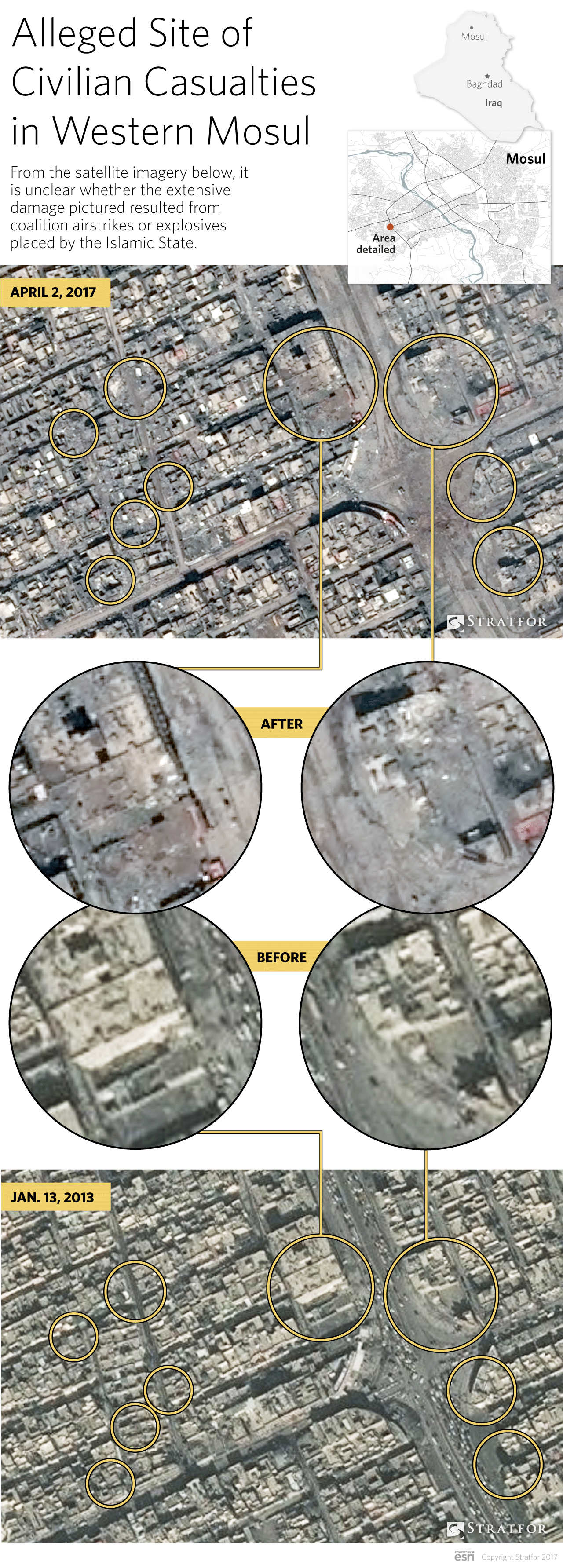
A number of houses in the neighborhood have partially or completely collapsed as a result of explosions. Though a considerable share of these houses are still standing, satellite imagery cannot give any insight into the structural damage that may have been done below their roofs. The way in which the wreckage is dispersed also indicates that it was caused not by a single explosion, but by several different ones throughout the neighborhood.
The steep civilian price tag highlights the obstacles the Iraqi military — and the U.S.-led coalition backing it — have encountered in the operation to recapture western Mosul. In the more densely packed half of the city, more civilians are present as the troops maneuver through crowded residential areas. In the case of Jadida, in particular, an account by Iraqi forces suggests that Islamic State fighters gathered residents into buildings before positioning snipers on the rooftops, where they shot at advancing troops in hopes of drawing fire from U.S. aircraft.
Yet even in the absence of such traps, the risk of civilian casualties is substantially higher in Mosul's western half than it was in the city's east. This fact will continue to create problems for coalition forces as they struggle to clear the embattled city of the last isolated jihadist pockets left in Mosul.
