
The IPO is intended to raise money for the country's Vision 2030 reform plan, but for the sale to be as lucrative as possible, Saudi Arabia first had to lower tax rates to more competitive levels. In theory, a reduction in taxes should increase the amount investors are willing to pay for a stake in Saudi Aramco, driving up the initial sum that Saudi Arabia can expect to receive through the IPO.
Changing the income tax rules also signals to the world that Saudi Arabia is serious about the IPO and will not back down from it. This also means that the kingdom is likely committed to fostering the health of the global oil market by continuing to back OPEC production cuts, which are up for extension on May 25. Saudi Arabia's goal is to push global oil inventories closer to five-year averages at the time of the IPO so as to attract the most interest it can. Of course, even the best-laid plans often go awry: Russia — the country cutting the most production outside OPEC — has been noncommittal in its support for extending the cuts and was probably behind the monitoring committee's sudden abandonment of its proposals for renewing them. (Russia is one of five members in the monitoring committee, and all four of its fellow members have publicly backed an extension.)
Changing Saudi income tax rules signals to the world that Riyadh is serious about its IPO of Saudi Aramco and will not back down from it.
By making the income tax changes retroactive to Jan. 1, Saudi Arabia is also voluntarily reducing its oil revenue for the year. Riyadh was already expecting a budget deficit of 198 billion riyals in 2017, assuming oil prices stayed around $50 to $55 per barrel and that around 85 percent of Saudi oil export revenue ended up in government coffers. In total, the government expected to earn 480 billion Saudi riyals in oil revenue. Under the new regulations, that is unlikely to happen, though a significant portion of Riyadh's losses could be made up through increased dividends. To account for any shortfalls, Saudi Arabia will likely need to draw even more money from its foreign exchange reserves (which stood at $524 billion at the end of January), borrow more from financial markets and/or increase its revenue taxes on companies outside the energy sector. Saudi Arabia already sold off $17.5 billion in bonds in October.
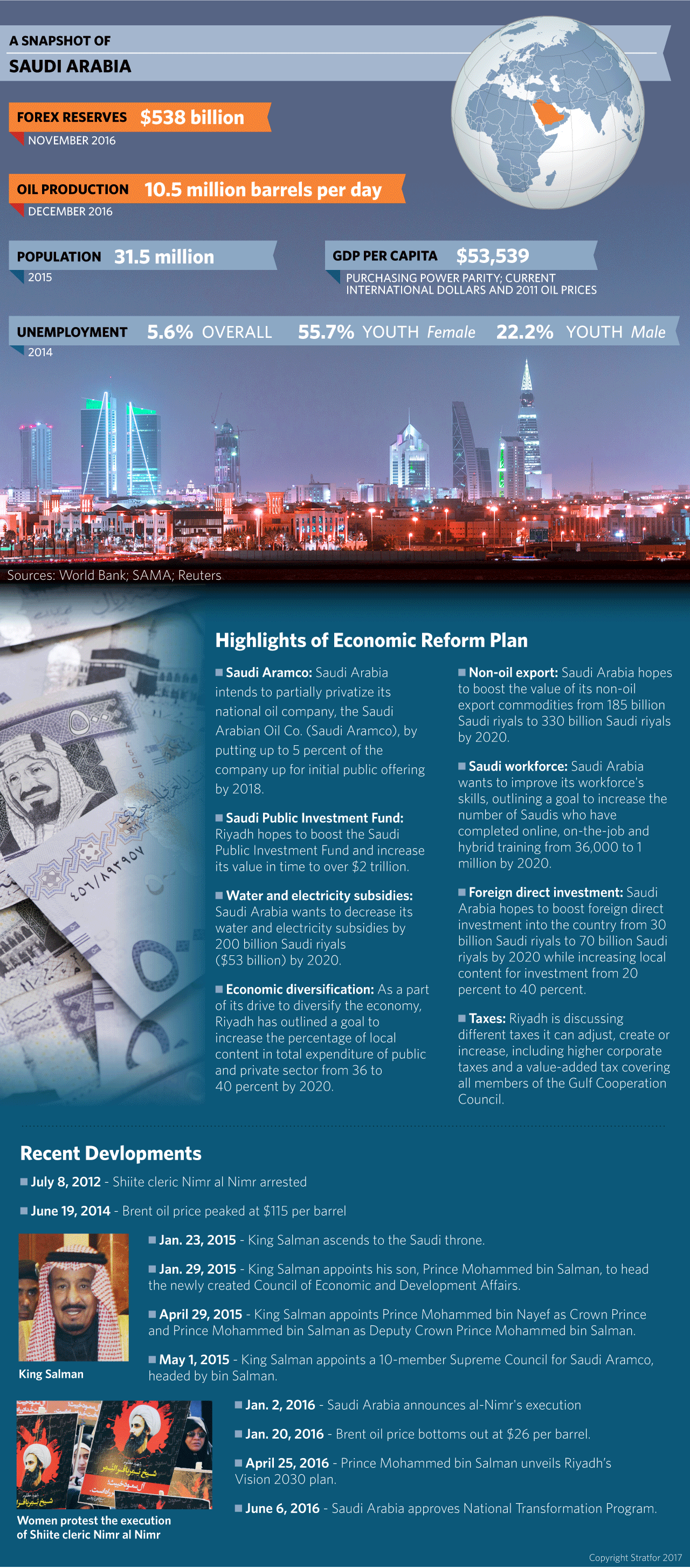
But the Saudi government has been counting on some short-term pain for long-term gain. Historically, Saudi Aramco, the oil sector as a whole, and a few other large public entities have been the primary revenue generators for the Saudi state. Under Riyadh's Vision 2030 and five-year National Transformation Program, Saudi Arabia wants to boost its non-oil revenue from the 199 billion riyals it earned in 2016 to 530 billion riyals by 2020. The government hopes to meet its lofty goal through subsidy reform, the Gulf Cooperation Council's (GCC's) proposed value-added tax and incentives for foreign workers, among other things.
In fact, just as the tax cuts for Saudi Aramco were announced, the Saudi Housing Ministry announced that it would be releasing its plans this week for taxing undeveloped land in urban areas. The taxes are expected to generate between 50 billion and 75 billion Saudi riyals per year, potentially replacing up to a third of the revenue lost by reducing the tax burden on Saudi Aramco. As with any new tax measure planned or implemented in Saudi Arabia, however, the government's enforcement does not always match its intention. Private landowners will probably be reluctant to pay the new tax, as they were in the United Arab Emirates when a similar tax was implemented in recent years. Because there is little history in the GCC of such large-scale taxation, it is unclear how well — or whether — companies will accept the new rules, and the extent to which the Saudi government will enforce them.
Regardless of implementation, Saudi Arabia will take a slight hit to its finances in 2017 and 2018 before many of the new tax measures are rolled out. Though it will be difficult for Riyadh to hit its target for non-oil revenue by 2020, given the downturn in the global oil market, it has little choice but to make the painful (if necessary) economic adjustments, no matter the cost.
