
An offensive by U.S.-supported Syrian Democratic Forces against Islamic State-held positions on the south shore of Lake Assad, the reservoir impounded by Tabqa Dam, on March 22 has allowed them to secure their first beachhead south of the Euphrates River. Attackers borne by boats and U.S. helicopters took the Islamic State by surprise, and the SDF has made rapid progress in spreading out from the initial positions they captured.
For the past few months, the SDF, with heavy U.S. support, has been involved in an operation to cut off Raqqa, which sits along the northern banks of the Euphrates, as allied forces prepare an offensive against the Islamic State-held city. As part of that effort, the SDF moved rapidly south across a broad front toward the river, reaching its banks and covering more than dozens of kilometers on either side of Raqqa.
It was clear that the next stage of the offensive was going to involve a crossing of the Euphrates, with the ultimate aim of fully isolating the city by cutting off Highway 4 on the south side of the river. The surprise crossing at Lake Assad, which is significantly wider than the river itself, landed forces deep behind Islamic State lines. It is another way in which U.S. support for the SDF plays a vital role, affording it a level of mobility and flexibility that greatly increases its effectiveness.
The site of the SDF's landing is near the Tabqa Dam, the largest hydroelectric dam in Syria, and also close to the Islamic State-held Tabqa military air base, the largest and most significant in the Raqqa region. That base will play a pivotal logistics role in the latter stages of the Raqqa campaign.
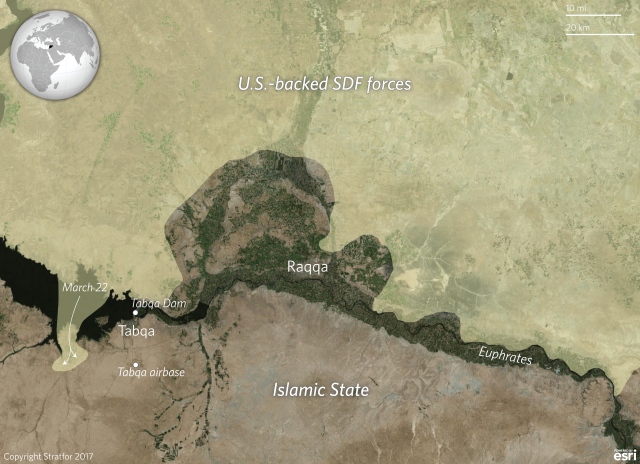
The landing cuts off Highway 4 at a significant distance from Raqqa, blocking the advance of Syrian loyalist forces that could interfere with the campaign. Loyalists had, in fact, been racing toward the city over the past few weeks, reaching the Euphrates northwest of the reservoir. Instead of allowing them to reach Tabqa, the town nearest the dam, which would enable them to block the Islamic State themselves, U.S. support helped ensure the SDF would capture these critical objectives.
The SDF's blocking position, coupled with a major rebel offensive in Hama that forced a shift in loyalist reinforcements, effectively ended the Syrian government's hopes of reaching the Raqqa battlefield. Russia had hoped the loyalists would achieve that goal, improving Moscow's negotiation position with Washington. By helping put the SDF in this strategic position, the United States has made considerable progress in blocking Russian and Turkish interference in the Raqqa battle. And the considerable U.S. backing has allowed the SDF to make steady progress in isolating Islamic State forces in Raqqa, setting the stage for the battle for the city.
