
Elections are stealing the spotlight this year, much as they did in 2016. Upcoming votes in France, Germany, the Netherlands and perhaps Italy have put eurozone members on edge and invigorated Euroskeptic parties across Europe. But in terms of sheer scale, the biggest election is taking place in India. In Uttar Pradesh, the world's most populous state, voters headed to the polls between Feb. 11 and March 8 to elect state lawmakers. For Prime Minister Narendra Modi, however, the vote's significance goes well beyond the state's legislature. The elections in Uttar Pradesh will serve as a powerful gauge of Modi's performance and that of the ruling Bharatiya Janata Party (BJP) with just two years to go before India's next general elections.
Checking In
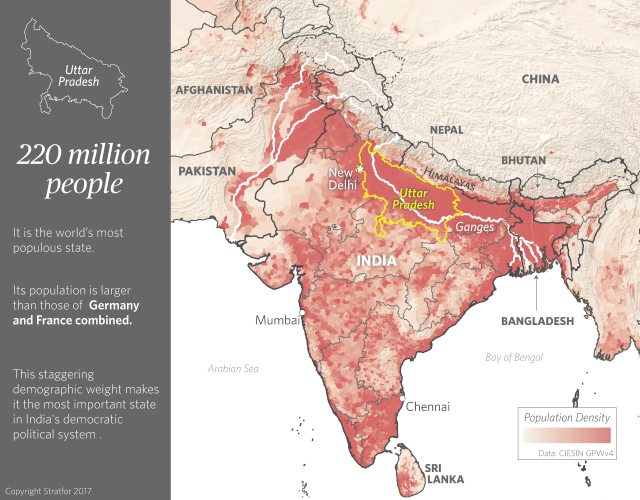
Uttar Pradesh is only one of seven Indian states holding elections this year. But its staggering demographic weight makes it the most politically consequential state in India's democracy. Home to 220 million people, Uttar Pradesh boasts a population larger than those of Germany and France combined. Modi, moreover, owes much of his surprise victory in the 2014 national elections to his performance in the state. The election was a runaway success for the BJP, which trounced the incumbent Indian National Congress to become the first party in 25 years to win a majority in the legislature's lower house. (Nationwide, the BJP won just 31 percent of the vote, but in a political landscape as crowded as India's, that figure constitutes a landslide.) In Uttar Pradesh, the party came away with 71 of the state's 80 lower house seats — a feat made all the more impressive by the fact that the state was governed by the Samajwadi Party. That party, by contrast, bagged just five seats in Uttar Pradesh.
Modi's campaign, built on promises to boost employment and fueled by a strong command of social media, appealed to voters in the state. During the race, Modi touted his accomplishments as chief minister of Gujarat, one of India's fastest-growing states, to establish his image as a capable, experienced leader. Of course, as prime minister, Modi hasn't quite lived up to his campaign. In particular, he has struggled to deliver on his two biggest promises: to promote economic growth through manufacturing and to reform India's convoluted labor and land laws. But for voters in Uttar Pradesh, these issues, though important, take a back seat to matters such as corruption and law and order. To address these concerns, Modi spearheaded an ambitious demonetization initiative and took a firmer stance on Pakistan in the disputed Kashmir region. The results of the Uttar Pradesh election will indicate whether these efforts have been enough to sustain his — and the BJP's — popularity in the state.
The election is a three-way race between the BJP, Chief Minister Akhilesh Yadav's Samajwadi Party and the Bahujan Samaj Party, led by Mayawati, a four-time former chief minister. Support for the parties traditionally falls along caste lines: The BJP relies on the upper castes' vote, the Samajwadi Party derives most of its support from Yadav and Muslim voters, and the Bahujan Samaj Party depends on the Dalits, or "Scheduled Classes," in elections. For the past several years, however, the BJP has been working to broaden its appeal and draw voters from the lower castes, or "Other Backward Classes," to its side. Its efforts paid off in 2014 elections, when the BJP polled well among non-Yadav members of the Other Backward Classes and with Dalit voters. The outcome of the state elections in Uttar Pradesh will reveal whether that trend has continued.
Prelude to a Second Term
A strong performance by the ruling party in the vote would bode well for the prime minister. Because reform happens at a ponderous pace in India's fractious, billion-citizen democracy, Modi has treated his first term in office, now more than halfway over, more or less as a prelude to a second term. And even if he wins re-election in 2019, he will be only as effective in office as his party is in Parliament. Though the BJP holds 52 percent of the seats in the legislature's lower house, no party holds a majority in the upper house. The BJP's National Democratic Alliance coalition controls about 30 percent of the upper house, while the Indian National Congress' United Progressive Alliance holds nearly 27 percent of the seats. This plurality has proved a huge stumbling block for the BJP's legislative agenda. Unlike the lower house, whose members are elected by direct vote, the upper house is elected by state assemblies. That means the BJP has to keep winning state elections if it hopes to achieve the upper house majority that Modi needs to advance his agenda. A victory in Uttar Pradesh — which has 31 seats in the upper house — would be an important step toward that goal.
Temple Tantrum
At the same time, however, a BJP-dominated state assembly in Uttar Pradesh could hinder Modi's agenda. A victory for the party could galvanize the fringe elements of the Hindu nationalist movement, which aims to bring India's multifarious population under a unified Hindu identity. The BJP's ideological parent organization, the Rashtriya Swayamsevak Sangh (RSS), is the main proponent of Hindu nationalism, and it played a prominent role in grassroots campaigning ahead the Uttar Pradesh vote. One of its most vociferous demands concerned the construction of a temple in the city of Ayodhya. In 1992, a mob of Hindu militants demolished the Babri Masjid, a mosque in Ayodhya built in the 15th century on land the assailants claimed was the birthplace of a Hindu god, Lord Ram. (The mosque's demolition touched off months of deadly riots across India.) To this day, the more extreme factions of the RSS want Modi to erect a Hindu temple on the site of the destroyed mosque in honor of Ram. The prime minister has so far demurred for fear that the issue would reignite violence between India's Hindu and Muslim population. If the BJP comes to power in Uttar Pradesh, though, the RSS will grow louder in its calls to build the temple.
Although this outcome would reduce the number of seats the ruling party could gain in the upper house, it would probably also temper the Hindu nationalists' furor. A loss, on the other hand, would raise the stakes for the BJP in the 2018 state elections and ensure more of the same in Parliament for the rest of Modi's term. It would also dim the prime minister's prospects for re-election, if only slightly; it's unclear whether a candidate will emerge who could match Modi's charisma and popular appeal. Furthermore, considering the state's fickle electorate — which voted the Samajwadi Party into power in 2012 and then flipped for the BJP two years later — Modi may well eke out a victory in Uttar Pradesh in 2019, regardless.
Whatever the outcome, the state elections in Uttar Pradesh will be Modi's biggest test yet. The state is the center of India's political system, and the results of its elections will give the prime minister and ruling party a clear indication of what they can expect from now until the next general vote.
