
What is certain is that the implementation of such a tariff, or the withdrawal from NAFTA, would be extremely disruptive. Bilateral trade would fall. Otherwise stable supply chains for U.S. companies operating on both sides of the border would be disturbed. U.S. consumers would pay more for Mexican products. Mexico would almost certainly enact retaliatory tariffs. The situation has all the trappings of a trade war — a war that Mexico probably cannot win, considering it imports staples such as fuel and food from the United States.
The Obvious
Since trade wars are bad for business, the threat of tariffs is, in all likelihood, a negotiating tactic meant to force Mexico to accept U.S. trade terms — namely, its terms for renegotiating NAFTA. Still, as president, Trump could impose tariffs and repeal NAFTA if he chose to do so, and given how little is known about the finer points of his trade strategy, these measures cannot be ruled out.
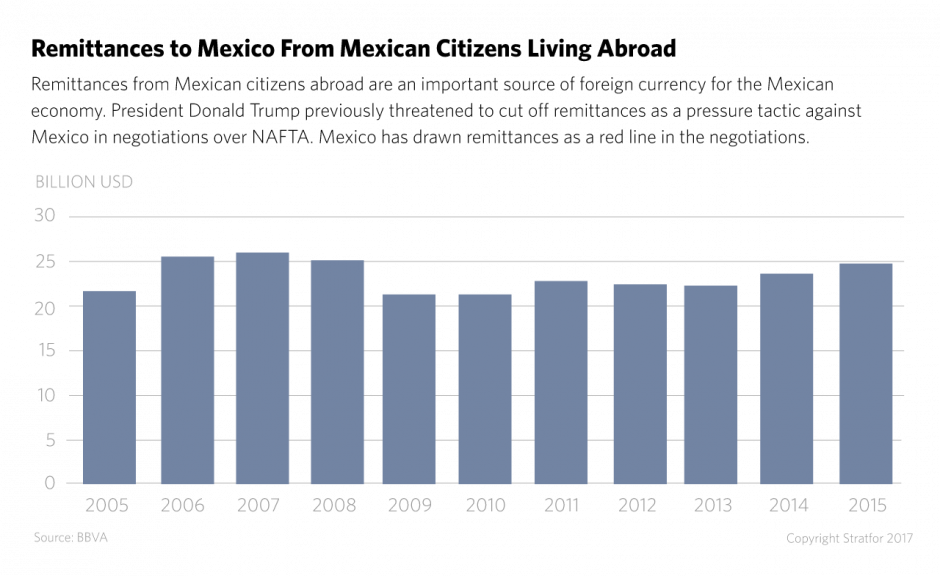
And that they cannot be ruled out puts Mexico in a tough position. Mexico would prefer to keep trade relations as they are, but that may no longer be possible. In fact, Mexican negotiators have begun to take firmer stances on issues such as funding the border wall and blocking remittances from Mexican migrants. They hope this will pressure the United States into meeting some of its demands.
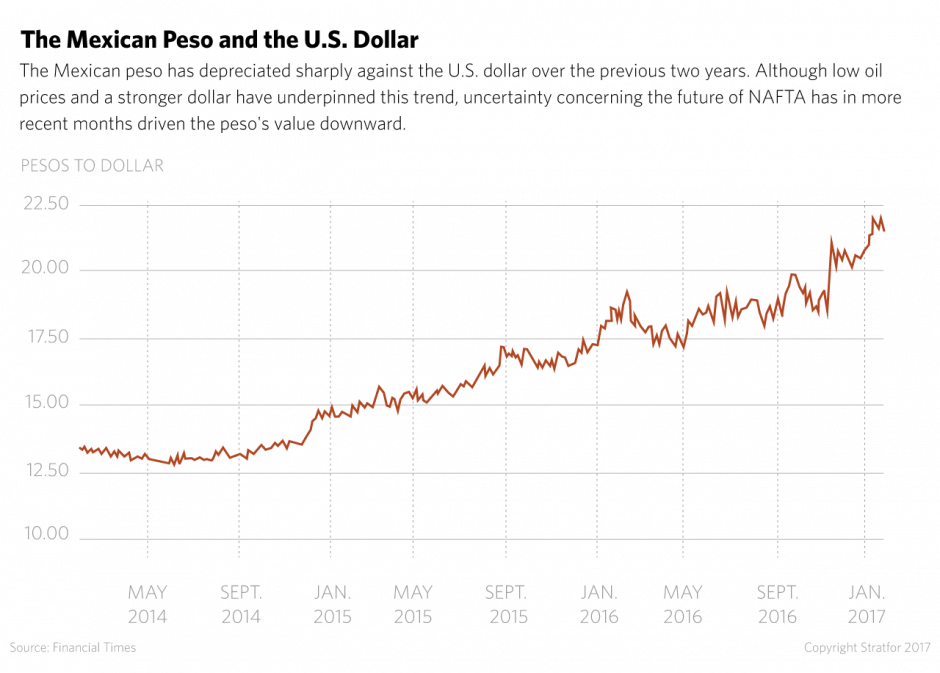
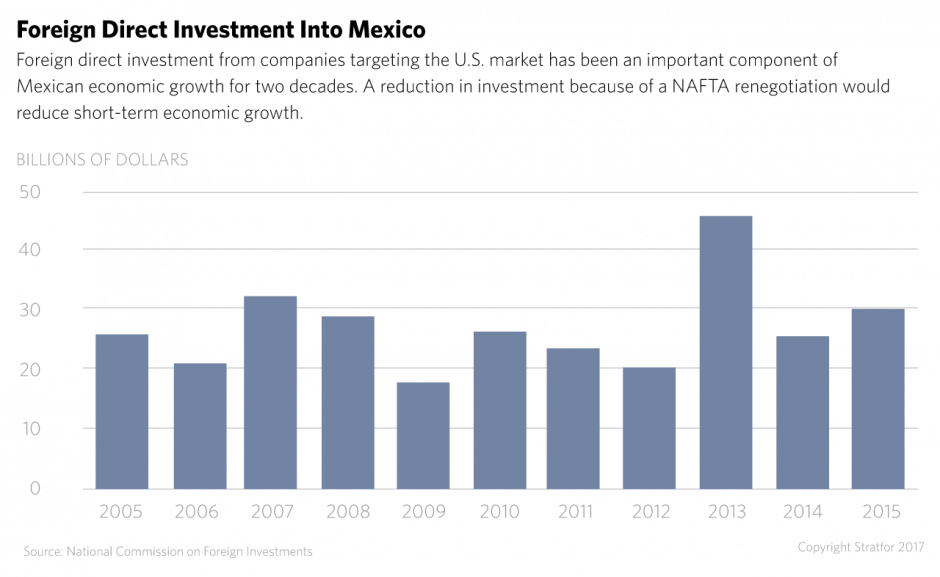
But it's hard to argue with the obvious: A trade war, or even a lesser dispute within NAFTA, would probably hurt Mexico more than it would hurt the United States. The United States accounts for about 80 percent of Mexican exports, and its departure from NAFTA would immediately expose the risks of Mexico's dependence on the U.S. market. Even a bilateral trade agreement outside of NAFTA would not fully mitigate those risks. Exports would likely plateau, inflation would increase as the peso depreciated, and capital would flee the country. Supply chain disruptions could lead to lower foreign investment — something that could slow Mexican economic growth for years to come. Aware of all these potential outcomes, Mexico City will try to defend its interests as best it can while bending to as many of Trump's demands as possible.
Unfavorable Circumstances
But even partial agreement to U.S. demands puts Mexico's ruling Institutional Revolutionary Party (PRI) on the defensive. With a presidential election scheduled for 2018, the PRI's opponents will use the negotiations against Pena Nieto, whom they will characterize as weak or ineffective. (This is an especially potent accusation given how offensive much of the Mexican populace considers Trump's proposals.) Already parties such as the centrist National Action Party (PAN) and the populist National Regeneration Movement (MORENA) are making headway in the polls. Put simply, the PRI will be fending off its rivals even as it fends off Trump.
Then there is the issue of social stability, which is far more tenuous than it may seem. In fact, there is a general dissatisfaction with Pena Nieto — a dissatisfaction that came to a head Jan. 1, when a government-ordered fuel price hike triggered weeks of protests. Even in the best of circumstances it's hard to imagine the Mexican people accepting a deal that hurts them more than it hurts their U.S. counterparts. But these are not ideal circumstances: Capitulating to the United States makes the PRI look weak, but giving up too little will only hurt the Mexican economy — and either of these outcomes will only galvanize the public against the president.
Perhaps the only good news for Mexico is that these kinds of negotiations take time to design. In the coming months, Mexico City and Washington will continue to engage each other to determine what their political and economic relationship will be, and the design of the trade negotiations will be essential to those discussions. Mexico, operating as it is from a weaker position, will try to keep the focus on economic issues — it would rather avoid security issues such as undocumented immigrants, on whose behalf Mexico City will continue to lobby. There are, notably, parallel negotiations taking place alongside the official government talks. In the past, Mexican billionaire Carlos Slim, the richest man in Mexico, and the Mexican business community have reached out to Trump, and they appear to be conducting their own talks with Trump and his advisers.
The Mexican government will also try to mitigate the economic fallout from lower U.S. trade by courting other potential export markets. To that end, it has already announced its intention to improve trade ties with China and Japan. According to a Stratfor source, the Mexican foreign ministry has increased its contacts with the Japanese government, possibly to discuss this very issue. But in the short term, even better ties with Asia will do little reduce the economic pain of a trade fallout with the United States.
