
Mosul is falling steadily into the hands of Iraqi government forces. Now, three months into the offensive, the military has pushed the Islamic State out of an estimated 95 percent of the eastern portion of the city. Progress in the east is critical. Once in control of the eastern banks of the Tigris River — which bisects Mosul — anti-Islamic State forces can turn to concentrate on the west.
The gains followed an Iraqi Ministry of Defense decision to reinforce the eastern front, with a particular focus on the southeast. On Jan. 14, Iraqi forces recaptured the University of Mosul, once one of the main Islamic State headquarters in the city. Troops now also control all five of the severed bridges that connect the two halves of the city. Because of the minimal damage to these bridges, the military can now use temporary replacements to move across the Tigris, although the Islamic State may bomb these bridges as well to disrupt travel. In fact, the Islamic State already did so when they recently bombed the oldest bridge. On Jan. 18, Iraqi Prime Minister Haider al-Abadi and military commanders said that troops have nearly cleared the eastern districts. Lt. Gen. Talib Shaghati of the counterterrorism forces even declared the mission in the east essentially accomplished. Still, skirmishes in the northeast continue.
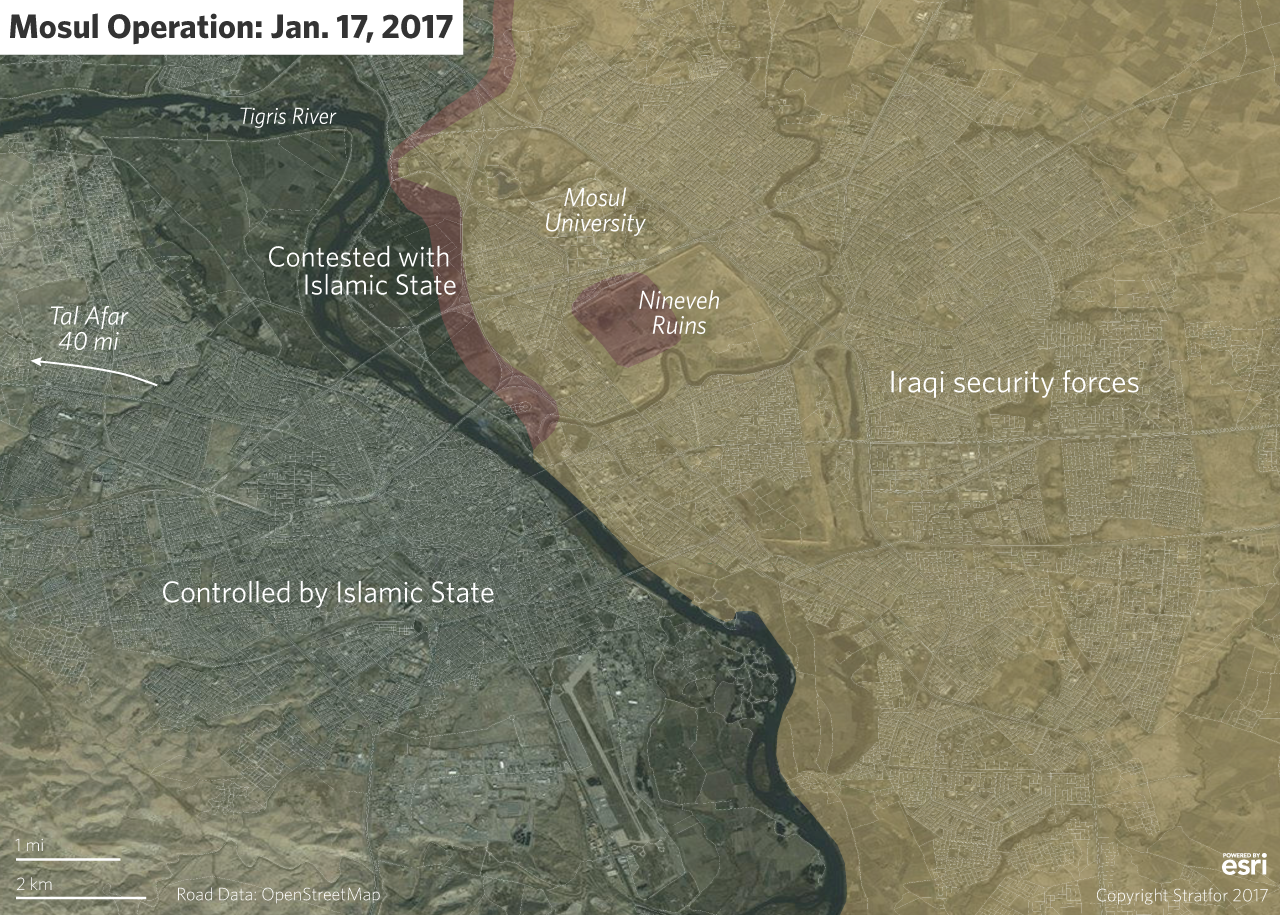
With a firm footing, the army can remain behind to maintain control of the east. The armed forces will concentrate on rebuilding infrastructure and accommodating the return of displaced residents. The Iraqi government hopes to bring as many of these civilians back as possible to ease the burden on overflowing government camps.
Meanwhile, Iraqi special operations forces will be tasked with retaking the five neighborhoods in the west from deeply entrenched Islamic State fighters. This half of the city is the oldest section, with narrow streets and high population density. It will become increasingly hard for Iraqi forces to minimize civilian casualties. At the same time, Shiite-dominated Popular Mobilization Forces will continue their task of clearing villages further west between Mosul and Tal Afar. After they have pushed Islamic State fighters out, they do not plan to continue into the city itself.
On the regional level, Saudi Arabia announced early this week that it would establish a new subset of its anti-terrorism coalition to help with operations to retake Mosul and the de facto Islamic State capital of Raqqa. Riyadh established the coalition in December 2015 to combat regional instability (namely the Islamic State), but it has suffered from a lack of active participation by its ostensible members. The Iraqi prime minister welcomed the move, but said that Iraq does not need more military aid and instead requires assistance to rebuild infrastructure around Mosul and resettle civilians. Before it fell to the Islamic State, Mosul was home to some 2.4 million people and now only 750,000 remain. Reconstructing the city following this drain will require massive efforts and political balancing.
