
Shifting political winds and growing discord among Western powers that, so far, have stood shoulder-to-shoulder against Russia have created an opening for Moscow as it seeks to bring an end to its two-year standoff with the West. Following the 2014 revolution in Ukraine, Russia's intervention in the country’s east and its annexation of Crimea drew a series of economic sanctions from the United States and the European Union that are still in force. Today, both Russia and NATO members are building up their forces along Russia's western borderlands, and relations between Moscow and many Western powers are at a post-Cold War low. Though Russia is interested in easing tensions with the West, it will not trade away its strategic position in the region by relieving pressure on Ukraine or other countries along its border to do so.
For now, the West has stayed fairly united in its attempts to contain Russian actions through sanctions and negotiations over the Ukrainian conflict. In turn, Russia has tried to use its leverage in other theaters, including the Syrian civil war, to barter for better terms in its talks on Ukraine and its borderlands. But this strategy has had its drawbacks, and in recent months, the United States and European Union have discussed expanding sanctions against Russia for its activities in Syria.
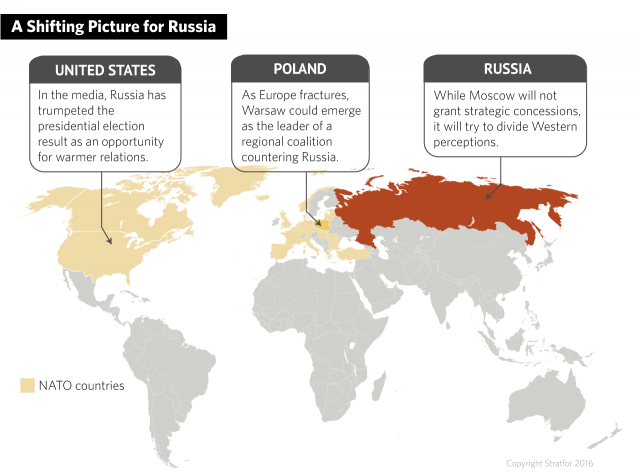
Still, recent events have given Moscow hope for a break in its impasse with the West. In Donald Trump's election as the next U.S. president, Moscow perceives an administration that will be more sympathetic to its interests. During his campaign, Trump promised to improve ties with Russia and suggested that the United States may not help NATO allies that fail to meet the alliance's defense spending targets. Trump also indicated that he would seek more protectionist economic measures and renegotiate trade pacts — pledges that worry many of Washington's European partners. While these comments may have been merely campaign rhetoric, Moscow has not missed the chance to begin building relationships with members of the incoming administration. In the media, Russia has characterized the election results as an opportunity for better ties with the United States.
European Divides Deepen
There are limits to how quickly or to what extent Washington and Moscow can redefine their tense relationship, and they will probably remain at odds in 2017. But uncertainty over the direction of their relationship is sowing seeds of doubt among Washington's allies, which Moscow will try to capitalize on. Europe's uneasiness over the changing of the guard in the United States comes as the Continent finds itself increasingly divided on a number of issues. Nationalist and populist parties are gaining ground in several core EU countries. On the heels of the United Kingdom's decision to leave the bloc, France's National Front and Italy's Five Star Movement have vowed to hold referendums on their eurozone memberships, should they win power. Even more moderate parties in these countries are promising to pursue more protectionist measures. With national elections scheduled in France, Germany, the Netherlands and possibly Italy next year, Europe's continued solidarity is not a given.
Wide-ranging media campaigns directed by Moscow have fueled Europe's questions about its future and Washington's continued support. Russia has also provided financial and political aid (both overt and covert) to some of the more divisive political forces on the Continent, including National Front leader Marine Le Pen and Italy's anti-establishment Five-Star Movement and Northern League. EU members such as Austria, Hungary, Bulgaria and Italy have spoken out against persistently poor relations with Russia, but none have been willing to block decisions to extend Russian sanctions, which must be made unanimously. In the past, the United States has pressured those countries to vote in favor of keeping the sanctions in place. The European Union is likely to renew the punitive measures heading into 2017, but as the year progresses, the issue will come up again. If U.S. pressure abates and Continental fissures deepen, the outcome of that vote could be different.
Filling the Vacuum
Should sanctions against Russia be lifted, the more vulnerable states on its borderlands will turn to other powers or alliances to guard against Moscow's potential aggression. Germany is the most obvious Western heavyweight that could maintain pressure on Russia. Traditionally, Berlin’s stance toward Russia has been more moderate in comparison to those held by the United States and the more Russophobic European states. But as Europe's most influential power, Germany cannot afford to let Russia expand its influence into borderland states — many of which are now part of the European Union. Germany and France have led negotiations with Russia over Ukraine via the so-called Normandy format, though the United States has also held its own track of talks on the conflict with Moscow. Berlin has refused to compromise with the Kremlin over Ukraine or sanctions without Russia making substantial progress on meeting the Minsk accords, the plan to end fighting in eastern Ukraine.
Germany is also increasingly concerned with what it sees as Russian meddling in EU politics and its growing influence over member states' media — including its own. Over the summer, Germany reportedly shifted its definition of Russia in its strategic strategy "white book" document from "partner" to "rival." The white book also reportedly accused Russia of openly undermining European stability. In the past year, German intelligence agencies have stepped up their efforts to counter Russian propaganda and computer espionage programs as well.
But Germany's ability to take a more aggressive approach to countering Russian influence is limited. German politicians are divided over Russian policy: Even some members of the ruling coalition have pushed for better relations with Moscow. With general elections set for 2017, German Chancellor Angela Merkel will be reluctant to deepen that divide or trigger a hostile response from Russia. Though Germany will have its hands full in trying to prevent the European Union's various fractures from splitting the bloc altogether, Berlin will also be seeking to boost cooperation within the bloc as a response to global uncertainty.
Spotlight on Poland
As Western unity weakens, Poland will be the most likely candidate to lead the charge against Russia's spreading influence. Poland, the weightiest of the borderland states, has enjoyed the backing of NATO and the United States in its anti-Russian attitude. In recent years, Poland has become less enamored with European integration and has echoed the United Kingdom's push to repatriate powers from central institutions in Brussels to Europe's national parliaments. Warsaw will grow more combative within the bloc as it continues to crumble.
But Poland cannot wage its war against Russia's clout alone. In the past, Warsaw has attempted to strengthen its regional alliances as a member of various organizations, such as the Visegrad Group, which also includes Slovakia, Hungary and Czech Republic. However, militarization and coordination among Visegrad members have stagnated, and Warsaw fears that flirting between Moscow and Slovakia and Hungary could undermine the alliance. In the future, Warsaw is likely to press for coordination among countries in its neighborhood that hold similar foreign policy orientations, such as Sweden, the Baltic states, Romania, Czech Republic and Ukraine. Poland has already served as a critical spoiler to Russian aggression in the region through its financial and military support for the Western-oriented government in Ukraine, as well as a part of a regional interconnector system aimed at diversifying natural gas supplies away from sources in Russia, which has used them as a political weapon.
Greater cooperation could include political support, intelligence sharing, anti-Russia media campaigns, energy links and joint military exercises, both within and outside of the auspices of NATO. The United Kingdom has been a vocal supporter of Poland's stance against Russia. During a historic summit on Nov. 28 between British Prime Minister Theresa May and her Polish counterpart, Beata Szydlo, London confirmed that it would expand its military support for Poland next year. The British military will send 150 troops to Poland in April to reinforce NATO's eastern flank against Russia.
But there are limits to Poland's influence. Its political heft cannot compare to that of EU giants like France, Italy and Germany that are less hostile to Russia. Warsaw cannot rally bloc-wide initiatives or sway foreign policies, as can Paris and Berlin. Moreover, plans for future military buildups through NATO could be curtailed, should relations between Russia and the United States thaw. Though a more consolidated Polish-led regional effort among many borderland states to counter Russia is likely to coalesce in 2017, Warsaw's efforts will only widen the divides within Europe, ultimately benefitting Moscow. Russia is not under the illusion that its ties with the West will warm again, but the lack of a united front against it will help Moscow regain its footing after more than two years under extraordinary Western pressure.
