
Despite its rapid pace, the advance toward Mosul has been relatively uneven. Elite Iraqi special operations forces arrived at the city's outskirts before the rest of the coalition, which also includes tribal militias and the federal police. According to the battle plan, the advance into Mosul itself was to have begun only once the Iraqi army had converged on the city from three sides. Nonetheless, Prime Minister Haider al-Abadi reportedly ordered the special operations forces to continue on to the city, hoping to sustain the advance's momentum and prevent the Islamic State from using a pause in the fighting to regroup. Furthermore, though the original strategy provided for an avenue of escape to the west of Mosul, the Iraqi government allegedly bowed to pressure from Tehran in late October and allowed the Iranian-backed Popular Mobilization Forces to close it. The uncoordinated advance from a single direction, coupled with the decision to keep fighters trapped in the city, has turned Mosul into a deadly urban battlefield where Islamic State forces are sure to fight tooth and nail until the end.
A Well-Prepared Enemy
Islamic State forces were well-prepared for the confrontation in Mosul. Even before the campaign began, they laid out belts of IEDs, zeroed in their mortars and cleared fields of fire. In addition, Islamic State fighters established an intricate network of tunnels in the city that not only provides cover against airstrikes but also enables them to suddenly appear in neighborhoods that the Iraqi forces had previously declared clear. The militant group is also driving vehicle-borne improvised explosive devices (VBIEDs) in droves — approximately 15 per day for a total of 600 by the last count — into advancing Iraqi forces. Emerging from narrow streets and even home garages, the deadly vehicles take just minutes to reach nearby Iraqi convoys. The resulting attacks are difficult to counter with airstrikes or anti-tank missiles. Small arms fire is similarly ineffective against the vehicles because of the armor that the Islamic State invariably bolts to them. To make matters worse for the coalition, winter rains have provided cover for local Islamic State counterattacks using heavy weapons.
By deliberately embedding themselves with Mosul's civilian population, Islamic State forces have all but disarmed one of the Iraqi army's greatest weapons: airstrikes. In an effort to free up their firepower, the army's commanders considered reversing their instructions for civilians in the city to stay put. Al-Abadi and his advisers reportedly vetoed the proposal, however, for fear that fleeing civilians would either get caught in the crossfire or make it out of the city only to overwhelm the limited capacity of Iraq's refugee camps.
The Grueling Battle Ahead
So far, the battle for Mosul has taken a tremendous toll on Iraq's armed forces. The United Nations estimates that nearly 2,000 Iraqi troops were killed in November alone, many of them in Mosul. Having been heavily engaged from the start, the Iraqi special operations forces are showing signs of strain. They have continued to bear the brunt of the fighting since entering Mosul, joined by the forward elements of the 9th Armored Division that have reached the eastern parts of the city. But officers in the 9th Armored Division have complained that their tanks and armored vehicles are of little use in Mosul's dense urban terrain, where repeated ambushes have hit several of their convoys. Once the 15th and 16th Infantry divisions link up with the special operations forces and 9th Armored Division elements in the city, they will ease the burden on the beleaguered troops. Islamic State forces are making their advance long and difficult, though. Northeast of the city, the 16th Infantry Division is still making slow progress, while the 15th Infantry Division is spread thin to the southwest from Mosul all the way to Tal Afar.
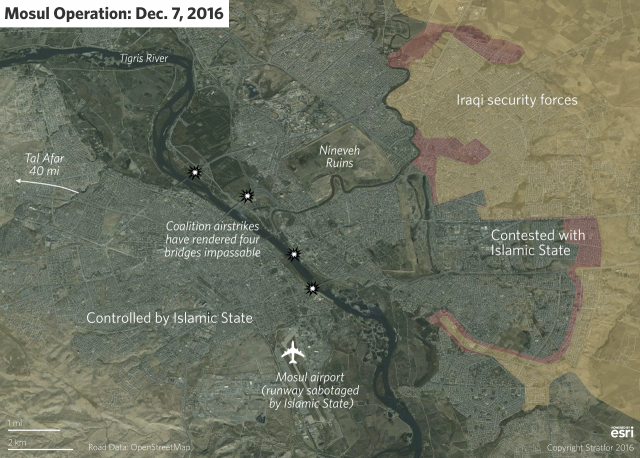
The Iraqi army and its allies are adapting their tactics to overcome the Islamic State. Coalition air power bombed four of the five main bridges across the Tigris River to hamper the Islamic State's ability to send reinforcements to the city's east side. Now, it has turned its focus to cratering the main roads inside the city to impede enemy VBIEDs on their way to the front line. The Iraqi army has also sent additional units from Baghdad to reinforce the battle-weary units, including an infantry regiment to bolster the 9th Armored Division, which normally comprises four armored regiments.
Notwithstanding the fierce battle that lies ahead, the outcome is all but certain: The Iraqi army will eventually retake Mosul. In the meantime, the costs of the campaign — in lives lost and damage done — will continue to mount, perhaps for months to come. The longer the campaign wears on, and the more casualties it inflicts, the more it will weaken military units that the Iraqi army needs for future campaigns, particularly the special operations forces. The Islamic State, moreover, could use the destruction that the offensive has wrought on Mosul and its residents to turn the local population against the Iraqi government. Even more pressing is the risk that the Iraqi army, frustrated and depleted, could enlist the Popular Mobilization Forces' help in taking the city, further skewing the delicate political balance that was struck to bring the disparate coalition together.
