
So far, the United States has been more than happy with the Turkish operations against the Islamic State in northern Syria. They have weakened the group tremendously by depriving it of resources, territory and fighters. But Washington's focus in the area has always been to drive the group from Raqqa, its self-proclaimed capital. To that end, the United States has also relied on the Syrian Democratic Forces coalition, dominated by the Kurdish militia group the People's Protection Units (YPG), which Turkey views as a threat to its national security. As Turkey's Operation Euphrates Shield progresses toward al-Bab, the spate of fighting between Turkish-backed rebels and the YPG is increasing. To the United States' displeasure, the fighting has distracted the YPG and could threaten to undermine the Raqqa effort altogether.
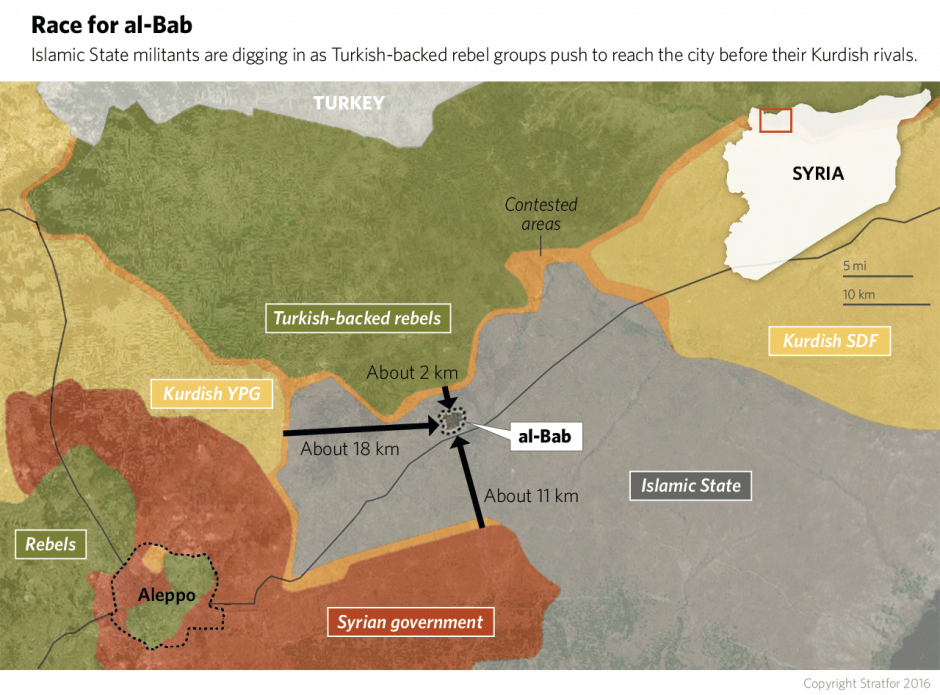
Moreover, the United States is concerned that the Turkish-backed rebels are getting perilously close to loyalist lines. It wants to avoid clashes with the Syrian government forces, backed by Russia and Iran, which are also warily watching the approaching rebels.
Aleppo: The Hard-Fought City
Ties between Turkey and Russia thawed somewhat in 2016, almost a year after Turkey downed a Russian fighter jet in northern Syria. This created the opening for Ankara to intervene in northern Aleppo in the first place. The relationship was never easy, however, and Moscow has repeatedly demanded that Ankara coordinate its actions in Syria with the government of President Bashar al Assad. Moscow, Tehran and Damascus worry that the steady Turkish-backed rebel advance against the Islamic State is bringing them ever closer to the vital battleground around Aleppo city. Though Turkey's goals in Operation Euphrates Shield are to drive back the Islamic State and block the YPG's Kurdish expansion, Turkey's rebel allies are still linked to the rebels besieged in the city and want to come to their aid.
Having fought hard for the city, Damascus and its allies are determined to prevent a new rebel threat from emerging from the north. Damascus has worked with YPG forces north of Aleppo to facilitate their advance eastward to al-Bab to block Turkey's rebels. Loyalist forces have also threatened Turkey with retaliation if it continues south, and they have reportedly locked their air defense radars on Turkish warplanes as a warning. Finally, loyalist forces have been assembling in large numbers in Kweiris air base, south of al-Bab, and may launch their own operation northward to expand the loyalist-held territory between Aleppo and the Turkish-backed rebels.
Missing Deterrence
Under these circumstances, the withdrawal of U.S. support is untimely for Ankara to say the least. The U.S. special operations forces on the ground and coalition air support were a helpful addition in the fight against the Islamic State, but they were even more crucial as a deterrent to loyalist action in the area. Loyalist — and by extension, Iranian and Russian — unease over a potential clash with U.S. forces was an added layer of security to the Turkish-backed operation in northern Aleppo. With U.S. forces leaving, that effect is gone.
Determined to seize al-Bab, Ankara will proceed with the operation despite the drawdown in U.S. support. Still, Turkey was well aware of the risks involved in the operation even when it had ample U.S. support. After much progress, Turkey is poised on the outskirts of al-Bab, but its rebel allies are unlikely to capture the city swiftly from determined Islamic State resistance. Meanwhile, Ankara will keep a close eye on the YPG and — without direct U.S. support — on loyalist forces as well.
