
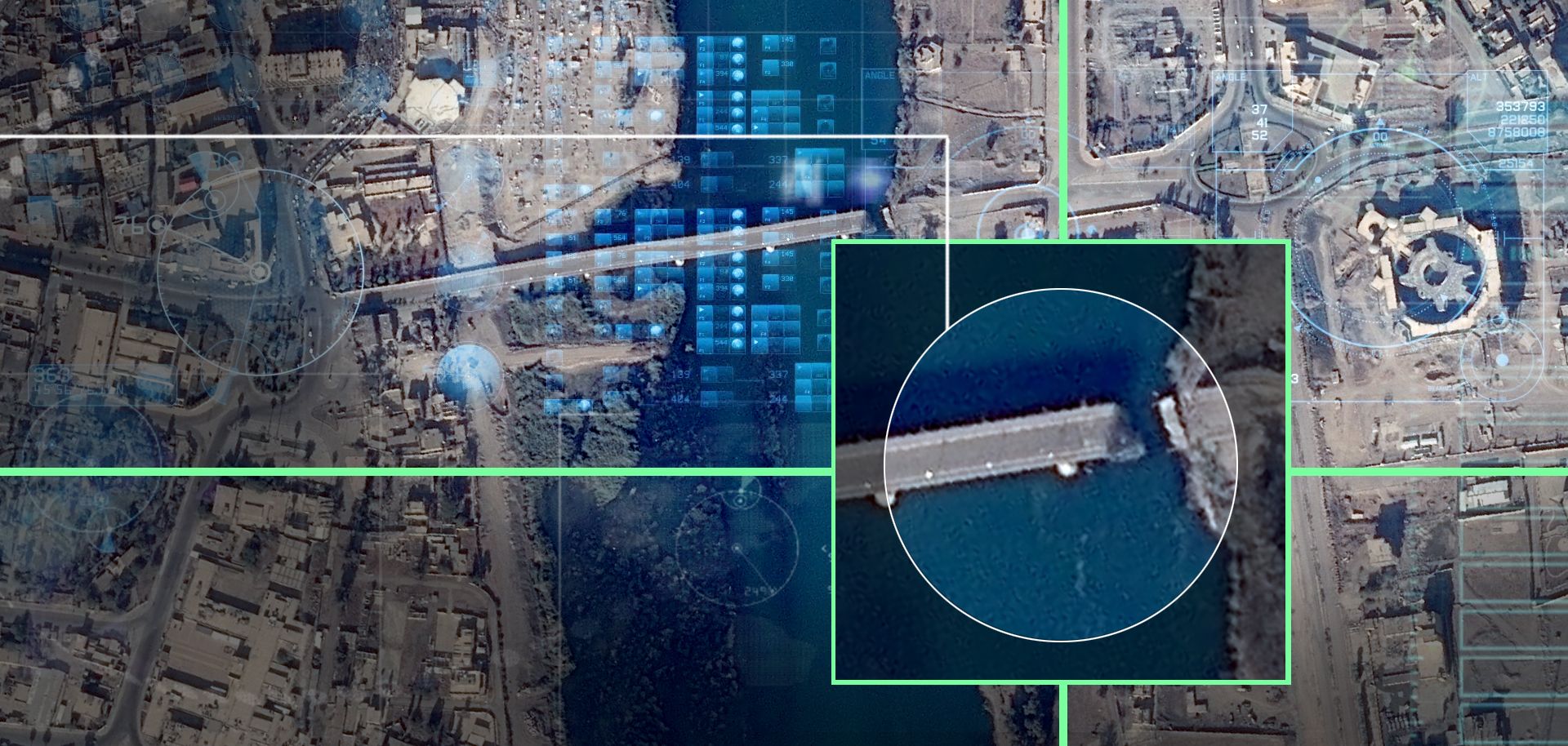
After more than two years of occupation by the Islamic State, the Iraqi city of Mosul has taken a battering. Numerous reports have detailed the city's state of disrepair, some documenting a moderate degree of destruction while others describe a town laid to waste. Based on recent satellite imagery, Mosul appears to have suffered significant damage, though accounts of the city in ruins seem to have been exaggerated.
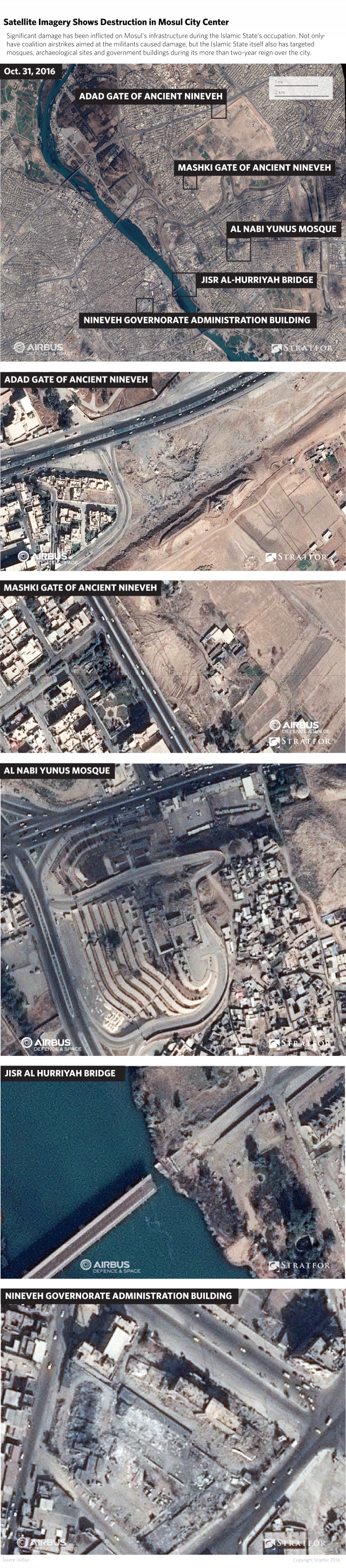
From the photographs, it is clear that some of the destruction in Mosul was caused by relentless coalition airstrikes on Islamic State positions and facilities ahead of the ongoing Iraqi offensive to recapture the city. One of these airstrikes, for instance, knocked out a bridge over the Tigris River to reduce the group's mobility. Though most of the river's other bridges are still intact, the Islamic State allegedly plans to use explosives to collapse the crossings as Iraqi forces draw closer.
Not all of the devastation, however, has been driven by such pragmatism. Many of Mosul's demolished buildings were once mosques or archeological sites that the jihadist group destroyed for cultural and ideological reasons. One of the city's most prominent houses of worship, the Mosque of Prophet Yunus, was sacked not long after the Islamic State seized Mosul in June 2014. The mosque, believed to be the burial place of the biblical prophet Jonah, is clearly missing its iconic minaret in the photographs above. The remnants of the ancient gates of Nineveh, which once stood in the heart of Mosul, were also caught in the Islamic State's crosshairs. The group bulldozed the gates and parts of Nineveh's historic city walls in April as part of its cultural campaign against historical artifacts.
Apart from archeological and religious sites, the satellite imagery also shows that the Islamic State recently damaged several of the city's government buildings. The group, trying to prevent the buildings' recovery and use by approaching Iraqi forces, once relied on many of these administrative offices itself. The Nineveh province administration building, located in the center of Mosul, had served as the Islamic State's municipal headquarters after it occupied the city. Now that structure has been almost completely flattened by explosives.
The photographs above focus on the sites of the most extensive destruction, but they are by no means the only devastated areas. Damage is evident throughout the city's center, and as the fighting between the Islamic State and its Iraqi foes spreads through Mosul, more will follow. Once the attacking coalition retakes the city, extensive reconstruction of Mosul's basic infrastructure will be needed before life can return to normal. Either way, it is clear that the costs that the Islamic State has imposed on local Sunni citizens will be felt well after the group's presence in the city has ended.
