
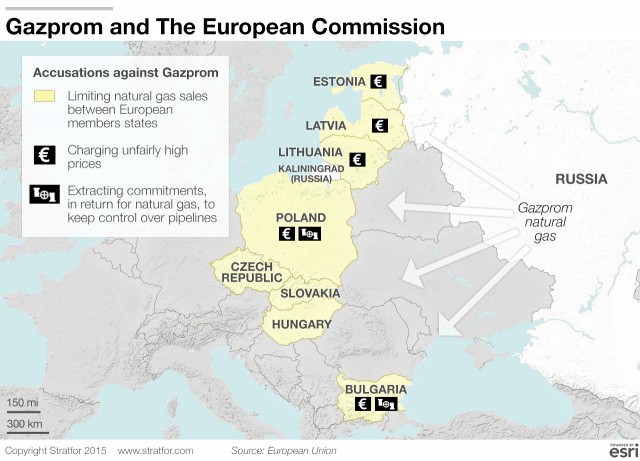
After years of tension, Gazprom and the European Union seem to be overcoming some of their differences. On Oct. 28, the European Commission finally agreed to grant Gazprom greater access to the OPAL pipeline, something the company had sought since 2009. Gazprom and the European Union are also nearing a settlement on the bloc's antitrust probe into the company's practices, allowing Gazprom to avoid billions of dollars in fines. That the European Union is finding common ground with Gazprom reflects the company's shifting priorities in Europe. But despite these hints of improvement in its relationship with Brussels, Gazprom still faces an uphill battle in getting some of its other projects in Europe off the ground.
Throughout the last decade, Moscow wielded Europe's dependence on Gazprom as a political tool, repeatedly cutting off natural gas supplies to the Continent to force the bloc, or member countries along the transit route, into compliance. In response, the European Union imposed regulations to limit Gazprom's involvement in the downstream and midstream gas sectors while working to improve its own infrastructure to break Russia's effective monopoly in Europe. Although Russia remains the largest supplier of natural gas for continental Europe, Brussels has succeeded in checking Gazprom's — and, by extension, Moscow's — power over its European customers. This, coupled with the rise of alternative sources, such as liquefied natural gas, has forced Gazprom to look at the European market in commercial rather than political terms. To maintain its dominance — and to satisfy Europe's conditions for the OPAL pipeline and antitrust deals — Gazprom has conceded to some of Brussels' demands. For instance, it began issuing contracts with prices indexed according to spot prices for natural gas rather than for oil, and it also started holding auctions to sell natural gas in the bloc.
Greater Sales With Greater Flexibility
Gazprom's new strategy in Europe is simple. The company is striving not only to increase the amount of natural gas that it can deliver to Europe but also to diversify its transit routes, thereby giving it more flexibility. As natural gas supplies from the North Sea fall, demand for Russian natural gas in northwestern Europe is expected to grow. But Gazprom depends on Ukraine as a transit state for much of the natural gas that it supplies to Europe, a risky arrangement for the company and its customers on the Continent given the tensions between Kiev and Moscow. Consequently, the natural gas behemoth is doing everything in its power to bypass Ukraine with alternative routes. (The potential political benefits of cutting Kiev out of the loop are an added bonus for Moscow.)
The OPAL pipeline would be an instrumental part of this initiative. The pipeline connects the existing Nord Stream pipeline, which runs from Russia to Germany under the Baltic Sea, to the German-Czech border, enabling Gazprom to deliver to customers in Central and Eastern Europe without going through Ukraine. Until now, however, the European Union has restricted use of the OPAL pipeline to just 18 billion cubic meters per year, about half of its capacity. This meant Gazprom had to continue piping natural gas through Ukraine and at the same time limited Russia's Nord Stream to about three-quarters of its capacity. Under the new proposal, another 7.7 billion to 10.2 billion cubic meters of the OPAL pipeline's capacity will be opened up for auction, and Gazprom will be able to bid. As a result, the company could wind up with access to roughly 75 percent of the pipeline's total capacity.
The Tricky Part
Having resolved its antitrust suit and gained greater OPAL access, Gazprom will turn its lobbying efforts to the Nord Stream II pipeline system, which would run parallel to the Nord Stream. Though the new route would be a boon for Gazprom, doubling its direct export capacity to Germany to 110 billion cubic meters, the project will have to clear several roadblocks before it gets underway. Brussels is still deliberating whether its prohibitions against a company transporting natural gas through its own pipeline apply to offshore pipelines, such as Nord Stream and Nord Stream II, that connect a European and non-European country. Gazprom contends that the rules do not apply offshore, since pipelines that link North Africa and Southern Europe via the Mediterranean Sea are not subject to the restrictions. But rather than extend the precedent to the proposed Nord Stream II, the European Union may devise a regulatory scheme specific to the new system, much as it has just done with the OPAL pipeline.
A Thorn in Gazprom's Side
Poland's opposition has already interfered with Gazprom's progress on the Nord Stream II project. In August, Warsaw blocked the formation of a joint venture between the company and five European energy firms, leaving Gazprom to fund the project on its own, at least for the time being. Now, Poland is once again trying to obstruct the Russian firm. The country's state-owned natural gas company, Polskie Gornictwo Naftowe i Gazownictwo (PGNiG) has threatened to sue the European Commission if it offers Gazprom a deal to settle the antitrust probe. In addition, PGNiG has promised to sue the commission and German energy regulator Bundesnetzagentur over the OPAL deal, claiming that increasing the Russian firm's access to the pipeline would violate several EU laws and regulations.
Although it is unclear whether PGNiG will make good on its threats, they exemplify the kinds of challenges that Gazprom will face going forward. Relations between the European Union and Gazprom may be warming, but as the Nord Stream II's regulatory and legal difficulties suggest, making new inroads into Europe will be difficult.
