
The long-awaited push to retake Mosul from the Islamic State has begun. On Oct. 16, Iraqi Prime Minister Haider al-Abadi announced on national television that the operation to recapture the country's second-largest city, which has been under the jihadist group's control since June 2014, was underway. Iraqi forces have been preparing for the offensive for months, gradually advancing north toward the city to put into place the logistics lines needed to support such a massive and lengthy endeavor.
So far, the Iraqi military and Kurdish peshmerga forces spearheading the operation have made considerable progress. As expected, the bulk of the fighters have concentrated their efforts on moving northward along highways 1 and 80, though supporting advances from the east and north by remaining Iraqi troops and peshmerga have seen significant success as well. The U.S.-led coalition has also provided air and artillery support to the operation, while the predominantly Shiite Popular Mobilization Forces have offered ground support on the outskirts of the city once they join the offensive.
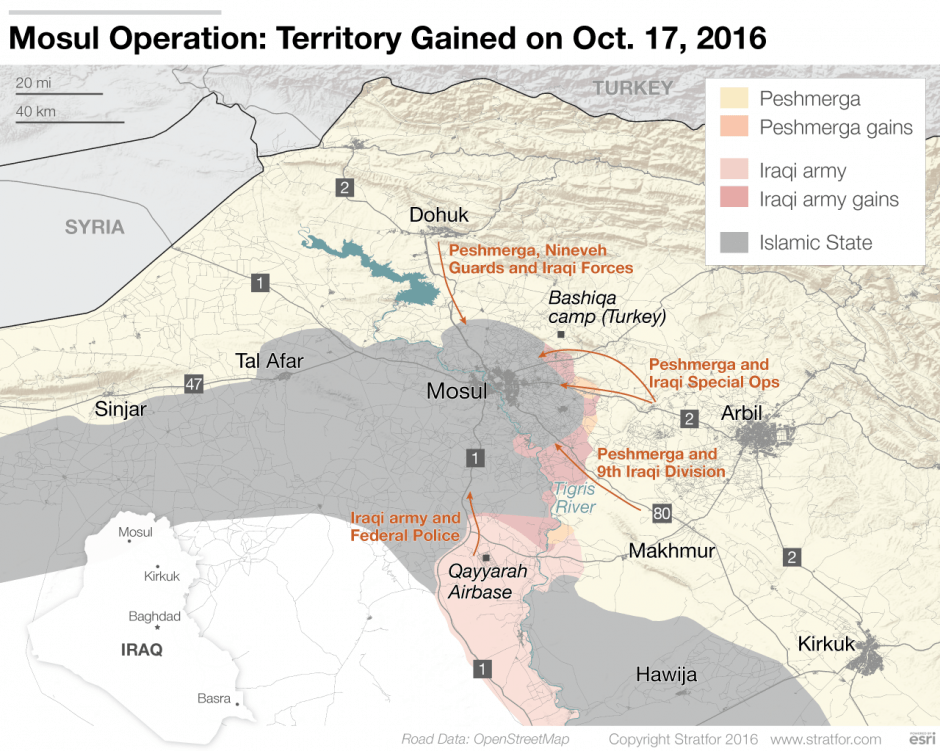
But despite its early success, the campaign to dislodge the Islamic State from one of its last remaining Iraqi strongholds will be neither quick nor easy. The group is undoubtedly preserving its strength for conflict inside the city itself, which will be more difficult and more destructive than waging war in largely unpopulated areas. For now, the militants are likely relying solely on rearguard action, or defensive maneuvers made by a retreating force, while they wait for their opponents to converge on the city.
As the battle for Mosul unfolds, the danger of it causing a humanitarian crisis will increase. Some 750,000 Iraqi citizens still live in the city, and though Iraqi authorities and international aid agencies have set up refugee camps in preparation for the assault, they will not be able to handle a sudden, sizable influx of people. And as the Islamic State is expelled from the city, it will become more desperate as it weakens, taking bigger and bigger risks to try to regain the territory it has lost.
