
The attack, which is reported to have taken place near the Yemeni port of Mokha, targeted the Emirati HSV-2 Swift, an advanced transport ship that was originally part of the U.S. Joint High Speed Vessel program. While the Houthis claim that the ship sank, unnamed U.S. defense officials reported that the heavily damaged vessel was moved to the port of Assab in Eritrea, where the United Arab Emirates is running logistics operations in support of the war effort in Yemen. The naval presence around Yemen plays an important part in this effort by transporting and supplying ground forces operating in the country, delivering humanitarian aid and enforcing a blockade meant to prevent weapons transfers to the Houthis. An attack on a coalition vessel by an anti-ship missile would represent both a failure of the embargo and a substantial risk to nautical logistics operations.
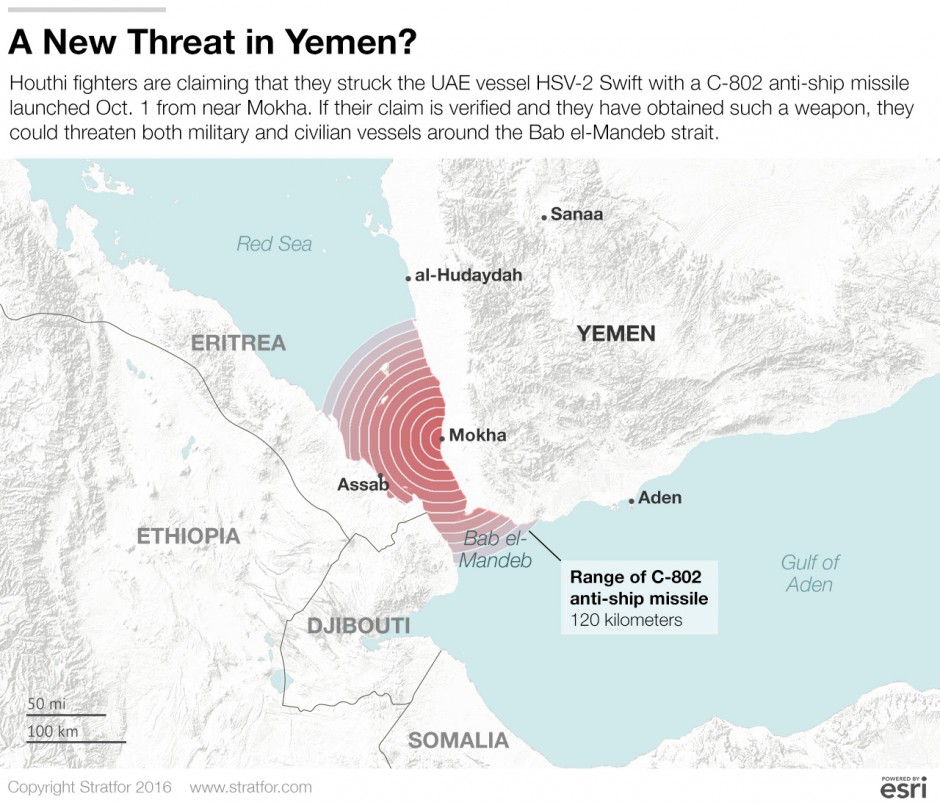
The Houthis said they used a Chinese-designed, C-802 anti-ship missile system to conduct the attack. Its long-range missiles are designed to home in on surface vessels and inflict devastating damage. With a range of 120 kilometers (about 75 miles), the missiles would put a sizable stretch of the area near the Bab el-Mandeb strait connecting the Red Sea with the Gulf of Aden in the line of fire. More important for the United Arab Emirates, though, the missiles could also reach Assab and the naval base that it has been constructing just north of the port. If such missiles have been delivered to the Houthis, the most likely supplier would be Iran, which has bought C-802 missiles from China and produced its own variant, the Noor.
Deploying a weapon of this kind would be a big step up for the Houthi rebels, whose previous attempts to attack vessels from the Saudi-led coalition employed artillery or anti-tank weapons. Attacks using artillery, which require a lucky shot to score a direct hit, are not very effective. But according to earlier claims, Houthi fighters using this method damaged coalition patrol boats. Anti-tank weapons, which have a relatively short range, are typically more effective but require the target vessel to be close to shore, so opportunities to use them do not arise often. Furthermore, Yemen owned a stockpile of Styx anti-ship missiles that many fear Houthi fighters could use to disrupt global shipping in the Bab el-Mandeb. However, those missiles are outdated, possibly to the point of being inoperable, and they are designed to be deployed from aboard ships rather than from land.
Despite the Houthis' claims and supporting video, competing accounts suggest that the attack demonstrated the tactical wit of the Houthis but not the advanced weaponry they boast. Some reports quote U.S. defense officials as saying the attack was conducted with a shoulder-launched anti-tank missile fired from aboard a boat. This theory would more closely match previous Houthi tactics, and the use of boats to approach the HSV-2 Swift for an attack under the cover of darkness cannot be ruled out. Separate reports that the Saudi air force later targeted a number of fishing boats off the coast near Mokha could indicate a perceived threat from such vessels.
Regardless of the method used to attack the HSV-2 Swift, the Houthis have demonstrated an ability to strike effectively at costly coalition assets deployed in the waters near Yemen. Whether they did so by obtaining new advanced weaponry, or by deploying their existing weapons in an innovative way, the apparent threat they pose to coalition vessels and civilian shipping in the Red Sea is clear. The United States has already dispatched several warships to the area to help secure the waters. It is unclear if the United States intends to get more deeply involved in the Yemen conflict by taking pre-emptive action against the Houthis, but that remains an option.
Meanwhile, the Houthi rebellion is still holding its own inside Yemen. Houthis continue to resist Saudi-backed military offensives and the authority of the Yemeni government led by President Abd Rabboh Mansour Hadi. Yemeni forces and their coalition allies are finding it difficult to make gains on the ground, and Houthi forces continue to hold territory inside Saudi Arabia from which they frequently launch artillery attacks on towns in the border region. On Oct. 2, the Houthis also announced the formation of a new governing council and appointed their own prime minister, Abdel-Aziz Ben Habtour. By doing so, the Houthi movement showed its resolve in the face of the coalition's campaign against it.
