
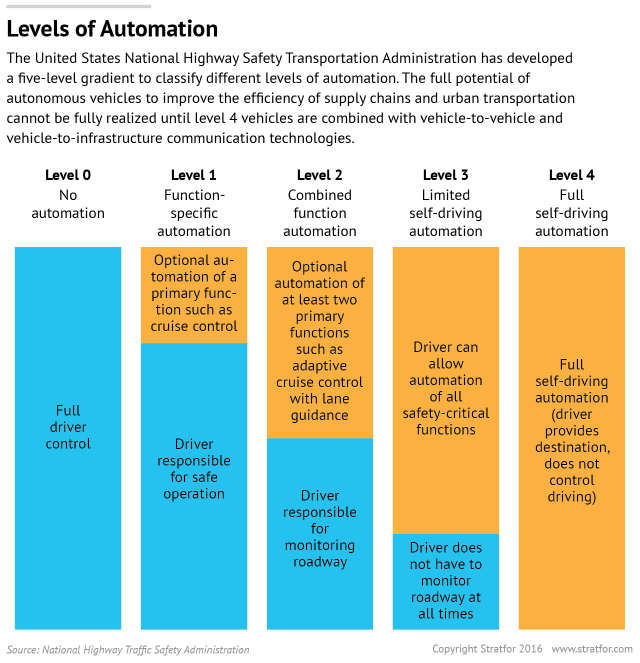
The Department of Transportation's new automated vehicle policies delineate the role of the state and federal government, meet safety standards, create a model state regulatory framework and establish new legal codes that it will eventually apply to self-driving cars. The Department of Transportation has made it clear that safety is the primary concern. Self-driving cars automate a wide array of maneuvers in their systems, but the level of complexity can vary significantly, which is why the Department of Transportation is adopting the SAE International definitions for the level of automation to regulate each level accordingly.
Of course, there are and will be many challenges with highly automated vehicles. For example, legislation for conventional vehicles has specific guidelines to notify the driver when something happens. For a self-driving car, who or what do officials notify? Do they notify a car's central computer, or a computer controlling just the anti-lock braking system information? These questions will have to be answered before automated vehicles are fully integrated into society. Concerning safety, the Department of Transportation will also address the review process in 15 different areas, including cybersecurity, system safety and ethical considerations, all under a specific operational design domain (ODD) — or the conditions and environment that the car or feature was designed for. Currently, an ODD for Tesla's autopilot feature could be cruising at high speed on a highway in one jurisdiction, while there is a different ODD for parking in a different jurisdiction. Consequently, testing for both differs. Furthermore, some levels of automation will have certain ODDs while others will not. Various driving laws also differ from state to state. A common ODD would go far in simplifying these disparate operations — and in regulating them.
Initiatives in the Federal Automated Vehicles Policy are designed to solve other initial regulatory concerns as well. The human-machine interface and its exemption from some regulations suggest that the federal government will allow testing vehicles and the commercial vehicles to have dramatically different setups during the review process (such as the review model of a self-driving car having a steering wheel). Easing review restrictions will enable technicians to develop the automated technology more quickly. U.S. regulators are taking into account ethical dilemmas, too. The most cited hypothetical dilemma involves a car on a bridge purposefully plunging into the water to avoid a collision and minimize the expected loss of life, which the automated car could calculate. Considering such cases is another proactive policy that will make the transition to driverless cars a little more seamless.
The safety and certification review is by no means finalized. Emerging technologies are a trial and error process, and there will be issues that have not even been thought of. The federal government knows this and is therefore trying to centralize its authority over the process while still allowing states to perform emissions testing and license drivers, similar to what they do for conventional vehicles.
Beyond the United States
But the rest of the world is not standing still on driverless cars, either. Regulation and legislation still divide domestic development and adoption of autonomous vehicle technology. Innovators in Europe and East Asia also have to adapt to changing regulatory parameters, ones still primarily confined to conventional car technology. But plans for regulatory adjustments are in the works in several nations, and legislative flexibility can help differentiate the leaders from the followers in future automated vehicles.
More than 70 countries abide by the United Nation's Vienna Convention on Road Traffic. Established in 1968, the agreement covers road traffic safety and ensures consistency and compatibility in traffic laws. In March 2016, the United Nations took the first steps to adjust the language of the Vienna Convention, explicitly allowing for operators to transfer tasks to the automated vehicle systems as long as the technologies can be switched back to the driver. But this applies only to limited tasks and additional adjustments, including ones to self-steering systems that still need to be enacted, which could occur as soon as next year. Germany, a global leader in developing highly autonomous vehicles and a signatory of the Vienna Convention, will benefit from these regulations. Still, the law requires a human operator in the car, which limits how much it can aid or support future technical development in abiding countries.
Most Asian countries are not subject to the Vienna Convention but still cope with their own existing (or nonexistent as the case may be) regulations. China, a prime location to develop and adopt autonomous vehicles, has traditionally had little official legislation regarding driverless cars. The government is in the process of drafting unified standards, guidelines and considerations for consistent communication between vehicles and government infrastructure. Still, China's work is not without regulatory setbacks: In July, automated vehicle testing was banned on national highways following the Tesla accidents in the United States.
Japan, a state in demographic decline with high social acceptance of automation and robotics and an established technical prowess, has the means and the motivation to innovate autonomous vehicle technology. Yet Japan's Road Traffic Act requires a driver during testing. Moreover, vehicles without a steering wheel cannot be tested on public roads. Though the government is certainly supportive of developing autonomous vehicles, legislative changes are progressing slowly.
South Korea supports the technology and its development as well. It has removed speed limits unique to autonomous vehicles, created K-city — a test center for automated cars — and designated sections of public highway for testing, though it requires two operators as a safety measure. Still, even these regulations will eventually cap the level of technology that can be tested.
Rules Are Rules
Many factors besides technical hurdles dictate where and when technological shifts happen and when an emerging technology ultimately fails or succeeds. Often, the regulatory environment and government support of a specific technology can make all the difference. The United States' regulatory environment, guided by state regulations that have already allowed initial testing prior to federal legislation, gives it an advantage over many of its competitors with automated vehicles. The framework laid out by the Department of Transportation illustrates a regulatory environment that understands and supports the development of automated vehicle technology. Other nations will follow suit with their own plans and policies, but the United States will enjoy its technological lead, for now.
