
If a recent publication is any indication, scientists may have made a notable step in battery storage technology. Researchers at The University of Wisconsin, with collaborators in Saudi Arabia, wrote an article published Sept. 21 in a prominent chemistry journal describing their work on the technology that integrates regenerative silicon solar cells and aqueous redox flow batteries.
Using batteries to store energy generated by solar panels is by no means a new concept. And redox flow batteries are often noted as one of the leading contenders for grid-level energy storage technologies. But this advancement is significant in that it marks the integration of the two concepts, allowing the energy from light to directly charge the redox flow battery in a successful, if unoptimized, device.
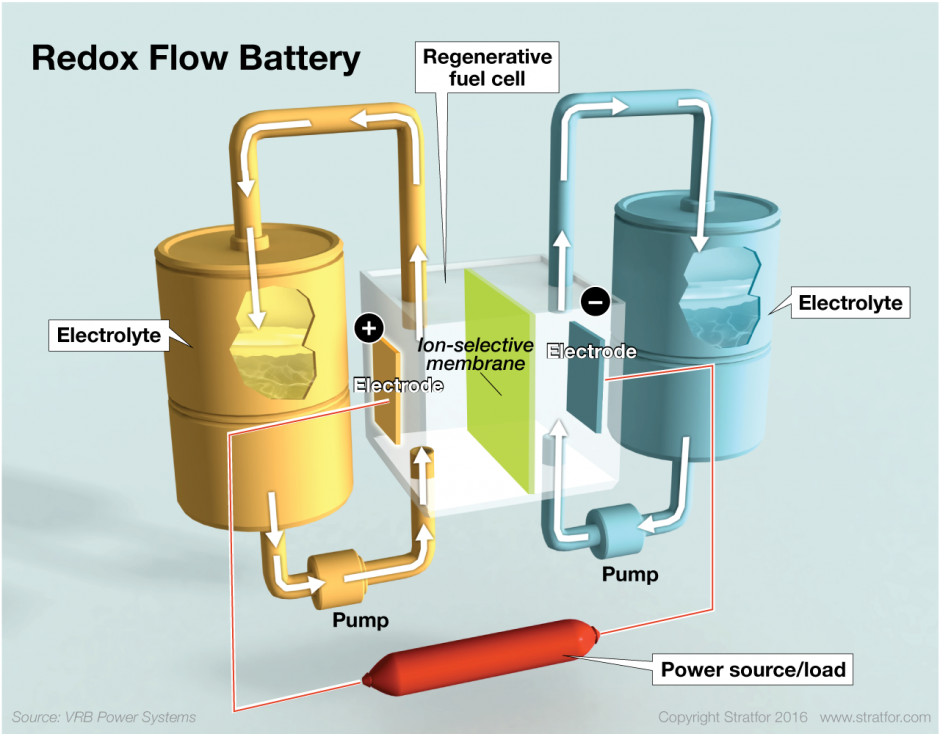
This publication marks the initial phase of the technology, but there are many hurdles left in the development process before the technology can be considered for large-scale use. For it to be geopolitically relevant, it must be further developed, with considerations such as safety, cost and scalability remaining to unproven. The device would need to be optimized for efficiency, scaled up and proved to be commercially feasible (compared with other available options).
This advancement illuminates important considerations when it comes to the slow crawl away from traditional hydrocarbon energy sources. One of the factors limiting the optimal use of renewable energy is the discrepancy between electricity demand and its generation. Given the variability of renewable sources, it is not always possible for production to meet demand when wind is not blowing or the sun is not shining. This is what makes technologies that optimize energy storage so important to the long-term viability of renewables.
The advancement is still in the nascent stages of development. There are certainly hurdles to overcome (and they may never be for this exact technology) but it or others like it have the potential to help solve some of the factors limiting renewable energy technology.
