
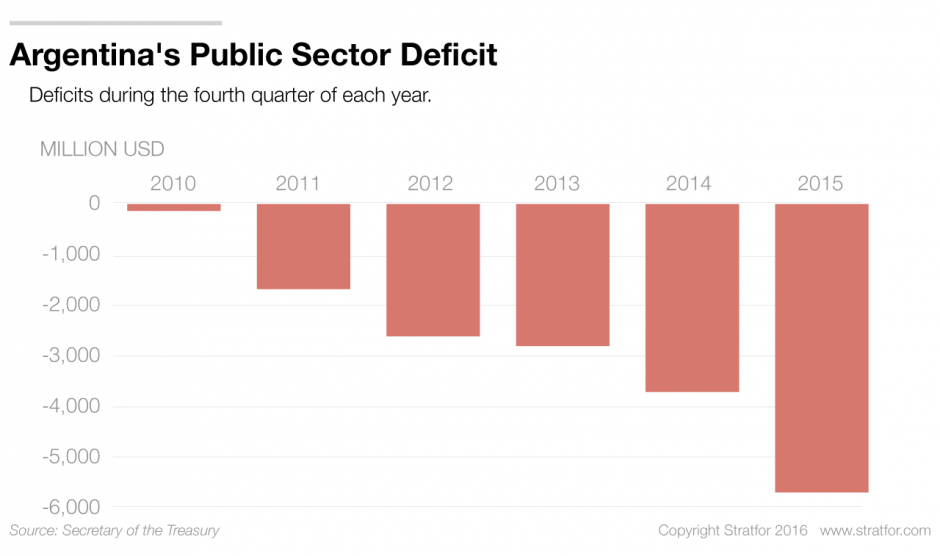
Argentina is in the middle of a political and economic transition. Since Mauricio Macri of the conservative Republican Proposal party was elected president in November 2015, the country's political leadership has shifted to the right. During the last years of the previous administration of former President Cristina Fernandez de Kirchner, a rapid rise in deficit financing contributed to heavy inflation (near 45 percent year-on-year in August 2016). In a bid to draw more foreign investment, Macri has tried to implement fiscal discipline in the country, cutting public spending to reduce the country's widening budget gap, which totaled 5.4 percent of Argentina's gross domestic product in 2015. At the same time, he ordered the removal of most foreign exchange restrictions — one of the largest barriers to foreign investment in Argentina — and reduced taxes on agricultural exports.
Whether the current administration will be able to sustain the pace of these reforms or win a second term in office remains to be seen. In the next few years, the Macri government will face two major tests of public opinion in the 2017 legislative elections and the 2019 presidential election. But neither vote will necessarily bring an end to Argentina's pro-business policies, regardless of the outcome.
The Stakes of the Elections
The 2017 legislative elections are unlikely to derail the president's outreach to foreign investors. Even if the ruling Cambiemos coalition loses seats in the vote, its opposition is too divided to effectively counter the president's policies. Greater legislative representation for the opposition could, however, make it more difficult for Cambiemos to pass legislation, requiring the government to negotiate more with rival parties to push laws through the Congress. But unless the Cambiemos coalition performs exceptionally poorly, Macri will still have the means to enact new measures that will further facilitate investment.
The 2019 presidential vote poses a greater risk to the current administration. By then, Argentine voters will have experienced steep increases in utility prices as part of the government's fiscal reforms. (The price of natural gas is expected to rise by an average of around 230 percent for households and 500 percent for businesses by the end of the year.) On the other hand, Macri's initiatives and the greater availability of foreign currency through investment may drive down inflation over the next few years. But there is no guarantee that the measures will work in time to sway voters' opinions, which by late 2019 could be colored by years of utility hikes. Outside factors will also limit Argentine economic growth for the next couple of years and may influence voters' views of the current administration. The Brazilian economy, which accounts for a fifth of Argentine exports by value, has been stuck in recession since 2015. Although the country will probably climb out of its economic slump in the next year or two, its economy is unlikely to grow at a pace that will solve Argentina's economic problems.
A Lasting Legacy?
Even if Macri's administration does not endure beyond the 2019 vote, however, some of the changes it made to Argentina's business climate probably will. The country is unlikely to revert to the complicated investment policies of the preceding president, many of which were more a product of Argentina's limited fiscal options than of a conscious effort to discourage foreign investors. Fernandez implemented foreign exchange restrictions and stringent import controls, for instance, in an attempt to stem capital outflow at a time of economic distress. If Macri's policies prove to significantly increase the flow of currency into Argentina, a future government — even a left-wing Peronist one — may be reluctant to reinstate such measures for fear of scaring off investors again. Even so, Argentina will remain more protectionist than other countries in the region, and any new government will keep protecting the sectors of its economy that are most vulnerable to foreign competition.
The longevity of Argentina's pro-business climate will depend on how the country's economy performs over the next three years. Whatever the result, the government's efforts to revive Argentina's economy by increasing the burden on taxpayers will cost a wide swath of Argentine voters. And that could cost Macri a second term in office.
