
India has a long history with Southeast Asia. The country's influence remains visible throughout the region, from the Indian diaspora communities in Kuala Lumpur to the ancient Hindu temples in Jakarta. Some Southeast Asian nations owe their very names to India; Indonesia, for instance, means "Indian islands." Now, it seems that India hopes to renew its sway in Southeast Asia. In the span of one week, Indian Prime Minister Narendra Modi hosted the president of Myanmar, made his first trip to Vietnam and attended the 14th annual India-Association of Southeast Asian Nations (ASEAN) Summit in Laos. The spate of engagements demonstrated Modi's intention to deepen New Delhi's presence in Southeast Asia, an achievement that will be easier said than done.
Looking East
Modi first revealed his plan to enhance his country's ties to Southeast Asia in 2014, when he recast India's long-standing "Look East" policy as "Act East." Increased cooperation with Southeast Asia could help India achieve a variety of goals. India, for instance, wants to counter China's influence in Southeast Asia and affirm its status as a rising global power. To that end — and to enhance security in the Malacca Strait, an important conduit for Indian trade — the country is working to strengthen its military ties with Vietnam. En route to the G-20 summit in China, Modi stopped off in Vietnam, marking the first visit to the country by an Indian prime minister in 15 years. During his visit, Modi offered Hanoi a $500 million line of credit for defense purchases, and discussed bolstering India's naval presence in the region with his Vietnamese counterpart, Nguyen Xuan Phuc. Vietnam, in turn, upgraded its relationship with New Delhi to a "comprehensive strategic partnership," the same status that China and Russia share.
But of all the factors driving India's Act East strategy, trade is the chief motivator. Since India and ASEAN finalized their trade agreement in 2009, bilateral trade between them has grown markedly, reaching $76 billion in 2015 — $6 billion higher than the initial goal. ASEAN, furthermore, is India's fourth-largest trade partner, accounting for 10 percent of the country's overall bilateral trade. Both sides of the trade agreement intend to increase trade even further, aiming to hit $100 billion by the end of the year.
Stymieing India's Success
But India and ASEAN fell short of that mark and will likely continue to. As much as India wants to expand trade with ASEAN, the structure of its economy will stymie its efforts. Since the country has long struggled to develop its manufacturing sector, its exports are mostly resource-based. Its main exports to Vietnam, for example, are meat, fish and cotton. Electronic goods, mineral fuels and machinery, meanwhile, constitute half of ASEAN's imports. On the other hand, though India has a strong services sector, ASEAN's protectionist policies make it difficult to export them to countries in the union. This partly explains why China's trade with ASEAN continues to dwarf India's and why India's exports to the bloc have not budged from $25 billion in 2010, even as overall trade between the two has grown. The trade imbalance frustrates New Delhi, but until the Indian government enacts the reforms to its land and labor laws necessary to encourage manufacturing, its exports to Southeast Asia will grow slowly, if at all. (Bilateral trade dropped last year.)
Even if India overcame the limitations of its export market, it lacks the infrastructure required to support more trade with ASEAN. Roads are the arteries of commerce, and a country's economic health hinges on its ability to efficiently transport goods via roads, railways and waterways within its territory and beyond. Because India relies on the Strait of Malacca for more than half of its international trade, New Delhi wants to diversify its trade routes and build alternate land and water-based routes. Here, too, India's efforts have fallen short.
Insufficient Links
Any alternative trade route linking India to Southeast Asia will necessarily pass through Myanmar, with which India shares a 1,600-kilometer (994-mile) border. In 2005, India undertook a $140 million dollar project to build a highway from Morzam state to Thailand by way of Myanmar. But poor intergovernmental cooperation and planning have stalled the project. Although India's Border Roads Organization upgraded a 132-kilometer stretch of road from Moreh, India, to the border town of Tamu, Myanmar, New Delhi did not instruct it to upgrade the nearly 70 bridges along the road, rendering it unusable. During their recent meeting, Modi and Myanmar's president signed a memorandum of understanding to build the bridges. Still, there is nothing to suggest that New Delhi has allocated additional funding for the project or that India's intergovernmental coordination has improved. Now, the expected completion date for the highway has been pushed back from 2016 to 2019.
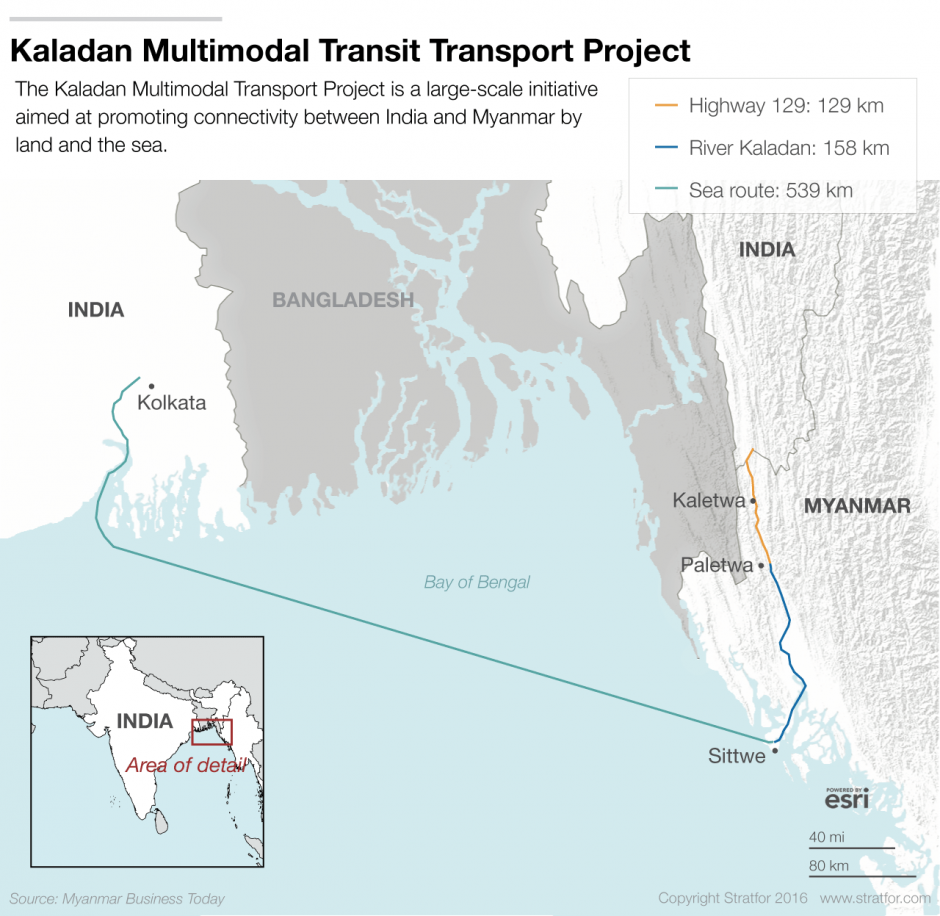
Another infrastructure endeavor has been similarly unsuccessful. Begun in 2008, the Kaladan project, which proposes to connect the Indian state of Mizoram to Myanmar's Port of Sittwe by road and waterway, has already exceeded its budget by $24 million dollars. Once complete, the proposed route will require goods to be transferred from boats to trucks at an impassable point in the Kaladan river, slowing down transit time. Moreover, the network of roads that constitute the Indian portion of the route still need extensive repairs.
Despite the strides India has made toward strengthening its relations with Southeast Asia, the country is far from reaching its goals in the region. Until India can overcome its internal legislative constraints, its export industry will be no match for China's. And until the country has built infrastructure to facilitate greater trade with Southeast Asia, its bilateral trade ambitions will remain unrealized.
